LaGuardia Airport: A Realistic Look at Trauma

By Portfolio Editor Roz Hamlett

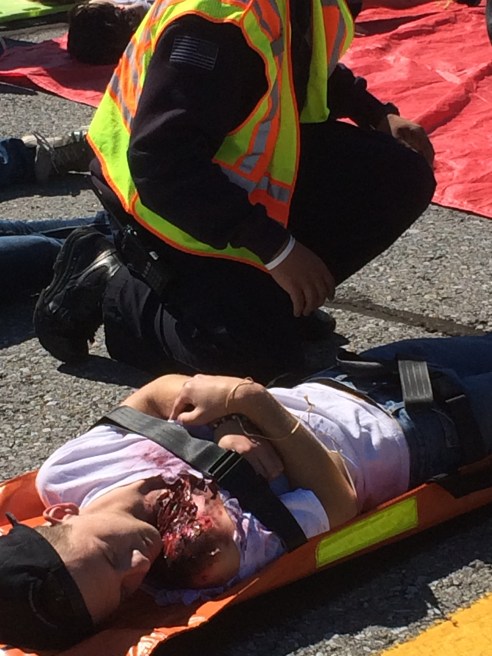
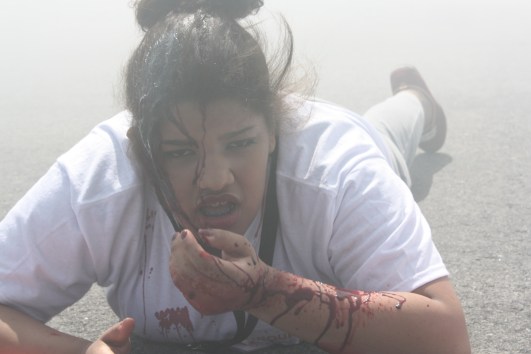
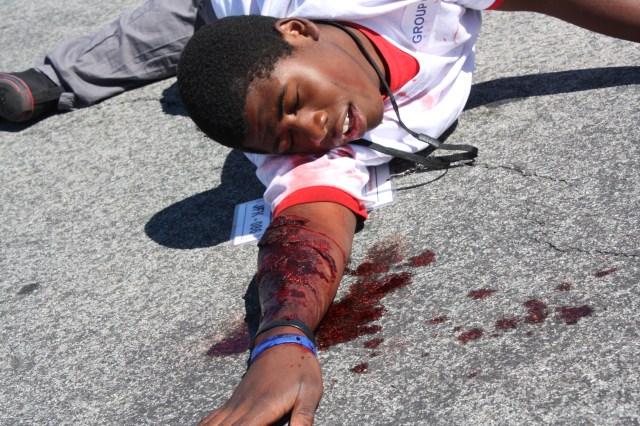
Hidden mostly from view so as not to alarm the traveling public, scores of horrifically wounded and mass casualty victims were strewn about the tarmac at LaGuardia Airport on a recent Saturday morning.
IMG_0052 (00000003)

As part of an exercise, a Boeing airliner had collided with a cart on the runway, but nobody knew exactly why the cart was in the glide path of the landing plane. The unauthorized cart or “tug,” (because it tows aircraft around the airfield), had been in the wrong place at the wrong time.  It could have been human error or the nefarious work of someone determined to take lives.
IMG_0469

Though the scene at LaGuardia was alarming, it was simply a live emergency drill, one of many such emergency simulations conducted annually by the Port Authority at its facilities.  These exercises help train first responders, law enforcement, medical personnel and other participants to prepare for genuine emergencies, gain practical experience and develop confidence in their skill and knowledge to handle the real thing.
IMG_2428

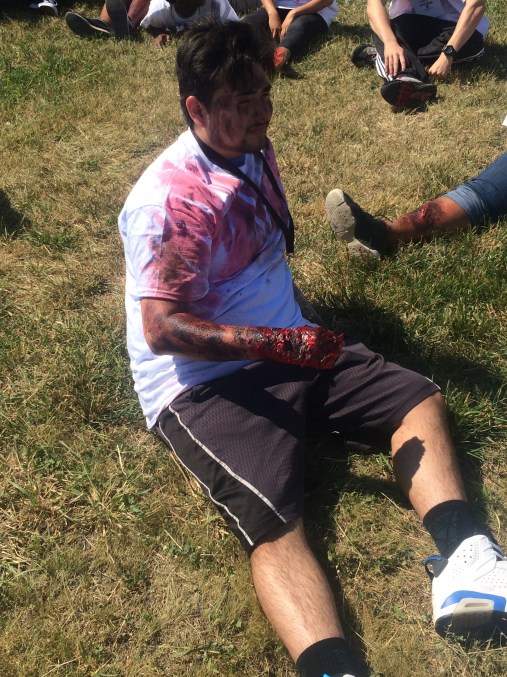
“We believe it is important to create training scenarios that are as real as possible in order to offer our responders the most realistic experience possible. Moulage is one of the ways we achieve that level of authenticity,” said Mike Ricker, Coordinator of Security Exercises and Training. “The severity and type of injuries are driven by the exercise’s precipitating incident, whether it’s a crash, explosion or a fire.”
IMG_0450

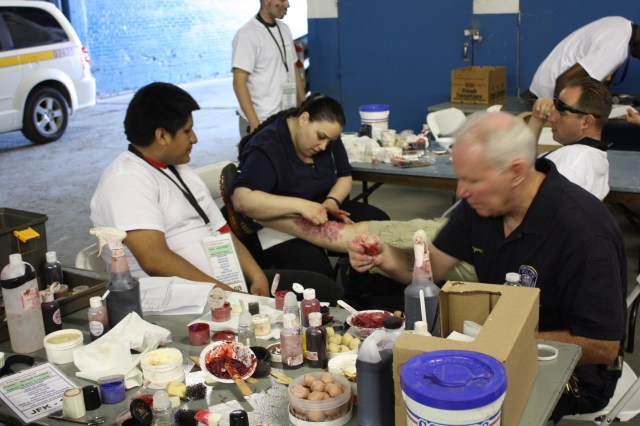
Moulage is the technical term for the design and application of makeup to create realistic wounds. As any woman can attest, the skillful application of makeup is a combination of technique, art and hard work. At the Port Authority, specially-trained PAPD officers learn how to apply different kinds of clay, liquid latex, red food coloring and even homemade concoctions of their own to create lifelike wounds. Like chefs in a kitchen, many moulage artists have their own favorite recipes for injuries. Some artists are even known to recycle the bones from last night’s rack of ribs, providing they are first boiled and bleached to remove the grill marks.
IMG_0436

Ricker said such realism is not about shock value as much as the stress factor. “By mirroring the types of stressful scenarios that our responders will face during an actual event, we are able to improve outcomes by giving them the opportunity to confront these stresses in a training scenario as opposed to experiencing them for the first time during an actual incident,” he said.

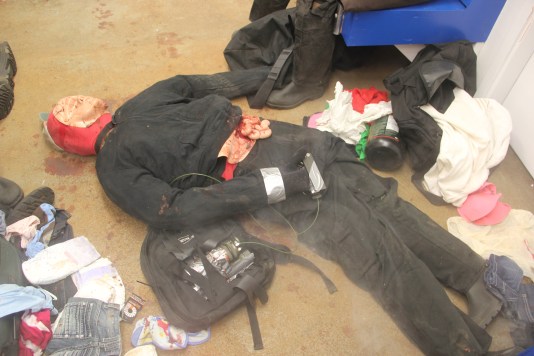
The PAPD moulage team, which handles the design of the injuries, consults with members of the security team and varies the injuries based on the training scenario being enacted. For example, Ricker said, “in exercises that involve fire we would generally see victims with burns and smoke inhalation. An aircraft crash or train derailment might produce traumatic injuries such as severe lacerations, fractures and deep puncture wounds.”
SEMAC Exposed Entrails

In the highly-choreographed world airside at the region’s airports, drills and the elaborate preparations for them are taken very seriously. Ricker and the other members of the security team and PAPD aren’t taking any chances. Because anything that’s even slightly amiss could mean the difference between life and death.

“We are after the best possible outcomes,” he said.
Posted in aviation, LaGuardia Airport, New Jersey Fire Department, New York Fire Department, PAPD, PATH, Port Authority, Port Authority of New York & New Jersey, Port Authority Police Department, terrorist attack, Uncategorized | Tagged , , , , , | Comments Off on LaGuardia Airport: A Realistic Look at Trauma

World Trade Center:  Lower Manhattan Gets a Living Wall…Literally

By Lenis Rodrigues and Rudy King, Media Relations Staff

Some walls protect people while others create boundaries.  Some walls decay eventually and crumble into ruin.  But the “Living Wall” at Liberty Park, designed as a piece of serenity in an urban public space, invites millions of people to come together from all walks of life to simply breathe fresh air and enjoy the beauty.

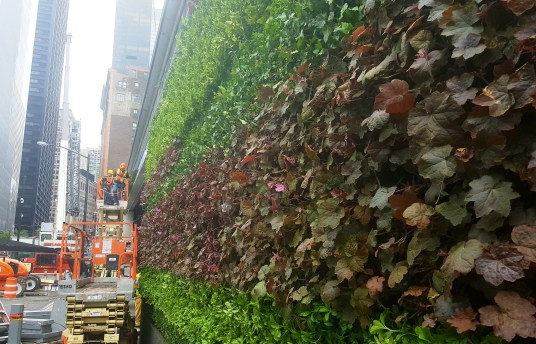
The Living Wall Up Close (00000002)  Almost 15 years after 9/11, the opening of Liberty Park today marks another milestone in the revitalization of Lower Manhattan. The 336–foot wall promises to make the park an attractive destination for everyone in New York City.
“This park symbolizes the Port Authority’s commitment to rebuild and improve the WTC site while memorializing all those whose lives were lost on 9/11, ” said Port Authority Chairman John Degnan.

“Creative vertical gardening is transforming what otherwise would be the prosaic walls of the Vehicle Security Center into green space for New Yorkers and visitors to the World Trade Center,” said Pat Foye, Executive Director of the Port Authority.

“The Living Wall provides a green space that symbolizes the resiliency of New Yorkers, the vibrancy of Lower Manhattan and its connection to the Memorial Plaza,” said Steve Plate, Port Authority Chief of Major Capital Projects.

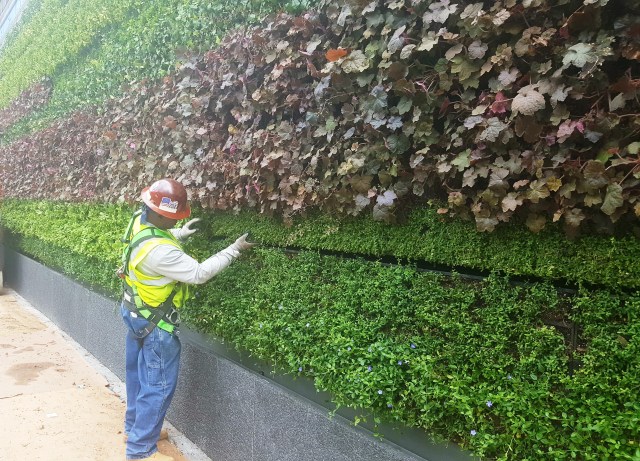
Worker adjusts plants (00000002)

The wall, which is 25 feet high, was built with 826 panels to hold more than 22,000 plants. An 18-zone drip irrigation system is placed strategically to water the plants while small gutters catch extra water that may not be absorbed.

The wall is planted with six types of plants: 3,849 Baltic Ivy, 3,657 Common Periwinkle, 3,490 Coral Bells, 5,782 Golden Star, 3,734 Japanese Spurge and 1,844 vines of Wintercreeper. This combined plant palette was chosen to thrive vertically in a partially shaded location.

The plants are arranged in a staggered, horizontal grid to complement the 9/11 Memorial.  From a landscaping perspective, the chosen plant species – each having a different color, leaf texture and size, and growth habit – work together to soften the scale and façade of the building, and to provide year-round visual interest.

In addition to the wall, the park also features the Horse Soldier statue in honor of the troops who served in Afghanistan during Operation Enduring Freedom; a descendent of Anne Frank’s famous Horse Chestnut Tree, and more than 150 trees and shrubs. Construction of the Greek Orthodox Church continues on the park and will serve as both a church and bereavement center. The southwest corner of the park will feature the Liberty Street pedestrian bridge that crosses over West Street to Brookfield Place in Battery Park City.

Posted in 9/11, Anne Frank House, Liberty Park, New York, NYC, One World Trade Center, Pat Foye, Port Authority of New York & New Jersey, September 11, Steve Plate, terrorist attack, Twin Towers, Uncategorized, World Trade Center, World Trade Center Transportation Oculus, WTC | Tagged , , , , , , , | Comments Off on World Trade Center:  Lower Manhattan Gets a Living Wall…Literally

Outerbridge Crossing: Of Horses and Men

By Portfolio Editor Roz Hamlett

The Outerbridge Crossing opened to great fanfare 88 years ago this week. Unlike its busy counterparts – the George Washington, Goethals and Bayonne bridges – not much exciting has occurred at the Outerbridge in recent years.

That is, until yesterday when an itinerant philosopher, Tod “Doc” Mishler, 80, with his horses Chief Spirit and Ruby in tow, created a media stir by saddling up to cross the span, without alerting police beforehand they were coming, and without using a customary horse trailer.  Such foresight on Doc’s part would have allowed the PAPD to arrange the safest crossing possible.  Still, Port Authority police escorted the threesome across the bridge without incident, albeit at a slowed pace.

Doc, a former philosophy professor at Western Michigan University, has been on a mission since 2002, when he sold everything he owned and decided to ride horseback across the country to raise awareness about the plight of hungry children.  He was even invited to address Congress during the George W. Bush administration. Yesterday, he was en route to a meeting of the Federation of Black Cowboys in Brooklyn.

Following this week’s trip across the Arthur Kill, Doc and his equine friends were issued summonses by PAPD to appear in court on two separate charges: unlawful trespassing and impeding traffic, according to the PAPD.  The legal status of Doc’s companions was less clear. During the PAPD interrogation following the incident, neither Chief Spirit nor Ruby made any comment (that was intelligible to the human ear).

For those who may have thought Doc should have gotten off with a warning, consider that the PAPD’s primary responsibility is safeguarding the traveling public, whether by vehicle or on horseback.  It’s not hard to imagine what might have occurred had a car backfired and spooked Ruby or Chief Spirit.  Two skittish horses galloping eastbound down the roadway may not have ended so well.  It could have caused drivers to lose control, and people could have been injured, or worse.

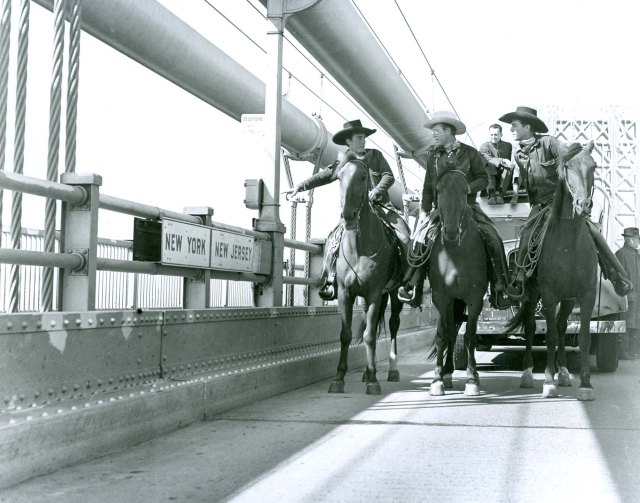
This would appear to be the first time in modern history that quadrupeds have used a Port Authority bridge facility to cross the Arthur Kill, which connects Perth Amboy, N.J. to Tottenville, Staten Island, although in 1931, a man driving a horse named “Rubio” and buggy crossed the Hudson River on the GWB, during opening day festivities.

GWB_1938

Horses on the George Washington Bridge in 1938


Posted in Bayonne Bridge, George Washington Bridge, Goethals Bridge, GWB, NY/NJ region, NYC, Outerbridge Crossing, Port Authority, Port Authority of New York & New Jersey, Port Authority Police Department, Staten Island, Uncategorized | Tagged , , , , , | Comments Off on Outerbridge Crossing: Of Horses and Men