Lincoln Tunnel Throwback: Conquest of the Hudson

By Portfolio Editor Roz Hamlett

Almost 90 years ago, the Port of New York & New Jersey began planning what was originally called the Midtown Hudson Crossing in the riverbed beneath the Hudson River, a seemingly impenetrable and distant netherworld as strange to most people as the planet Mars.

Fast forward to May 17, 1934. The groundbreaking for the Lincoln Tunnel took place that day; the agency hired Castle Films to produce Conquest of the Hudson, a documentary recording the construction project.  Castle, which later became part of Universal Pictures, brought motion picture aesthetics to the project such as a professional voiceover artist and a music soundtrack.  The completed film was used as a “short” between full-length features in movie houses.  Film buffs and families also could buy the reels and see tunnel construction on movie projectors from the comfort of home.

Conquest of the Hudson captures every aspect of the construction of the Lincoln Tunnel:  blasting through the bedrock, sandhogs working in a compressed air environment, the roadway and tile finishing work inside the tunnel, and even the first cars to travel through it.

The film explains how engineers solved the problem of driving a 32-foot boring for 8,000 feet, most of it below sea level and 4,600 feet of it under the river, while at the same time creating a 31-foot watertight shell of steel and concrete inside the boring to keep the river out.

In retrospect, the interests and expertise of Castle Films and the Port Authority were well aligned.  Just as tunnel construction was getting underway, 16mm sound film equipment was entering the marketplace.  This technology made the dramatizations of large-scale projects like the Lincoln Tunnel available to a general audience. The founder of the film company, Eugene Castle, was among the first to realize that film was an important education and marketing tool for business. The Port Authority agreed with him.

As Castle’s film business grew, he moved to new, larger offices in Rockefeller Plaza in 1933.  In 1937, three years after construction began, the first tube of the tunnel was completed.

Two of the central technologies that formed the foundations to life in 20th century America were cinematic and automotive.  What makes Conquest of the Hudson an important part of Port Authority history is that the documentary showcased these intertwined technologies in ways that captured the popular imagination while educating the traveling public.  The short film was among the first filmed marriages of public transportation and cinematic achievement.   

Posted in historic photographs, history, Hudson River, Hudson tunnels, Lincoln Tunnel, movie history, movies, NY/NJ region, NYC, PANYNJ, Port Authority, Port Authority of New York & New Jersey, Port of New York Authority, public transportation, transportation history, Uncategorized | Tagged , , , | Comments Off on Lincoln Tunnel Throwback: Conquest of the Hudson

Susan Baer: An Aviation Trailblazer Remembered

By Portfolio Editor Roz Hamlett

Susan Baer left an indelible mark on the Port Authority, becoming the agency’s first woman aviation director and a highly respected transportation industry pioneer, breaking down silos and cracking the glass ceiling of an industry long dominated by males.

susan-baer-port-authority-ny-njjpg-8c69b8fb16eab93a_large

Susan Baer stands at the window in the brand new Administration Building at Newark Liberty International Airport in 2002.

Baer, who died last week at the age of 65, was the only person, man or woman, to manage all three major metropolitan airports run by the Port Authority — JFK International, LaGuardia and Newark Liberty International. Before transitioning to the agency’s Aviation Department, she also ran the Port Authority Bus Terminal and the Lincoln Tunnel.

During her 37-year agency career, Baer’s accomplishments were all the more impressive coming as they did at a time the Port Authority was a male-dominated agency. Baer, who eventually became an influential role model for so many young transportation professionals, understood the power of a helping hand. Throughout her career, she was an enthusiastic supporter of women in aviation and regularly provided others with access to her network.

Portrait

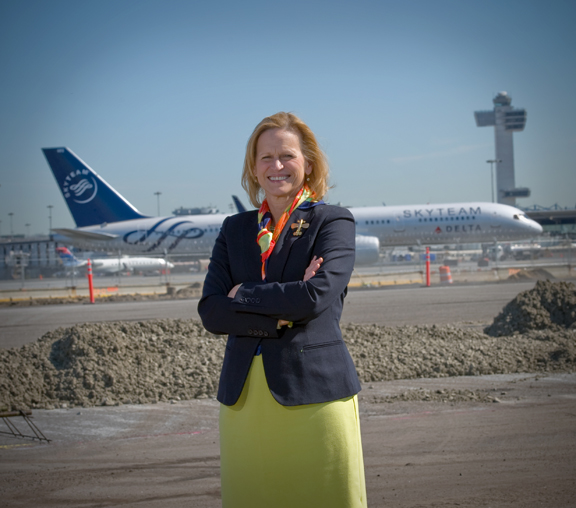
Port Authority Aviation Director Susan Baer on the runway at JFK in 2010.

Diane Papaianni, general manager of New Jersey Airports, occupies what was once Baer’s old office at Newark Liberty. “I think of her often. I learned so much from her over the years.  Her ability to take control of a room and manage the most complicated issues with a level of confidence and enthusiasm always amazed me. “

“On the one hand there was Sue the leader sharing her aviation and PA experiences with you, and on the other hand, there was Sue sharing her family life and baking skills with you,” Papaianni recalled. “In the midst of her hectic day, she always remembered to ask you about your family as well.”

Sharon DeVivo, president of Vaughn College of Aeronautics and Technology, where Baer served on the board for the last 23 years, said she was instrumental in helping develop the college’s first airport management curriculum. “She was invested completely in the success of all our students,” DeVivo said. “She touched thousands of students.”

Pat Foye, the Port Authority’s executive director, said that in turn for her “professionalism, integrity and leadership” at the Port Authority, her colleagues rewarded her with “fierce loyalty.”

That sense of loyalty and respect was widespread. Lillian Borrone first met Baer in the 1970s when she was one of the young college leadership fellows rotating among various departments at the Port Authority. In recent years, Borrone, former director of Port Commerce, shared an important connection with Baer while working on behalf of the Women’s Transportation Seminar (WTS), an international organization dedicated to the professional advancement of women in transportation.

“She understood the importance of being an exemplar – especially to women, but also men as well,” said Borrone, who believes that the experience Baer gained at the Port Authority, working at both the staff and line department levels, gave her both special insight and opportunities to pass along skills of great value.

On 9/11, Baer was at the helm of Newark Liberty and watched the destruction of the World Trade Center before helping to shut down airport operations, then restart them in the anxious days following the attack.

Baer was also focused on the people needs of airport travelers, not just brick and mortar issues. The customer service representative program, the “Red Coats,” was developed and flourished under her leadership. One of her major goals while at the Port Authority was advocating for NextGen, the satellite-based technology that allows planes to fly more efficiently using GPS instead of ground-based radar.

Tom Bosco, who succeeded Baer as Port Authority aviation director, said, “Sue Baer was the consummate professional, a skilled manager and an inspirational leader. I always admired her energy and steadfast commitment to both her family and the job.  Even while battling illness, she maintained a grueling schedule that could have easily grounded the strongest among us.”

A graduate of Barnard College with a master’s degree in business administration from New York University, Baer held numerous memberships in professional organizations, including the Aviation Women’s Association, Airports Council Institute, the American Association of Airport Executives, the Newark Museum and the Wings Club.

sue-300x254

Susan Baer at Vaughn College in 2016

Summing up her career in a 2013 interview with USA Today, Baer said, “What I’ve tried to do is give other women opportunities and that’s something all women should be doing. It was hard for us to get here, but we ought to be making it easier for people who are coming behind us.”

Posted in airports, aviation, John F. Kennedy International Airport, LaGuardia Airport, Lincoln Tunnel, New Jersey, New Jersey Air Transportation, Newark Liberty International Airport, NY/NJ region, Pat Foye, Port Authority, Port Authority Bus Terminal, Port Authority of New York & New Jersey, Portfolio, Susan Baer, Uncategorized | Tagged , , , , , , , , , , | 2 Comments

Bayonne Bridge: The Case of the Missing Half-Scissor

By Neal Buccino, Media Relations Staff

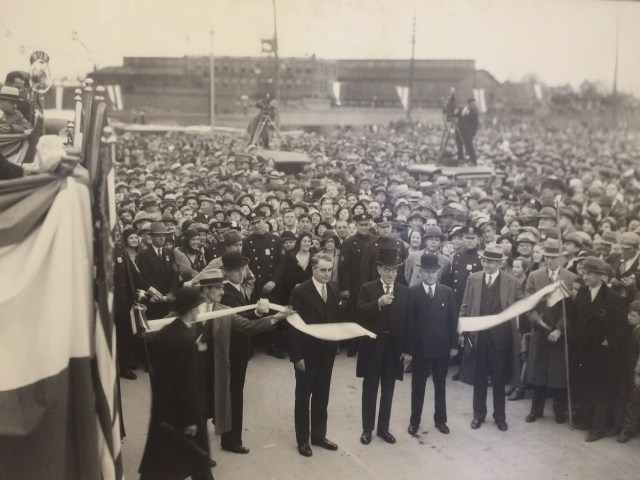
On a November day in 1931, a pair of scissors specially crafted for the occasion was used to cut the ribbon in the dedication of the Bayonne Bridge, whose magnificent steel arch was the longest in the world.

ribbon cutting

Cutting the ribbon at the November 14, 1931 dedication of the Bayonne Bridge.  From left:  Port Authority Vice Chairman Frank C. Ferguson; New York State Comptroller Morris S. Tremaine (holding the scissors); New Jersey Governor Morgan F. Larson.  Photo courtesy of the Bayonne Public Library

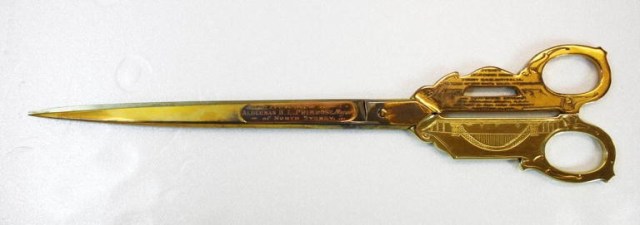
The Bayonne Bridge had a sister bridge in Australia — the Sydney Harbour Bridge, its nearly identical twin that was delivered just several months later.  It seemed fitting that the same pair of scissors – golden, elegant and engraved with the image of the Bayonne Bridge – should be used for both ribbon-cuttings. Their work complete, the scissors were separated, with one blade bequeathed to each country.

PHOTO B

This “hybrid” pair of scissors resides with the Stanton Library in North Sydney, Australia.  One blade came from the Brooklyn-made pair of scissors used in the ribbon cuttings of the Bayonne Bridge and the Sydney harbor Bridge.  The other blade was made in Australia.  Photo courtesy of eHive.com

Today, the Australian half, now paired with another blade, remains on permanent public display at the Stanton Library in North Sydney.  The Bayonne half? It vanished, never to be seen again.  The mystery of how it went missing and where it might possibly be continues to bedevil bridge buffs and Port Authority historians alike.  Its loss wasn’t discovered until 1981, when the Port Authority — preparing to celebrate the 50th anniversary of the Bayonne Bridge — wanted to bring the artifact out of retirement. It was nowhere to be found.

Bayonne Bridge/NYC ports,

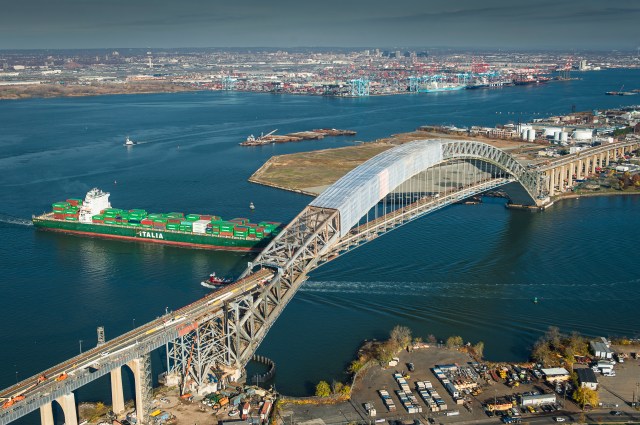
The iconic arch of the Bayonne Bridge.  Photo courtesy of HDR, Inc.

Just before the 1931 Bayonne ribbon cutting, Port of New York Authority Vice Chairman Frank C. Ferguson had made this declaration, according to a commemorative booklet published by the Port Authority: “The scissors used in cutting this ribbon will be sent to Australia, where they will be used in cutting the ribbon opening the Sydney Bridge, and then one-half kept there and one-half sent here to America.”

Bayonne Bridge/NYC ports,

The iconic arch undergoing steel reinforcement for the Port Authority’s “Raise the Roadway” project.  Photo courtesy of HDR, Inc.

So what became of the scissor blade that was supposed to be returned to the Port Authority after that auspicious inaugurating event?

This much is known: Agency representatives contacted the Australian Consulate in New York because they “wanted to know what happened to the scissors,” according to an August 1981 Sydney Morning Herald article. The inquiry set off a “delicate diplomatic search” but apparently yielded no resolution.

North Sydney local history librarian Shannon Haritos tells Portfolio the blade in question is believed to have been sent back to the U.S., possibly as a second composite pair of scissors, with the original Bayonne blade wedded to one made in Australia.

Beyond this, the historic record is mostly silent. Author Caroline MacKanness wrote in “Bridging the Sydney” that North Sydney’s composite pair of scissors was presented to that city’s mayor following the Sydney Harbour Bridge ribbon cutting. The mayor kept them “as a memento of his service” – and they might have remained with his family ever since, but the family donated them to the North Sydney Council in 2003.

As for the Bayonne portion, if it was sent to the U.S., did the recipient keep it as a memento of that grand opening ceremony? Is this memorial from the “Golden Age of Bridge Building” in the 1930s sitting in some family attic or basement drawer, waiting to be rediscovered? Was it simply lost in transit?

PHOTO E

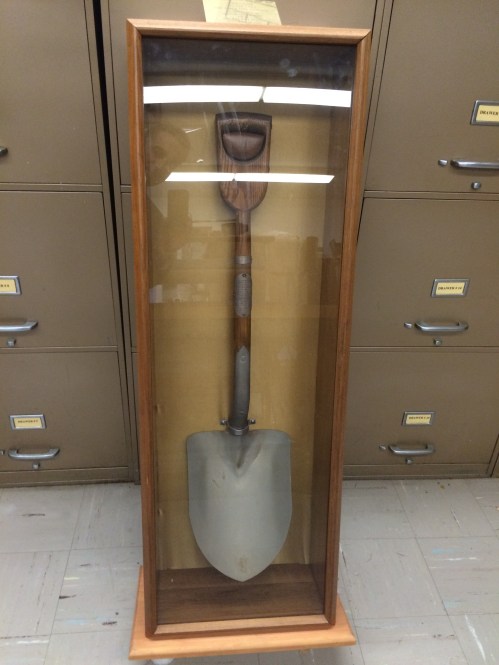
Another artifact is still with us.  The Bayonne Public Library has in its archives this shovel used in the September 1928 groundbreaking for the Bayonne Bridge.  Photo courtesy of the Bayonne Public Library

This November, the Bayonne Bridge will mark its 85 birthday. The milestone is sure to be commemorated by Port Authority leaders, local officials and bridge historians. Only one single question remains: Will the long-lost half-scissor finally turn up in time to join the celebration?


Posted in Bayonne Bridge, bridges, commerical shipping, containerization, historic photographs, history, New Jersey, New York, PANYNJ, PONYNJ, Port Authority of New York & New Jersey, Port Commerce, Port of New York & New Jersey, Uncategorized | Tagged , , , , , , , | Comments Off on Bayonne Bridge: The Case of the Missing Half-Scissor