Anatomy of an Accident: The George Washington Bridge

By Rudy King, Public Information Officer

We can assume that if you’ve ever driven anywhere in the New York/New Jersey region, at some point you’ve sat behind the wheel of your car experiencing a range of emotions . . . from impatience . . . to anger . . . to downright outrage at traffic that creeps along at the breakneck clip of a tortoise.

While understandable, emotional meltdowns behind the wheel are dangerous because they can boil over into traffic accidents on bridges, roadways and inside tunnels – causing everything from minor fender benders to episodes of road rage to major incidents involving fatalities.

The next time you find yourself in traffic gridlock, a general understanding of the different types of accidents and possible emergency responses may help to soothe your frayed nerves.

It would be misleading to attribute most accidents to emotionally-impaired drivers.  Because in addition to such obvious culprits as texting or drunk driving, there are a host of underlying reasons for crashes:  potholes, slick road surfaces, poor lighting, lack of or poor signage, and one of the most underrated problems, vehicle merges at toll plazas and roadways.

The good news is that safety programs like the Port Authority’s nationally-recognized Traffic Safety Improvement Program, have decreased the number of motor vehicle crashes at Port Authority facilities overall by more than a third or 36 percent since 2000.

The objective of the program is to minimize the frequency, severity, and risk of motor vehicle crashes on the Port Authority roadway system by strategically focusing attention and resources on those areas where the data indicates the problems are the greatest.

Here’s the general breakdown on what happens when an accident occurs at a Port Authority facility like the George Washington Bridge, America’s busiest bridge.  In all cases, the emergency response begins with capturing the event on camera and notifying the facility’s Communications Desk.  Accidents are handled in four different ways depending on the severity of the event:

  1. The Fender Bender or Side Swipe Accident Causing Minimal Traffic Delay

 Since the incident is minor, the involved vehicles are driven to a safe and secure location, and normal traffic flow is resumed.  The Port Authority Police Department (PAPD) speaks with the drivers, records statements and files the report.

  1. The Disabled Vehicle or Truck with Moderate Traffic Delay

 The PAPD is responsible for moving disabled vehicles.  If the vehicle can’t be moved immediately, traffic lanes are closed while the vehicle is removed.  The closed lanes are re-opened to normal traffic flow once the lane is clear.

  1. Truck/Car Crash or Multiple Cars or Truck Jackknife with Severe Damage/ Fire with Significant Traffic Delays, Lane Closures and Alternative Routes

 Under such circumstances, Tunnels and Bridges Agents (TBAs) are trained and equipped as emergency first responders.  They extinguish vehicular fires and perform extractions if a person is trapped inside the vehicle.  They work closely with PAPD, fire departments and neighboring hospitals.

  1. Truck/Car Crash or Multiple Cars with Serious Injuries and/or FatalitiesSignificant Traffic Delays – Alternate Route Suggested Due To Lane Closures and Accident Investigation/Scene Preservation

In addition to the actions above, PAPD will determine whether an accident investigation is necessary and will ensure that the investigation scene is preserved.

According to national highway statistics, a car accident occurs every minute of the day around the world and kills a child every three minutes. So the next time you are sitting in traffic, remember to take a deep breath and be patient because yours or someone else’s life may depend on it.
Posted in New York, PANYNJ, Port Authority of New York and New Jersey | Tagged , , , , , , , , , | Leave a comment

Port Authority of New York and New Jersey: Leading With Honor

Flag Day

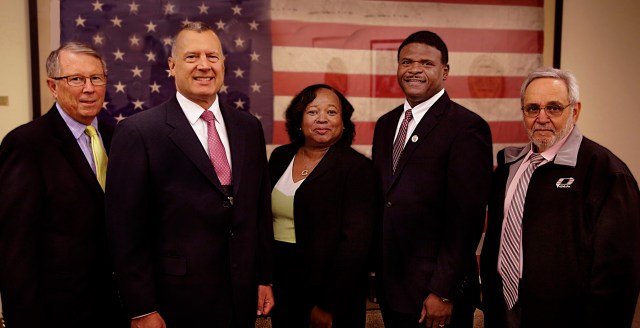
Left to right: Rick Larrabee, Director of Port Commerce; Tom Bosco, Director of Aviation; Stephanie Dawson, Acting Chief Operating Officer; Cedrick Fulton, Director of Tunnels, Bridges & Terminals; Mike Marino, Deputy Director of PATH

By Steve Coleman, Acting Director of Media Relations

As America commemorates its glorious past in this 99th year after the first Flag Day on June 14, 1916, we salute five leading and extraordinary executives at the Port Authority, each of whom remarkably served their country with honor and distinction under the red, white and blue before assuming top posts at the Port Authority.

These heroic and inspiring leaders credit the military experience they gained in the Armed Forces as excellent preparation for their current roles on behalf of the millions of people throughout the New York/New Jersey region:  ensuring the airport system is world class, that consumer products on which we depend flow smoothly through our port, that bistate crossings are well-maintained, that the trains run on time, and the enterprise of transportation business is accomplished.  Every day brings major challenges.  Every day is unique. In fulfilling the mission of the Port Authority, these astonishing individuals exemplify the U.S. Navy’s time-tested slogan – It’s Not Just A Job. It’s An Adventure. Click here to meet our leaders.

***

Retired Army Colonel Tom Bosco, who heads the agency’s airport system as Aviation Director, honed his skills on the front lines in Middle East battlefields, serving as an Army officer and helicopter pilot during Operation Desert Shield/Storm.  During his 24-year military career, he was the recipient of the Bronze Star for meritorious service and, following 9/11, led a 553-person National Guard battalion to provide perimeter security for the site.

***

During a 33-year career, retired Coast Guard Rear Admiral Richard Larrabee served his country in major sea and landside commands, including a tour as Coast Guard Captain of the Port.  Before retiring in 2000 as Commander, First Coast Guard District in Boston, Mass., Rick oversaw the search and rescue operations following the fatal plane crash of John F. Kennedy Jr. in 1999 and the subsequent crash of Egypt Air Flight 990 later that same year.  For the past 15 years, Rick has led the agency’s Port Commerce Department, which oversees the Port of New York and New Jersey, the largest cargo operation on the East Coast.

***

Retired Air Force Staff Sergeant Cedrick Fulton spent 10 years in the military beginning in 1979 before moving on to a Port Authority career that has brought equally challenging work as Director of the Tunnels, Bridges and Terminals Department.  During his military service, Cedrick was assigned to the 1st Tactical Fighter Wing at Langley Air Force Base in Virginia and the 23rd Tactical Fighter Wing in Alexandria, Louisiana.  During his service as an Aircraft Armament Systems Specialist and a Contracting Officer, Cedrick received the Air Force Commendation Medal among other honors.

***

Retired Army Colonel Stephanie Dawson, the agency’s acting chief operating officer who directs all of the agency’s transportation business, had a groundbreaking military career, becoming the first female to serve as a brigade commander in the New York Army National Guard.  As Brigade Commander, she provided command and control of assigned battalions, including the 369th Special Troops Batallion, the 101 Expeditionary Signal Battalion, the 56th Personnel Services Batallion and the 104th Military Police Batallion.

***

Retired First Class Navy Petty Officer Michael Marino, the deputy director of PATH, served beginning in 1968 on the aircraft carrier USS John F. Kennedy, stationed in the North Atlantic and the Mediterranean.  During that time, Mike led a crew of sailors and Marines in assembling jet fighters with armament in support of overseas missions. He continued in the Navy Reserves until 1976, at which time he began a distinguished career in the railroad industry.


Posted in New York, PANYNJ, Port Authority of New York and New Jersey, Portfolio | Tagged , | Comments Off on Port Authority of New York and New Jersey: Leading With Honor

The Visionaries Behind Solar Impulse 2

Part Three in aThree-Part Blog Series

By Gregory Quinn, Special to the Port Authority

My life and the life of my family has to do with exploration, with adventure. My grandfather was the first man in the stratosphere, and my father was the first to touch the deepest point in the ocean… For me, adventure and exploration is something in the blood — Bertrand Piccard to CNN.

We’ve devoted the first two parts of this series to the around-the-world journey of the sun-powered Solar Impulse 2, its connection to the storied history of New York aviation (it’s scheduled for a stopover at Kennedy Airport) and the inner workings of the aircraft itself.  In this third entry, we’ll explore the fascinating histories of the men in the cockpit— Bertrand Piccard and Andre Borschberg.

When acclaimed television producer Gene Roddenberry was creating the character of the new Captain of the USS Enterprise in the hit television sequel, Star Trek:  The Next Generation, he looked toward C.S. Forester’s Napoleonic naval officer Horatio Hornblower for inspiration, a man courageous by nature, possessing unparalleled skill at his post and capable of intense introspection and reserve.

When Roddenberry needed a surname for this brave new Captain, he discovered genius in a legendary family of explorers. And after casting a trained Shakespearean thespian in the role, Roddenberry had his man: Captain Jean Luc Picard. Inspired by Hornblower, modeled after Patrick Stewart and named for Swiss adventurers Auguste and Jean Felix Piccard.

The association to the long-running Star Trek science fiction franchise  may be the most recognizable thing about the Piccard family, but it’s far from the most substantial. At every generational rung of the Piccard family is an explorer who has distinguished himself in the history of exploration.

Auguste Piccard, a student of science and a colleague of Albert Einstein, developed an avid interest in ballooning in the 1930s. Seeking measurements to provide empirical evidence to support Einstein’s theories, Piccard took to the sky in his self-built balloon. He reached a record altitude of 51,775 feet, becoming, with his partner Paul Kipfer, the first man to enter the Earth’s stratosphere.

Auguste’s twin brother, Jean Felix, also was a high-altitude balloonist who also visited the stratosphere during the third and final voyage of Century of Progress. But Jean Felix’s legacy is best known in his many inventions, which include clustered high-altitude balloons and plastic balloons (an invention he created with his wife, Jeannette).

In a classic example of the apple-doesn’t-fall-far-from-the-tree syndrome, Auguste’s son, Jacques, also was an acclaimed, record-breaking explorer, though Jacques was more inclined to explore the deepest depths rather than the highest heights.

Having pioneered many developments in underwater vehicles, Jacques Piccard, along with Lt. Don Walsh of the U.S. Navy, was first to explore the deepest known part of the world’s ocean, the Challenger Deep in the Pacific Ocean’s Mariana Trench. This accomplishment propelled the Piccards into a truly unique distinction: The father held the world record for altitude height, while the son claimed the record for sea depth.

Bertrand Piccard lives up to his family’s astonishing history today. In addition to his current quest to circumnavigate the globe in the solar-powered Solar Impulse 2, Bertrand has already made history.  In 1999 he became, with his partner Brian Jones, the first person to circumnavigate the globe in a hot air balloon.

While Andre Borschberg’s family name may not have the name recognition of the Piccards, he has built a distinguished career for himself as one of the most accomplished pilots and businessmen in the world.  Prior to his work on the Solar Impulse project, Borschberg was a jet pilot in the Swiss Air Force and a graduate of the prestigious Swiss Federal Institute of Technology in Lausanne and the MIT Sloan School of Management.

But it was Borschberg’s love of aviation that led him to launch the ambitious Solar Impulse project with Piccard. The project called on Borschberg to summon all the expertise he learned in the Air Force, in school and in practice.

“We need to find a way to build an aircraft that is super-robust and super-light at the same time, and above all extremely efficient with energy consumption, so as to need only minuscule amounts of energy in order to fly, but with the same degree of resistance as a normal airplane,” Borschberg told CNN in 2011. “Hence the great complexity of the project, which gives the true measure of its philosophy and its objectives.”

As he is doing with the Solar Impulse 2, Borschberg alternated flights with Piccard on the Solar Impulse 1, setting various world records in the process, including the completion of the first 24-hour solar powered flight and the greatest height achieved in a manned solar aircraft.

***

We don’t yet know when Borschberg and Piccard will leave Nagoya, Japan and continue on their historic journey that began and will end in Abu Dhabi. Such is the nature of all great explorations of course: The greatest feats of technological ingenuity and meticulous planning are feeble when pitted against the unpredictable whims of Mother Nature. A few weeks after their journey resumes, Borschberg and Piccard will touch down at the Port Authority’s JFK International Airport, forever connecting all New Yorkers to their momentous journey.

Posted in naval fiction, Star Trek, television trivia | Tagged , , , , , , , , , , | Leave a comment