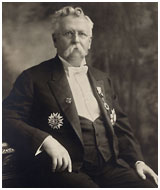
The Difference Makers: John Alexander Low Waddell

By Gregory Quinn, Special to the Port Authority

Part 2

In this series, we take a deeper look at the Port Authority of New York and New Jersey’s Difference Makers, the men and women who have been instrumental to the formation and continual success of our agency. In our second installment, we are focusing on John Alexander Low Waddell, a critical figure in the earliest days of the Port Authority’s existence.

***

The two cantilever bridges of the Port Authority of New York and New Jersey that cross the Arthur Kill—the thin, meandering river of water separating the western border of State Island and the eastern border of New Jersey, have much in common.

They are of similar age; the Goethals Bridge, to the north, spans 672 feet, while the Outerbridge Crossing, to the south, spans 750. They opened on the same day almost 90 years ago: June 29, 1928. And perhaps most importantly, both bridges were designed by John Alexander Low Waddell, or J.A.L. Waddell, one of the most prolific, widely respected civil engineers in American history. Over the course of his life, J.A.L. Waddell built thousands of structures, many of which still stand today as historic landmarks.

By the time J.A.L. Waddell, an 1875 graduate of Rensselaer Polytechnic Institute in Troy, New York, returned to New York at the age of 66, he was one of the most renowned bridge designers in the world.

His career began in Canada, the country of his birth, where he worked with the Canadian government’s Marine Department of the Dominion and the Canadian Pacific Railway.  His productivity and quick-wittedness was on display in an array of unique posts:  He worked in West Virginia for a mine company; in Japan as a foreign advisor and he was a professor at the Tokyo Imperial University.  He was an author of two books; and he worked as a bridge designer in Chicago, where the first of his many lift bridges would see completion in 1893.

In the early 20th century, Waddell was a principal designer of the famous ASB Bridge in Kansas City, Missouri. A lift bridge that at one point carried trains, passenger cars and pedestrians, the ASB Bridge is one of only two of its kind on the planet.

Waddell came back to New York in 1920, shortly after the ASB Bridge was completed. He had prior connections to the Empire State.  It was around this time that the nascent Port Authority of New York was looking to accommodate the much higher volume of interstate automobile travel in the aftermath of World War I. The Port Authority undertook a large-scale development project that included plans to connect New Jersey to New York through Staten Island by crossing the relatively thin span of the Arthur Kill.

The timing could not have been more fortuitous. Making a triumphant return to New York was the world’s foremost bridge design expert at the same time the Port Authority was looking to construct its first two bridges. J.A.L. Waddell would design both the Goethals and the Outerbridge, giving the Port Authority its first two bridges (and first bi-state development project) and New York and New Jersey residents unprecedented access and ease of travel.

Posted in history | Tagged , | 1 Comment

The Difference Makers 101: The Port Authority is Born

By Gregory Quinn, Special to the Port Authority

Part One: Governor Alfred Smith

In this new series, we’ll take an occasional and deeper look at the Port Authority of New York and New Jersey’s Difference Makers, the men and women who were instrumental to the formation and continual success of our agency. In our first installment, we are focusing on former New York Governor Alfred Emmanuel Smith, a critical figure in the earliest days of the Port Authority’s existence.

***

 The matter of Port development is critical. It affects the housing problems; it affects the cost of living; it affects the cost of doing business within the Port of New York; business is leaving New York because of inadequate facilities, and rival ports are taking advantage of delays in the development of New York’s plans in order to strengthen their own position. —  Alfred Smith, 1920

When Governor Al Smith delivered these words to the legislature in March of 1920, the need for an organized port agency with jurisdiction over the Port of New York had reached a critical mass. While the city of New York had already established itself as the premier urban area in the United States, its port was losing business and stature to rival, more vibrant ports in Baltimore, Philadelphia and New Orleans.

Recognizing this, Governor Smith looked to reinvigorate stalled talks between New York and New Jersey to form a port authority, and an ambitious New York, New Jersey Port and Harbor Development Commission was developed.

Things moved rapidly from there. In April of 1921, leaders from New York and New Jersey signed the Port Compact, stating that [the states] agree to and pledge, each to the other, faithful co-operation in the future planning and development of the port of New York, holding in high trust for the benefit of the nation the special blessings and natural advantages thereof.

The Port Authority was born.

While it’s fair to say that eventually a port authority would have been developed regardless, Governor Alfred Smith’s impassioned plea on behalf of such an agency in 1920 no doubt spurred PANYNJ’s development. And it was just in time too; for less than a decade later, the U.S. was mired in the worst global depression in history, and shortly after that, World War II.

Had Governor Smith not championed the port’s cause when he did, it is not hard to imagine that the development of a port authority could have been delayed much longer. The consequences of that happening could have been dire.  Governor Smith was one of the most influential New York politicians of the early 20th century. A major figure in the Democratic party, he was elected Governor of New York four times and was the Democratic U.S. presidential candidate in 1928, making him the first Catholic nominee for president, but he was defeated by Republican Herbert Hoover (Who would of course go on to be soundly defeated himself by Franklin Roosevelt in 1932).

Governor Smith was a known progressive, a fundamental leader in the Progressive Movement. He was also one of the most visible “wet” politicians—elected officials who strongly opposed the policy of Prohibition. After leaving office for good in 1928, Alfred Smith entered into private business in New York City, and he passed away there in 1944.

Today, the Alfred E. Smith Building in Albany, the second tallest in the capitol city, is named in his honor.  In a lifetime full of achievements and recognitions, one of his most lasting legacies will always be the Port Authority of New York and New Jersey. For it was his passionate stewardship that helped the agency take shape, and the millions of people who rely on Port Authority functions every day owe him a debt of gratitude.

Posted in historic photographs, history buffs, New Jersey, New York, Port Authority | Tagged , , , | Leave a comment

A Port Authority Horse Named Valor

By Gregory Quinn, Special to the Port Authority

Kenny Tietjen served New York City as a Port Authority of  New York and New Jersey police officer. He lost his life during the events of September 11, 2001. He was only 31. Today his name lives on—in the memories of those who loved him, as the namesake of the Ken Tietjen Memorial Foundation, and in the visage of a miniature horse that provides comfort and support to those suffering. The horse is named for Ken. The horse’s name is Valor.

Ken’s sister Laurie Tietjen founded the Ken Tietjen Memorial Foundation to honor the memory of her brother and to help the many who still suffer from the tragedy of 9/11. Her organization collaborated with the Therapy Horses of Gentle Carousel, a not-for-profit that uses miniature horses to provide therapy to those who need it—the ill, injured, those suffering from Post-Traumatic Stress Disorder, etc.  Recently, Laurie visited with various police departments, first responders, and family members from around the city, bringing along a few miniature therapy horses to comfort the officers, to offer a moment of peaceful reprieve to people who deal with stressful and dangerous situations on a daily basis.

Laurie and the horses were not alone however; at the First Precinct, they were joined by former host of The Daily Show and 9/11 victims’ advocate Jon Stewart. It was certainly an odd sight for hard working men and women at the First Precinct—a pair of tiny horses and one of the most influential celebrities of this generation—but it was also a welcome one, a fun, light-hearted moment in between the intensity of the job.

Valor the horse is becoming a celebrity in her own right. Only a year old, she was recently assigned to a first responder’s position with the Los Angeles Sheriff’s Department. In that role, she visits with people who have lived through traumatic events, showcasing her special ability to “heal hearts and bring smiles to people.”

Additionally, Valor will serve as a public face for the sheriff’s department, working at a variety of community outreach and civic events. Public service is an appropriate job for Valor; just like the fallen hero from which she takes her name, Valor will dedicate her life to her community.

The Therapy Horses of Gentle Carousel, which comforts tens-of-thousands of people per year, continues a long tradition of equestrian therapy. Greek literature of antiquity tells of horses tending to the emotional wounds suffered by soldiers on the battlefield. Horseback riding was used to treat soldiers returning home from the First World War, and today, hippotherapists use horses to improve patients’ neurological function and sensory processing. Though horses are the archetypical beasts of burden, the source of comfort and therapy they have provided to humans for centuries cannot overstated.

The organization’s visit, courtesy of Laurie Tietjen and the Ken Tietjen Memorial Foundation, was much appreciated by all the officers who were lucky enough to attend. We here at the Port Authority of New York and New Jersey can’t thank them enough. The horses on hand provided comfort of course, but more importantly, they offered the officers an opportunity to pause and remember their fallen brothers and sisters.

Posted in Uncategorized | Leave a comment