PAPD Captain Kathy Mazza-Delosh: Woman of Action, Healer of Hearts

By Mercedes Guzman, Media Relations Police Blogger

The late Captain Kathy Mazza was a tough, no-nonsense but altruistic woman who commanded respect from both male and female police cadets as Commander of the Port Authority Police Academy, before she met an untimely death helping others on 9/11.
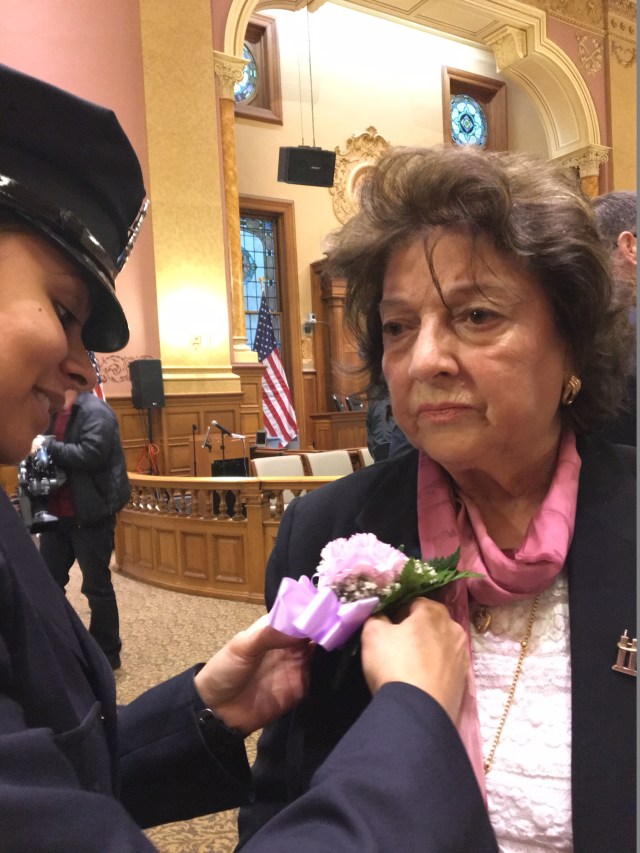
Rose Mazza

Police Officer Priscilla Sanchez pins a corsage on Captain Mazza’s mother, Rose Mazza, at the start of 2016 Women of Action Awards in Jersey City

For her heroism that day and her achievements over a distinguished career, Mazza  was posthumously honored this week as one of 18 winners of the 2016 Women of Action Awards, bestowed by the City Council in Jersey City.

Mazza was a first responder killed during the attack on the World Trade Center, but not before using her 9mm sidearm to shoot out the floor-to-ceiling glass walls of the North Tower’s mezzanine, enabling hundreds of people to escape with their lives.  She was last seen helping colleagues carry out a woman in a rescue chair.

Of the 37 PAPD officers who lost their lives that day, she became the first and only female Port Authority Police Officer killed in the line of duty.

In an interview before the ceremony, her mother, Rose tearfully explained that from the start, her daughter somehow sensed she wouldn’t live a long life.

“I recall my own mother’s words about Kathy:  ‘What a destiny she’s going to have!’ I’ve remembered her words all my life,” said Rose.

Rose remembers how as a teenager, Kathy used to sneak in the house at 3 a.m., well past her curfew.   “I knew early on that my daughter had her own mind.  She was a determined person who always told me she’d leave her mark on the world.”

Mazza grew up on Long Island with her parents, and three brothers with whom she arm-wrestled and learned the skills of sibling warfare. She attended Nassau Community College, obtaining her nursing degree and spending the first 10 years of her professional career as a cardiac nurse at St. Francis Hospital in Roslyn.

Family members recall that during the graduation ceremony in 1981, she broke the time-honored tradition of wearing a nursing cap.   Since male nursing graduates didn’t wear caps, she refused to wear hers and graduated “cap-less.” “She always did what she wanted to do,” her mother said.

According to her husband of 16 years, Christopher Delosh, a retired NYPD Officer, had anyone asked his wife why she joined the Port Authority Police Department in 1987 after working as a cardiac nurse, she would likely have said the PAPD offered a more secure retirement for herself and her family.  But he said “it was because she wanted to show [me] how [policing] is done!

She advanced quickly through the ranks, and after 13 years, she became the first female commanding officer of the police academy, during a time when there was only one other female captain in the entire department.

Another of Mazza’s significant achievements was convincing the Port Authority to install portable heart defibrillators in each of its airports, an accomplishment which saved many lives. She initiated the training program in which 600 police officers learned to use the defibrillators in the airports.  Recognized in 1999 for her efforts, NYC  named her the “Basic Life Support Provider of the Year.” She also oversaw the agency’s first-aid programs, certified first responder and EMT training.

PAPD Superintendent Michael Fedorko, who attended Tuesday’s awards ceremony, described Mazza as an officer “committed to helping people, and in the end, she gave her life to help people.”

PAPD Assistant Chief, Gloria Frank, worked with Captain Mazza when Frank was a rookie police officer in PAPD. “I was assigned to the Port Authority Bus Terminal in 1999, and Captain Mazza quickly became my mentor. Despite her tough facade, she was a very caring, selfless, fearless and dedicated woman who loved policing and advised me on how to perform police work at its best. I will never forget her kind words to me one day as she handed me a stack of police shirts, which still had the sergeant’s insignia attached to the sleeves.  She said, ‘you will need these one day.’ We both laughed. She was the first supervisor who saw the potential in me to move up the ranks.  She absolutely had an impact on my career.”

Mazza was a source of strength, not only in her law enforcement career, but to everyone in her life.  Just a year after she underwent open-heart surgery to correct a quarter-sized hole, she saved her own mother’s life by being the first to recognize her mother’s arteries were blocked.

Quickly she took charge of the medical staff in her mother’s operating room.  “Everyone was so shocked and intimidated by her presence that they just allowed her to run the show. She saved my life.  If it wasn’t for her, I wouldn’t be here today,” said Rose.
 

Posted in 9/11, Captain Kathy Mazza, NYC, NYPD, PAPD, police history, Port Authority, Port Authority of New York & New Jersey, Port Authority Police Academy, Port Authority Police Department, Uncategorized, Women's History Month | Tagged , , , , , , , , , , , , | 18 Comments

Bayonne Bridge: Giant Cranes Give the Bayonne a Much-Needed Lift

By Neal Buccino, Senior Public Information Officer

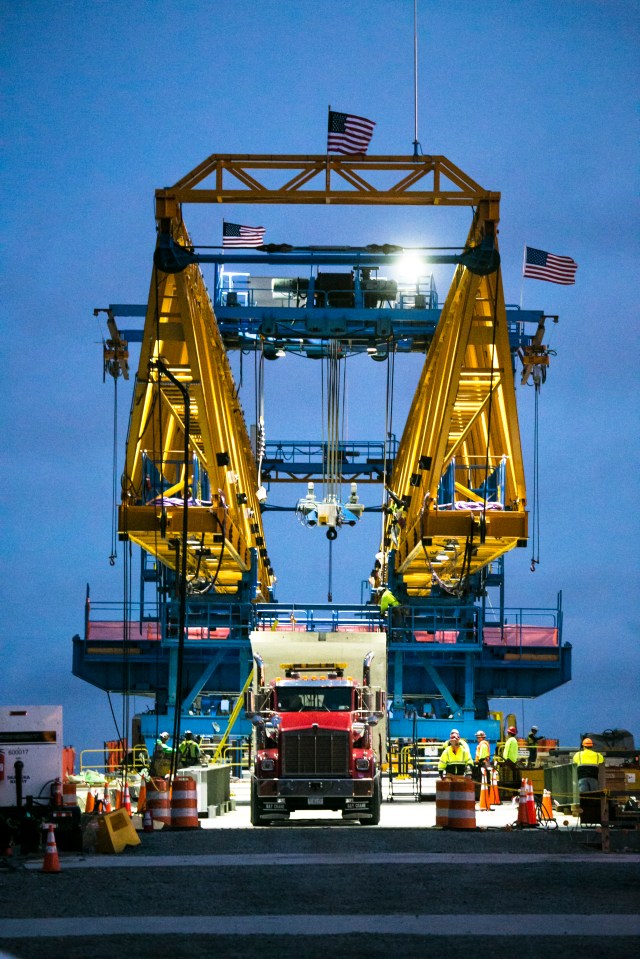
Two of the world’s most visually arresting pieces of construction equipment – looking more like colossal candy-colored robots than mundane cranes – are toiling away on either side of the Kill van Kull, building new roadways that will serve the elevated Bayonne Bridge.

Bayonne Bridge_055

Photo Courtesy of HDR

Known as segment-launching gantries, or gantry cranes, these mechanical giants haul and install the 70-ton concrete segments that make up the roadways. As big as they are – 500 feet long and 1 million pounds each – they work with finesse and precision, moving the roadway segments into just the right place for human workers to bind them with steel, epoxy and more concrete.

Custom-made for the Port Authority’s ambitious Bayonne Bridge “Raise the Roadway” project, the gantry cranes often operate at night when the bridge is closed to traffic. With their crayon-bold colors lit up in the dark, they seem to have arrived from another world – a Marvel Comics universe, perhaps, or a child’s oversized toy bin.

The project marks the first time engineers are building a bridge roadway above the original span, even as the lower road continues to carry traffic. It will maintain the steel arch that makes the Bayonne Bridge a civil engineering landmark, while giving drivers a safer, wider and more modern roadway with 12-foot lanes, new shoulders, a median divider, and a 12-foot bike and pedestrian walkway. See for yourself in the slideshow below and the time-lapse video of gantry cranes at work by the Port Authority’s Mike Dombrowki.

This slideshow requires JavaScript.

The “Raise the Roadway” project is designed to elevate the bridge from 151 feet to 215 feet. A joint venture of Skanska Koch/Kiewit Infrastructure Co. (JV), it will enable the world’s largest container vessels to pass beneath the bridge on their way to Port Newark/Elizabeth and Howland Hook, following the expansion of the Panama Canal.

With the Bayonne Bridge, it is fitting that even the gantry cranes combine strength and power with elegance of design.  Othmar Amman, the Port Authority’s then-Chief Engineer and the Bayonne’s legendary designer, said at its 1931 opening that great bridge projects “must not only be useful, but they must also conform to the aesthetic sense. This was one of the motives for the selection of an arch spanning the entire river in one sweeping graceful curve.”

True to Amman’s spirit, the design was groundbreaking. Its 1,675-foot steel arch was the world’s longest, and kept that title for 45 years. Its path through the Kill is diagonal, not perpendicular to the water – both to conform to the existing streets and create a more dramatic profile. Its hyperbolic arch becomes shallower toward the center, “principally for its pleasing appearance,” Amman said.

The New York Times wrote in 1931 of the Bayonne’s “symmetry and fineness of detail … that is impressive and haunting.” The American Institute of Steel Construction declared it the “Most Beautiful Steel Bridge” over the George Washington Bridge, which opened the same year.

Posted in Bayonne Bridge, bridges, Howland Hook, PANYNJ, Port Authority of New York & New Jersey, Port Commerce, Port Newark, Port Region of New York and New Jersey, Portfolio, Uncategorized | Tagged , , , , , , , , , , , | 7 Comments

Port Authority History: The 23rd Anniversary of the 1993 World Trade Center Bombing

Edited by Roz Hamlett, Portfolio Editor

For the last 22 years, the Port Authority of New York & New Jersey has marked the anniversary of the Feb. 26, 1993 World Trade Center bombing with a commemorative Mass at St. Peter’s Roman Catholic Church.  During the attack, PA employees Robert Kirkpatrick, Stephen Knapp, William Macko and Monica Rodriguez Smith and her unborn child, along with Windows on the World employee Wilfredo Mercado and visitor John DiGiovanni  lost their lives in an assault by terrorists that injured more than a 1,000 others.

While that tragic and sad moment in Port Authority history is marked forever in the agency’s collective memory, the heroism that occurred during the ensuing days and weeks is told through astonishing tales of heart, humanity and perseverance.

The following stories are excerpted from Perpetual Motion:  The Illustrated History of The Port Authority of New York & New Jersey.  Although most of the PA employees profiled here have retired or since passed on, their experiences on that February afternoon are indelibly etched into the Port Authority’s historical record.

At about the 58th floor, “the elevator stopped,” said Vincent Miller, trapped with seven others in an elevator halted by the blast. “We did not hear an explosion or feel a shock.  When smoke began to fill the elevator we realized something was wrong and we had to think fast.”  But these were no ordinary passengers.  Among them were five Port Authority engineers, including Chief Engineer Eugene Fasullo, all experts in the inner workings of the building.

The group attacked the problem systematically, by first pulling open the elevators doors.  Then, using makeshift tools – car and house keys –a few of them attempted to make a hole.  Others, looking for another means of escape, opened and removed the cover of the manual-control panel and used it as a hatchet to cut through two-inch-thick gypsum plank.  Finally, they cut a one–foot-square hole that opened into an access area with a fresh supply of air.

When the lights went out, they used the night light in their beepers and books of matches to cut through the elevator-shaft wall to escape.  After opening a small hole in the gypsum they heard a sound like breaking glass when they hit tile in the women’s bathroom.  By continuing to chop away with the control-panel door, they managed to make a hole big enough for the party to escape.

Ed Piccinich, manager of operations of the World Trade Center, and his 12-man team were trapped in an office in the subgrade – the heat of the blast had welded shut one door, while the second was blocked by tons of debris from collapsed cider block walls.  Bob Rafferty, a security coordinator, corralled the staff into his office, the only space that offered protection against the enveloping smoke.

Piccinich grabbed the flashlight and crawled forward to determine whether their last chance for escape was still available – the exit to the executive parking lot.  Reaching the parking lot, Piccinich saw that the blast had ripped open the bottom portion of the emergency door.  With Rafferty’s help, he was able to safely evacuate the employees through the opening.

Building mechanic Fred Ferby, working in the sub-basement, was thrown against a wall by the blast. Buried in the wreckage, he dug his way out.  Hearing his co-workers’ cries for help, he found a flashlight and searched for them, pulling two from the wreckage of the collapsed ceiling and leading them to safety.

Port Authority employees assisted their colleagues, many in wheelchairs. Two agency lawyers, Donald Burke and Michael Driscoll, carried fellow attorney Kathleen Collins and her wheelchair down 66 floors.

Paul Iannacone and Richard Pietruszki weren’t where they normally work – the B-3-level stockroom – when the bomb exploded. For Tom Martinez, fate was not so kind.  Working in the stockroom when the bomb went off, Martinez was flung beneath a table.  He sustained a back injury that would keep him out of work for three months.  After co-worker Oliver Brown helped him to safety, Iannacone and Pietruszki conducted a detailed search of the area to determine if anyone else was trapped or injured.

Working with a single flashlight, the two men crawled forward on their hands and knees in the pitch-black and smoke, patting the ground in front of them to make sure that they would not fall into any of the holes that had opened up.  They gave up after an hour of searching without finding other survivors.  They then sought out the FBI and local police to offer their intricate knowledge of the subgrade levels.

Three days after the bombing, one third of the World Trade Center was open for business.  To demonstrate that residents of the region would not be intimidated by terrorism, New York Governor Mario Cuomo and his staff led the return to the World Trade Center’s Tower Two by moving back into their offices two weeks ahead of schedule.

For six weeks following the attack, Port Authority staff and contractors worked around the clock to restore the towers and communications and safety systems, reconstruct damaged floors and supports and clean away mountains of rubble.

Posted in 1993 World Trade Center Bombing, Ground Zero, PANYNJ, Port Authority of New York & New Jersey, terrorist attack, transportation, Twin Towers, Uncategorized | Tagged , , , , , , , , , | Leave a comment