Women’s History Month: PAPD Assistant Chief Norma Hardy on the road less traveled

By Mercedes Guzman, Media Relations, Police Blogger

When PAPD Assistant Chief Norma Hardy of New Jersey Air Transportation began her trailblazing career more than two decades ago, she set out on a road less traveled by women to reach the highest levels in the department’s history.

Fifty years ago, women were practically non-existent in police work.  In fact, the first female police officers didn’t join the Port Authority Police Department until the 1970’s.  Since then, the number of female officers has grown, as well as the growing recognition that women can perform duties once thought best suited to men. Of the roughly 1,700 PAPD officers, approximately 180 are women, a small but increasing percentage.
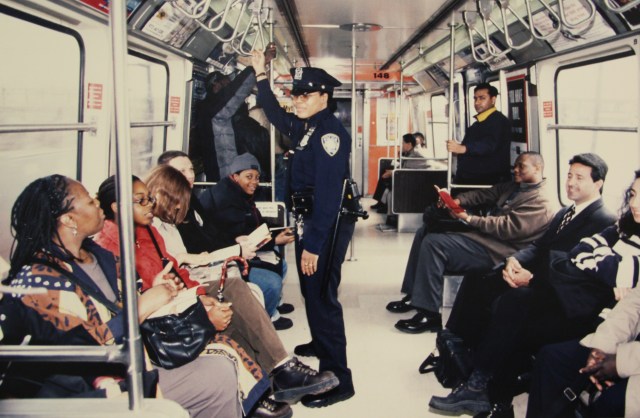
Hardy on train

“I believe women police bring a different perspective to police work.  Old school teaching has given me an ability to reach hard-core criminals,” Hardy said. “Many older criminals still hold a certain old school code of respect for women. In my career, I always told people I apprehended that it’s not personal.  I happen to be the one who caught you today.  I understand that anyone who chooses to go into law enforcement today faces many different dangers and challenges.”

Born and raised in Brooklyn, Hardy served in the Army National Guard and worked as an Emergency Medical Technician for six years before joining PAPD in 1992.  A short time after joining the department, she received the Medal of Valor for her acts of courage during the 1993 World Trade Center bombing.

A decade-long assignment at the Port Authority Bus Terminal (PABT) command followed, where she experienced everything from guns and drugs to prostitution ring arrests.  She was the first female officer trained to work with youth at the PABT.

Hardy recalls a young girl she met in the bus terminal’s restroom, wearing heavy makeup inappropriate for her age.  Outside the restroom, a strange man said he was waiting for his girlfriend; Hardy’s antenna immediately went up.

Weeks later, Hardy spotted the teenager again, but this time, instead of heavy makeup, there were bruises on her face and neck. The girl confessed to Hardy that she was, in fact, a 14-year- old runaway from Florida, who’d gotten caught up in a prostitution ring. Through Hardy’s efforts, the girl returned to her family in Florida.

In 2006 at the World Trade Center command, Hardy was promoted from sergeant to lieutenant and reassigned briefly.  However, she soon returned as an executive officer after letters from the U.S. Secret Service, NYPD’s Chief of the Department, family members of those lost on 9/11 and PA site managers requested that she return to the World Trade Center command because they wanted to continue to working with her.

In 2011, she became the first African-American woman promoted to the rank of Inspector. Chief Hardy is currently the Assistant Chief of New Jersey Air Transportation. When asked what advice she has for younger female officers joining the force, she encourages them to, “take advantage of seniority, listen, and treat everyone with the same level of respect.”

“I would not trade my time at the PABT for anything. It is where I learned how to be a law enforcement officer. If you could work there, you could work anywhere as a PAPD cop,” said Hardy.

Posted in 1993 World Trade Center Bombing, 9/11, aviation, Black History Month, bus terminal, Jersey City, New Jersey Air Transportation, Newark Liberty International Airport, NY/NJ region, NYC, NYPD, PABT, PAPD, police history, Port Authority Bus Terminal, Port Authority Police Academy, Port Authority Police Department, public restrooms, transportation police, Uncategorized, Women's History Month, World Trade Center, World Trade Center Transportation Oculus | Tagged , , , , , | Leave a comment

Women’s History Month: Lee Jaffe, Port Authority’s Legendary First Female Director of Public Affairs

By Lenis Rodrigues, Media Relations Staff

CLICK IMAGES FOR A CLOSER VIEW   

Lee Jaffe was a brilliant woman from a small Pennsylvania town who worked as the Port Authority’s Director of Public Relations from 1944-1965. She served as the agency’s spokesperson and earned recognition as the “voice” of the Port Authority.

Before joining the agency, Jaffe was a Washington correspondent for the Wichita Beacon. According to a 1965 New York Times profile, her first assignment was covering the Veterans’ Bonus March on Washington, which President Hoover countered with troops and tear gas bombs.

Associates told the Times that Jaffe showed up in spiked heels and white gloves. Her cab driver didn’t want to let her out at the Anacostia Bridge, saying “it’s no place for a woman.” She agreed, but jumped from the cab because, as she noted, “it’s a good place for a reporter.” For so many women already having a tough time breaking through the glass ceilings in the world of journalism, Jaffe’s comment was a rallying cry.

She also worked at the Binghamton Press and the Northwestern Miller Trade Journals. She was a member of the United States Senate and House Press Galleries and the White House Correspondents Association, and served during World War II as an information officer in the Office of War Information, assigned to the Office of Price Administration (OPA) for Metropolitan New York.

Like the contributions of so many accomplished but unsung women of her time, her greatest influence occurred behind the scenes.

Jaffe rallied the support of the public and the press on every major capital program undertaken by the Port Authority at the airports, seaports and the bus terminal, reporting to Executive Director Austin Tobin. She established close working relationships with editorial writers and reporters at all of the region’s daily newspapers, keeping them continually informed of Port Authority news and human-interest stories.

According to her colleagues and associates, Jaffe lived, slept and breathed the Port Authority and had a particular talent for sharing the agency’s message. “She was ingenious. She knew a good story and how to develop it,” said one of the region’s reporters. “And if you needed more [facts], she would get them and call you right back . She was head and shoulders above anyone else in the public relations field.”

For an idea of Jaffe’s influence, start with 1945. That year, there were 29 favorable editorials, according to summaries prepared by Tobin for the Port Authority Board of Commissioners. The next year, the number was 280, and it grew to 317 in 1947.

Beyond public relations, Jaffe left her imprint on other areas of the the agency. Although the initial architectural plans for the World Trade Center Twin Towers called for the construction of two 80-story towers, Jaffe thought it wouldn’t be exciting enough to attract multi-national tenants. According to news accounts, as Jaffe and Tobin discussed the possible design of the towers, she said, “Why not make it taller than the Empire State Building?” Tobin agreed, as did Port Authority commissioners.

After 21 years of devoted service to the Port Authority, Jaffe retired. “It’s been fun. I loved every minute of it,” she told the New York Times.  Jaffe seldom took more than one week’s vacation a year and was accessible at any hour of the day or night to provide information concerning the agency. She belonged to a number of public relations organizations and to the Foreign Press Association, Aviation/Space Writers Association, Women’s City Club of New York and Women’s National Press Club. And she lived a full life outside the agency with her husband Isadore and their beloved Myna bird, named Pretty Boy, and a Maltese Terrier.

On the eve of her retirement, she went to a routine meeting — or so she thought. She walked out of it not with a pad full of notes, but with the Port Authority’s Distinguished Service Medal. In 1944, The Port Authority started its Medal Awards program to acknowledge the contributions of dedicated long-term employees, and to reward heroism and other achievements by staff.

The medal points to “her valuable counsel and advice have been sought on every decision of major significance and that her unfailing ability to outline a course of action for the Port Authority to meet the public needs has always been of great assistance to her colleagues,” said the commissioners.”

The commissioners praised Jaffe for “imaginatively” telling the story of the Port Authority, and the confidence and respect the agency commanded from the news media during her tenure.

Posted in Austin Tobin, Empire State Building, historic photographs, history, history buffs, New Jersey, New York, Port Authority of New York & New Jersey, public relations, Uncategorized, women journalists, World Trade Center | Tagged , , , , , , , , , | 1 Comment

OUTSIDE THE BOX – NOT ALL PORT CARGO COMES IN A CONTAINER

By Deputy Director Steve Coleman, Media Relations

Nearly 60 years ago, entrepreneurial businessman Malcom McLean developed and launched an innovative shipping concept when he transported cargo in steel containers for the first time from the Port of New York and New Jersey to Texas.

When McLean strapped 58 boxes to a converted World War II tanker named the Ideal X on April 26, 1956, he revolutionized the method in which everyday goods like clothing, furniture, food products and other necessities of life move around the globe.  What was crystal clear to McLean, even during the formative years of maritime shipping, was that not everything fits in a 40-foot steel shipping box.

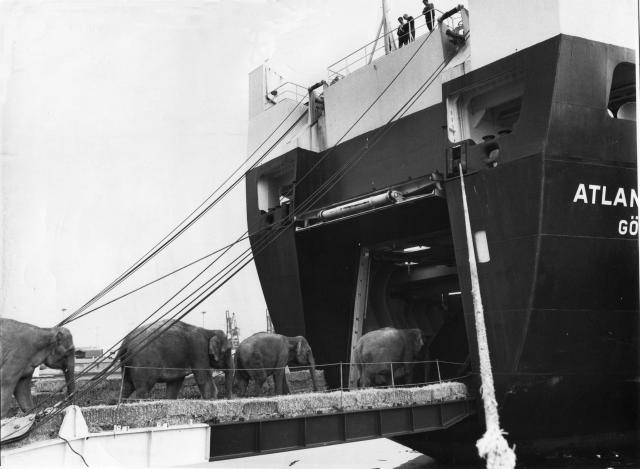
Over the next decades, everything from circus animals to PATH cars, subway cars, helicopters, giant steel beams and yachts have passed through the East Coast’s largest seaport.  As far back as 1971, a traveling circus with 19 elephants crossed the Atlantic Ocean from Southampton, England to New York aboard the Atlantic Champagne.  The animals traveled by sea to their new employers in Miami, the Ringling Brothers Barnum & Bailey Circus.  Provisions on board the ship included: 600 gallons of water, 300 loaves of bread and 8 tons of hay.

CLICK IMAGE FOR LARGER VIEW

More than 20 years later, Port Commerce Assistant Director Beth Rooney recalled her first encounter with unusual cargo. During those days, Rooney’s responsibilities were operations and leasing at the New Jersey Marine Terminals.  She watched in awe as several thousand pigs and sheep led by shepherds paraded down the gangway of a ship and onto waiting trucks.  “Having traveled to ports all over the world on commercial ships, it was something I had never seen before and haven’t seen since,” says Rooney.

In recent years, shipping line ACL/Grimaldi has transported 99 giant beams, some as long as 56 feet, from Luxembourg to the Port of New York and New Jersey for installation in One World Trade Center, including the signature first beam installed in the tallest tower in the Western Hemisphere.

Port tenant Harbor Freight Transport, a family-owned business started in 1947 and run by father-son team Steve Liberti and Stephen Liberti Jr., handles most unusual cargo these days, including shipments of NJ Transit subway cars, Airbus aircraft wings, Wall Street Bull replicas and even a giant Marilyn Monroe statue.  When asked to recall the most unusual shipment his company has handled in recent memory:  The elder Liberti didn’t hesitate –a cadaver on its way to a Caribbean medical school.


Posted in 9/11, commerical shipping, One World Trade Center, PANYNJ, Port Commerce, Port Jersey-Port Authority Marine Terminal, Port Newark, Port Newark/Elizabeth Marine Terminal, Port of New York & New Jersey, Port Region, Port Region of New York and New Jersey, shipping, Uncategorized | Tagged , , , , , , , , , | Leave a comment