The Lincoln Tunnel Helix and the Hamilton Death Rock

By Portfolio Editor Roz Hamlett

Across the Hudson River from NYC is the town of Weehawken, N.J.  Founded in 1859, it’s been home to the rich and famous, to casinos, hotels and theaters and a major rail and shipping hub. Today, it hosts the western terminus of the Lincoln Tunnel and the almost 80-year-old helix leading directly into the toll plaza.

Every morning during peak hours, the helix accommodates some 700,000 commuters and about 2,000 buses traveling into Manhattan via the XBL (Exclusive Bus Lane), the busiest bus lane in the world. Forty million vehicles use the helix every year to travel back and forth between New Jersey and New York.
153064571_7a3f9c1883_b

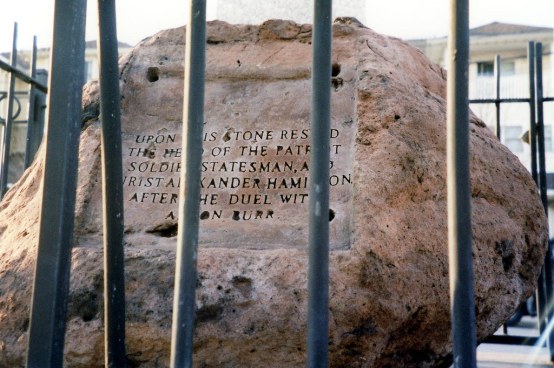
The Death Rock is the actual rock on which Alexander Hamilton’s head is said to have rested after he was shot to death by Aaron Burr, then Vice President of the United States.

The helix brings vehicles very near the site of one of the nation’s momentous events, though it isn’t something that would cross anyone’s mind, unless he or she happens to have tickets to Hamilton, the popular Broadway musical about the life of Alexander Hamilton, the first U.S. Secretary of the Treasury and founder of the Bank of New York (now BNY Mellon).  In recent years, BNY Mellon serves the Port Authority as the trustee for all of its bond issuances.

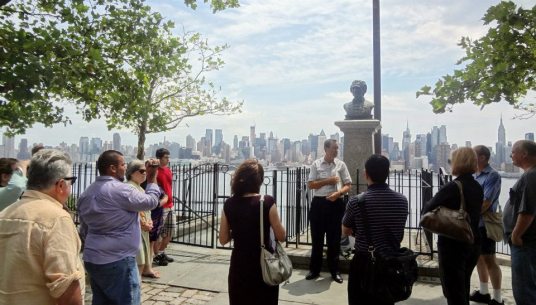
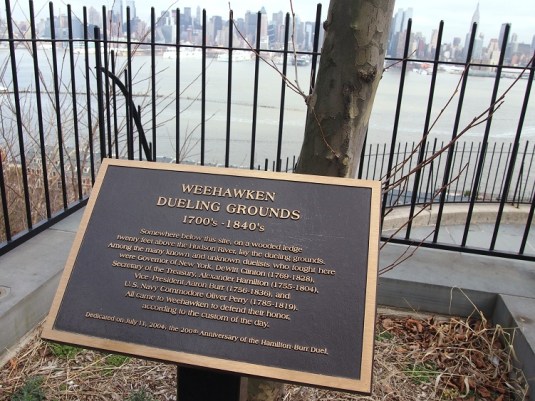
The Lincoln Tunnel is within striking distance of the Death Rock at the Alexander Hamilton Monument. The Death Rock is the actual rock on which Hamilton’s head is said to have rested after he was mortally wounded in a pistol duel with Aaron Burr, then Vice President of the United States.  The rock is located on tiny Hamilton Avenue at the southern tip of Weehawken, just north of the entrance to the Lincoln Tunnel.
weehawken%20event%20duel%20site

The relationship between Burr and Hamilton began as a political war of words that escalated out of control.  Hamilton considered Burr a dangerous bully and bad for the country.  The situation became deadly when Hamilton tried to block Burr’s re-nomination for Vice President.
Hamilton Death Rock 4_OTIS


At dawn on the morning of the duel, Hamilton crossed the Hudson with two witnesses, one of whom was a doctor. The men faced off and Hamilton fell to the ground.  Dr. [Hosack] rushed to his side, later publishing what he had witnessed: “His countenance of death I shall never forget.  He had at that instant just strength to say, ‘This is a mortal wound, doctor;’ when he sunk away, and became to all appearance lifeless. His pulses were not to be felt, his respiration was entirely suspended, and laying my hand on his heart, I considered him irrecoverably gone.”

As Hamilton was carried to the river bank to make the trip back across the Hudson, the doctor began to notice signs of life.  “In a few minutes he sighed. . . he breathed; his eyes hardly opened, wandered; to our great joy, he spoke.  He cast his eye upon the case of pistols, and observing the [pistol] that he had had in his hand, he said, ‘Take care of that pistol; it is undischarged and still cocked; it may go off and do harm.  I did not intend to fire at him.’”

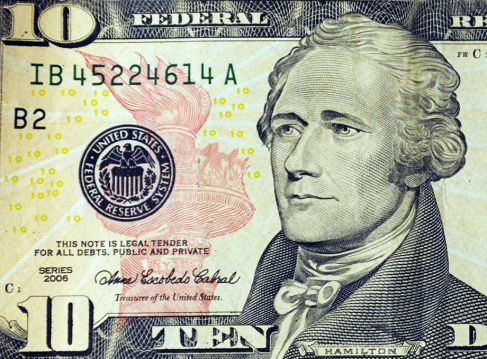
Hamilton lingered for a day at his Manhattan home before dying the next day – the pistol’s ball lodged next to his spine. In 2015, the current Treasury Secretary, Jack Lew, announced that the portrait of Hamilton on the $10 bill would be replaced by the portrait of Harriet Tubman, the former slave and abolitionist, but due to the extreme popularity of the Broadway musical, the decision was reversed recently and Hamilton will remain on the bill.
P1070551

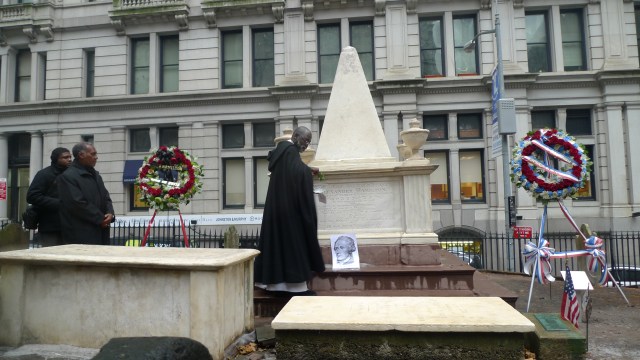
Hamilton is buried in the churchyard of Trinity Wall Street Church.
920x920


Posted in Alexander Hamilton, Broadway musicals, history, history buffs, Lincoln Tunnel, New Jersey, New York, NYC, Port Authority, Port Authority of New York & New Jersey, ten dollar bill, U.S. Treasury Secretary, Uncategorized, Weehawken, New Jersey | Tagged , , , , , , , , | Comments Off on The Lincoln Tunnel Helix and the Hamilton Death Rock

Liberty Park: A Memorial Within a Memorial

By Lenis Rodrigues, Media Relations Staff

Photos below by Michael Mahesh, World Trade Center Construction

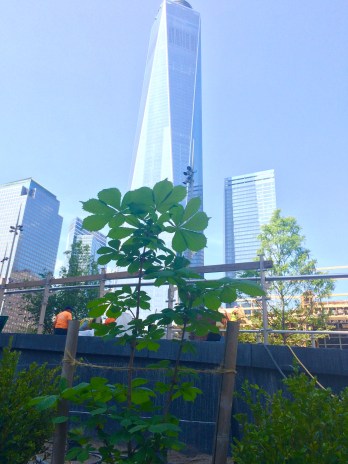
Earlier this month, a beautiful horse chestnut tree was planted at the Port Authority’s Liberty Park on the World Trade Center site, donated by the Anne Frank Center USA.

In her powerful memoir of life in Nazi-occupied Europe, the teenager Anne Frank wrote about a horse chestnut tree in the garden behind the secret annex where she spent more than two years in hiding before being captured and sent to a concentration camp. It was a source of comfort to the young girl, a symbol of freedom, hope, and the fight against hatred and intolerance.

Today, the horse chestnut is a symbol of that effort across the globe. Thanks to the stewards at the Anne Frank House, saplings have been distributed to numerous cities and towns around the world. In the United States, the Anne Frank Center USA’s Sapling Project received 11 of these precious saplings to donate to special locations across the country, including Liberty Park.


FullSizeRender

Photo by Lenis Rodrigues

The World Trade Center was chosen to receive an Anne Frank sapling early on in the project. The Port Authority’s vision for the rebuilding of the area devastated by terrorists, including the design of Liberty Park, truly embodies her vision of hope in the face of despair.

“This tree, located in Liberty Park, adjacent to the site of the nation’s worst terrorist attack, represents how today’s generation can learn to fight intolerance in all forms, to identify prejudice, stereotyping, polarization and to advocate for a world based on mutual respect,” said Steve Plate, Port Authority’s Chief of Major Capital Projects.

“We are thrilled to see one of Anne’s chestnut trees planted here in lower Manhattan at Liberty Park,” said Hilary Stipelman, Director of Outreach & Exhibitions at the Anne Frank Center USA. “It serves as a reminder of all that has passed and as an enduring, living symbol of hope for the future.”

ANNE030610

Photo Courtesy of Anne Frank House

Passages from the “The Diary of Young Girl”

The two of us looked out at the blue sky, the bare chestnut tree glistening with dew, the seagulls and other birds glinting with silver as they swooped through the air, and we were so moved and entranced that we couldn’t speak.” – 23 February 1944

“April is glorious, not too hot and not too cold, with occasional light showers. Our chestnut tree is in leaf, and here and there you can already see a few small blossoms.” – 18 April 1944

“Our chestnut tree is in full bloom. It’s covered with leaves and is even more beautiful than last year.” –  13 May 1944


Posted in 9/11, 9/11 Memorial and Museum, Anne Frank House, Liberty Park, New York, NYC, One World Trade Center, Port Authority of New York & New Jersey, Uncategorized | Tagged , | Comments Off on Liberty Park: A Memorial Within a Memorial

The George Washington Bridge and Artist Faith Ringgold’s Tar Beach

By Portfolio Editor Roz Hamlett

tar beach book image copy

The George Washington Bridge may not be quite as famous as that other well-known bridge in Brooklyn, but if popularity in the lofty world of bridges is measured by a span’s ability to inspire world-class art, the star power of the GWB is undisputed.

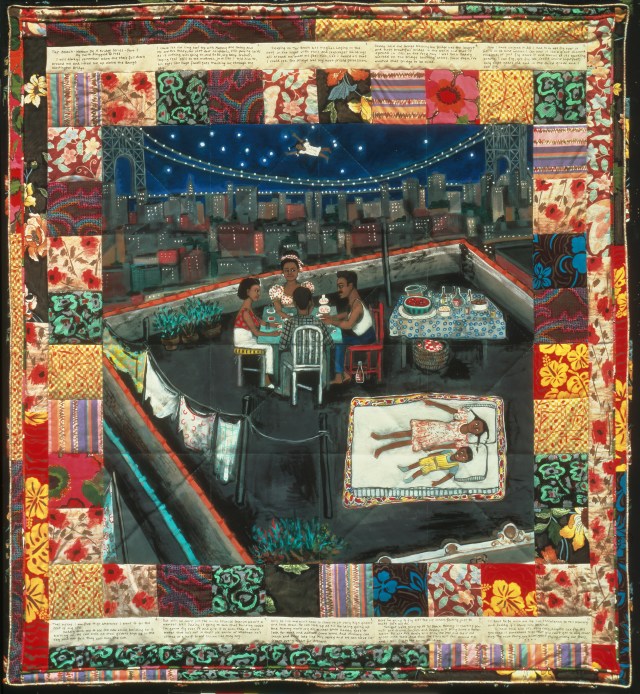
For the past 85 years, the George has sparked the imaginations of writers, composers, filmmakers and, perhaps most importantly, generations of children. Perhaps no artist has impressed the hearts and minds of children more through the bridge’s beauty than Faith Ringgold, renowned painter, textile artist and award-winning author of the children’s book Tar Beach. In the book, Ringgold recounts the dream adventure of eight-year-old Cassie Louise Lightfoot, who was born the same day the George Washington Bridge opened in 1931.

Cassie is based on Ringgold’s own childhood memories growing up in Harlem during the 1930s. To escape the sweltering summer heat of their Harlem apartment, Cassie’s family would go up to the roof and cool off on the “beach,” where Cassie dreamed of someday flying over the George Washington Bridge.  One evening she actually does: “Now I have claimed it,” Cassie says.  “I can wear it like a giant diamond necklace. It is one of my prized possessions.”

Tar Beach 13MB

Tar Beach is adapted from Ringgold’s original Tar Beach story quilt on which the narrative text of the children’s book, along with Ringgold’s autobiographical information, is woven on the quilt’s border.   And like her character, Ringgold, who now makes her home in Englewood, N.J., a short distance from the span, has been a lifelong fan.

“I never want to be more than three minutes from the George,” said Ringgold. “I could always see it as I grew up.  That bridge has been in my life for as long as I can remember.  As a kid, I could walk across it anytime I wanted.  I love to see it sparkling at night.  I moved to New Jersey, and I’m still next to it.”

Tar Beach was the first of Ringgold’s 11 children books.  The book was recognized as a Caldecott Honor Book in 1992 as one of the most distinguished picture books for children in America.

Other Ringgold masterworks are owned by many of the most prestigious museums of America – the Metropolitan Museum of Art, the Guggenheim, the Museum of Modern Art, the Philadelphia Museum of Art and the National Museum of American Art in Washington, D.C.  Her private collectors include Oprah Winfrey and a host of other luminaries.

For Ringgold, Cassie’s fantastic flight through the urban night sky symbolizes the potential for the freedom and self-possession of all women. “The women in my art,” said Ringgold, “are actually flying; they are just free, totally. They take their liberation by confronting this huge masculine icon—the bridge.”

Posted in Black History Month, bridges, Brooklyn, Faith Ringgold, GWB, New Jersey, New York, NYC, Port Authority, Port Authority of New York & New Jersey, public art, Uncategorized | Tagged , , , , , , | 1 Comment