GWB: Did You know?

By Portfolio Editor Roz Hamlett

Opening Day 1931-Martin Solomon crossed the bridge on a horse named Rubio

Soon after the opening day ceremony of the George Washington Bridge in 1931, the GWB became the busiest bridge in the world. On its first day, 57,788 vehicles and one man on a horse crossed the bridge.  Tolls for automobiles and horse and wagons were 50 cents and 25 cents for bicycles.  Initially it cost more to walk across the bridge than ride the bus.  Pedestrians were charged 10 cents and a shuttle bus ride across the bridge was only a nickel.  Eventually the pedestrian toll was dropped.

Do you know how the GWB got its name?

Throughout the four years of its construction from 1927-1931, everyone referred to the bridge as the Hudson River Bridge.  And then the Port of New York Authority – as it was known at the time — decided to call it the George Washington Memorial Bridge instead, which caused a big public ruckus because there were 25 George Washington Bridges in the U.S. already.   Finally, there was a popular referendum on the name, and tens of thousands of votes later, Hudson River Bridge emerged as the overwhelming favorite.  The Port Authority ignored that outcome and went with the George Washington anyway.

Did you know that over the years a wide assortment of stuff has spilled onto the GWB roadway from trucks and cars?  

In 2001, a tractor-trailer overturned near the GWB spilling cases of Bolivian beer that tied up traffic from Connecticut to Maryland.  Once, the eastbound lanes of the upper level of the GWB were temporarily closed when a truck spilled a load of watermelons.  Another time it was 14,000 pounds of frozen chicken parts.  Once, a herd of goats escaped from a truck and ran across the bridge.  An aromatic cargo of horse manure once spilled onto the roadway:  while Port Authority employees shoveled like crazy to clean up the manure and get things moving, garden-minded motorists caught in the traffic jam helped themselves to free fertilizer.

Did you know Othmar Ammann designed more bridges in NYC than any other civil engineer?

Although less well known than Brooklyn Bridge builder, John Augustus Roebling, Ammann, (1879-1965), gave more bridges to NYC than any other civil engineer.  During the 1920’s and early 30’s, Ammann was responsible for building the George Washington Bridge (1931), the Bayonne Bridge (1931), Triborough (1936), Bronx-Whitestone (1939), Throgs Neck (1961) and Verrazano-Narrows (1964).  He also supervised the construction of the Lincoln Tunnel and consulted on other projects in New York and beyond, including the Golden Gate Bridge in San Francisco.

Did you know that Othmar Ammann’s daughter confessed later in her life that there was a drawback to being his kid?

Dr. Margaret Ammann-Durrer told the New York Times in 2003 that growing up during the 1930s with her famous dad was like living with any other father you love.  “I had no idea what was going on in his head, but I remember him spending long hours bent over his desk at night.”   But she had one complaint: “I was in the seventh grade when the George Washington Bridge opened, and I always despaired the fact that I was supposed to have a good mark in arithmetic.”

Do you know what guitar strings and bridge cables have in common?

Before bridge cable is spooled and shipped out, a special machine stretches the cable.  Otherwise, like the strings of a guitar, which quickly go flat if not stretched before being tuned, massive bridge cables would sag under their constant tension if not pre-stretched.   The suspender ropes on the GWB measure about three inches in diameter, and are composed of 271 steel “wires” spun into seven strands bound together.

Do you know what paint chip colors are available for NYC bridges?  

Unless the structure is designated as a historical landmark or exempt from the guidelines of the Department of Transportation’s Division of Bridges, only seven colors are available:  Deep Cool Red, Federal Blue, George Washington Bridge Gray, Aluminum Green, Pulaski Red, Munsell Gray or Dark Green.  Though these choices seem limited, in 2003, there was an even smaller range of colors available – Pulaski Red, Munsell Gray or Dark Green.  The two all-time favorites are George Washington Bridge Gray and Federal Blue, which each have a strong color relationship to the sky.

Did you know that the iconic towers of the GWB were intended at first to be encased in granite?

Cass Gilbert, architect of the Woolworth Building and the old United States Custom House, had designed a granite cladding for the towers.  But then the GWB committee of the Port of New York Authority interceded for reasons that may or may not have included the high cost of granite.  According to an account of the design decision, Le Corbusier, a Swiss-French architect, urban planner and a pioneer of what today is known as modern architecture wrote: “Little by little the spirit of the modern times [made] itself felt:  these men said “Stop! No stone or decoration [on the bridge].  The two towers and the mathematical play of the cable make a splendid unity.  It is one.  That is the new beauty.”

Posted in Uncategorized | Comments Off on GWB: Did You know?

Solar Impulse 2: Following Lindberg’s Spirit of St. Louis

Words and Video by Ron Marsico, Media Relations Staff

Solar Impulse 2 glided eastward after taking off from Kennedy Airport at 2:30 a.m. today, attempting to become the first fuel-free plane to cross the Atlantic — 89 years after Charles Lindbergh’s historic single-engine fueled flight from Long Island to Paris.

Pilot Bertrand Piccard needed only roughly 600 feet of runway to bring Si2 aloft with its solar-powered propellers whirling on a huge wingspan stretching 236 feet that maximizes lift. The transatlantic leg is part of Si2’s larger mission: Becoming the first solar plane to fly around-the-world in a trip that started in Abu Dhabi last year and is expected to end there within weeks.

Si2 is following a portion of Lindbergh’s route to Europe, first flying up along North America’s eastern coast before veering across the ocean; While it took Lucky Lindy 33.5 hours to land in Paris, Piccard’s trip is expected to take four days and he will land in Spain instead of Paris because the weather window is better on that changed path.

Piccard’s fellow pilot, Andre Borschberg, flew into JFK Airport on June 11 on a short hop from the LeHigh Valley in Pennsylvania.  Three years earlier Borschberg and Piccard flew the smaller Solar Impulse 1 across the United States, finishing that trip at Kennedy Airport as a prelude to the trip around the globe.

Monitor radio transmissions inside the cockpit

Posted in airport history, airports, aviation, history, New Jersey, New York, Port Authority of New York & New Jersey, Solar Impulse 2, Solar Impulse II, solar-powered aviation, Uncategorized | Tagged , , , , , , | Comments Off on Solar Impulse 2: Following Lindberg’s Spirit of St. Louis

LaGuardia Airport: Flashback to the Past

By Portfolio Editor Roz Hamlett

Now that the ceremonial groundbreaking for the 21st century modernization and reconstruction of LaGuardia Airport is done, the airport’s long history officially turns over a brand new chapter.

The new plan calls for the remaking of the airport’s footprint and a 1.3 million-square-foot, 35-gate central Terminal B to be completed by the end of 2021, nearly a full century since the original site for LaGuardia was known as Glenn H. Curtiss Airport, named after the renowned aviation pioneer.

GlennCurtisAirport_NY_29_ne

The future site of LaGuardia Airport:  The Glenn H. Curtiss Airport in 1929 was formerly the site of the Gala Amusement Park, owned by the Steinway family.  The park was sold and transformed into the 105-acre private Curtiss Airport, which was later renamed North Beach Airport.

The initial idea to develop an airport for commercial flights and the selection of the airport’s location began as a publicity stunt in 1934.  New York Mayor Fiorello La Guardia, the small-statured man known as “The Little Flower,” threw a tantrum by refusing to deplane from a TWA flight from Pittsburgh to Newark, declaring that his ticket showed his destination as New York. With reporters conveniently already aboard the airplane, the press conference that followed almost imediately made clear that the time had come for a new, modern facility closer to Manhattan.

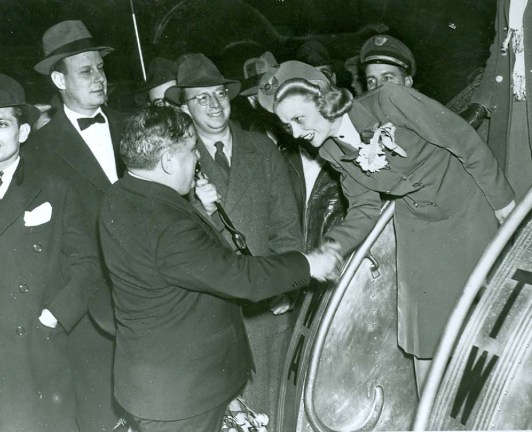
Mayor greets stewardess

Mayor LaGuardia greets a “stewardess” upon the arrival of the first scheduled flight, a Transcontinental and Western Air (TWA) DC-3 from Chicago, which landed just after midnight on December 2, 1939.

By 1939, Mayor La Guardia had finished building his new airport in Queens, and he attracted the airlines with below-cost leases.  On the day the airport officially opened as the New York Municipal Airport – LaGuardia Field, the mayor addressed some 325,000 spectators attending the ceremony while three planes carried banners across the sky: “Name it LaGuardia Airport!”

MAT-Historic-Buildings-Survey

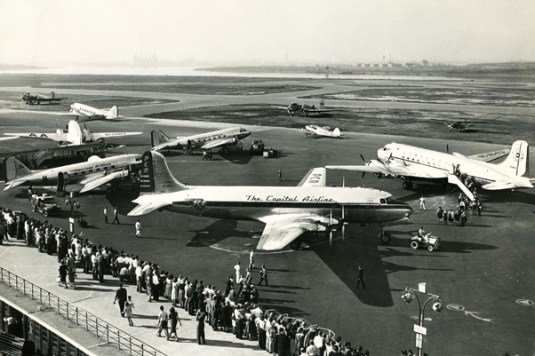
LaGuardia Airport circa 1953

Although the crowds loved it, and that’s what everyone would call the airport anyway from that day forward, the name wasn’t officially shortened to LaGuardia Airport until 1953.

During La Guardia’s term in office, he used his charismatic personality, domineering leadership style and considerable clout with the Roosevelt Administration to garner $1.1 billion in resources, funds that he used not only to build LaGuardia Airport and (Idlewild Airport), now John F. Kennedy International Airport, but also to construct signature infrastructure all over New York City.

Eleanor Roosevelt and Mayor La Guardia

Seated with First Lady Eleanor Roosevelt, Mayor La Guardia maintained close ties with both Roosevelts throughout his administration.

By 1945, the continuing investments needed to sustain development and operations at both airports proved too draining for New York City or the airlines.  Ultimately, La Guardia’s successor, Mayor William O’Dwyer, requested the Port Authority make a study of both airports to determine whether it was feasible for the agency to operate them.  In 1947, the Port Authority signed the lease with New York City, and a year later  the Port Authority assumed responsibility for airport operations and development, adding a new terminal building, a new control tower and an air cargo center.

LGA-1948-via-PWB_FEATURE

LaGuardia Airport in 1948, the year the Port Authority assumed responsibility for operations and development at both LaGuardia and Idlewild Airports.

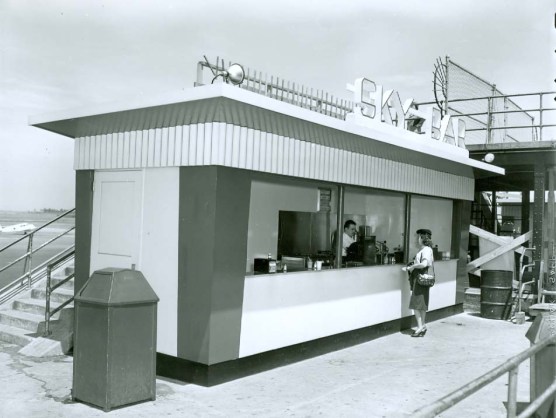
LGA_Hot Dog Stand at Observation Deck 1948

A hot dog stand called the Sky Bar opened in 1948 at LaGuardia Airport. Even after its construction was completed in 1939, Mayor La Guardia remained a staunch advocate of increasing aviation capacity in NYC.  In 1943, the City broke ground for Idlewild Airport, which opened in 1948, although Mayor LaGuardia died in 1947 before it opened.

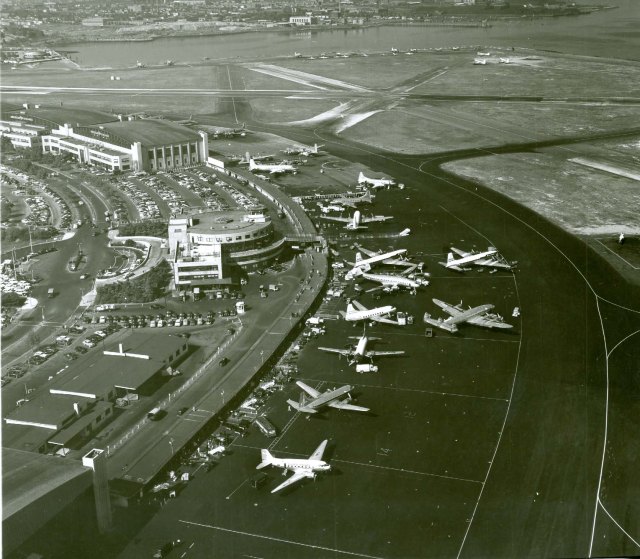
LGA_1953

An aerial view of LaGuardia in 1953.

LaGuardia was a large and impressive airport for its time, with its six hangars the largest in the world in 1939.  By the 1960s, however, the main terminal building, located adjacent to the Grand Central Parkway, was outdated and bursting at the seams.

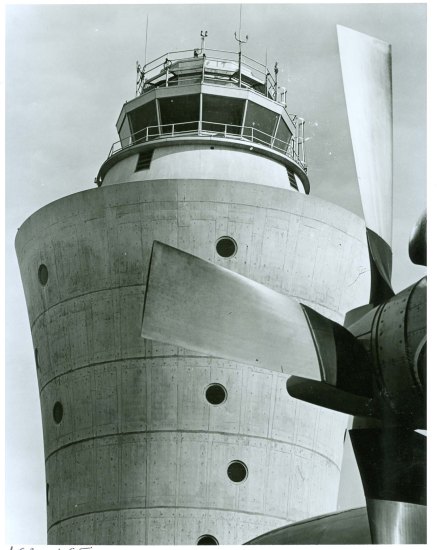
A new Central Terminal Building (CTB) replaced it in 1964. The $36-million, 1,300-foot-long structure was completed in time for the 1964-65 World’s Fair at nearby Flushing Meadows. With it came a rooftop observation deck running the full length of the terminal. The airport’s signature control tower, a circular design 150 feet high, had been completed two years earlier.

Observation Tower

The second control tower at LaGuardia Airport opened in 1964.

The central terminal building saw further expansions in 1967 and again in the fall of 1992, when the west wing was extended by 55 feet for greeting areas, baggage belts and other operational requirements.

The end of 2006 saw the beginning of construction for a replacement control tower in which operations began in 2010.  The new structure’s height has air traffic controllers standing 198 feet high in a much more noticeable structure that is on the highway side of the central terminal.

In 2015, more than 28 million passengers used LaGuardia Airport, making it the premier business airport in the business capital of the U.S., the busiest airport in the country without non-stop service to Europe.


Posted in airport history, airport terminals, airports, aviation, aviation geeks, historic photographs, history, history of aviation, international flight, John F. Kennedy International Airport, LaGuardia Airport, modernized airport, NYC, PANYNJ, Port Authority of New York & New Jersey, Uncategorized | Tagged , , , , , , , , | Comments Off on LaGuardia Airport: Flashback to the Past