Goethals Bridge Stay Cables: the Muscle of a New Bridge-building Era

By Neal Buccino, Media Relations Staff

Good bones are important.  But you can’t lift heavy weights without muscles of steel.

Such is the case for a class of bridges called cable stayed bridges, of which the new Goethals Bridge, under construction between Staten Island, N.Y. and Elizabeth, N.J., promises to be this region’s most visually striking example.

This month, the new bridge is finally gaining its muscles – specifically, its powerful stay cables.  Workers have installed the first of what will be 144 stay cables, each up to 400 feet long and 13 inches in diameter.

They will connect the bridge’s four sets of massive, V-shaped concrete towers to its twin roadways. As a constant stream of cars and trucks crosses the bridge, the cables’ extreme tension will transfer the weight of those vehicles from the roadways to the towers – the bridge’s concrete backbone. The towers, in turn, will channel all of the compressional force into the earth.

As shown in these photos by the Port Authority’s Mike Dombrowski, stay cable installation is a painstaking process.

A - preparing the pipe

Before installing the first stay cable on the new Goethals Bridge, workers prepare the high-density pipe that will serve as its outer shell.

Workers begin by threading a single strand – consisting of several steel wires tightly wound together and surrounded by a protective sheath – through a wide, high-density tube that will serve as the stay cable’s outer shell. A crane then hoists this arrangement up to a porthole-like anchor embedded in one of the concrete towers. The other end is fitted to a bazooka-shaped anchor at the bridge’s roadway. More of these strands are threaded through the tube, one by one, and anchored at the required level of tension.
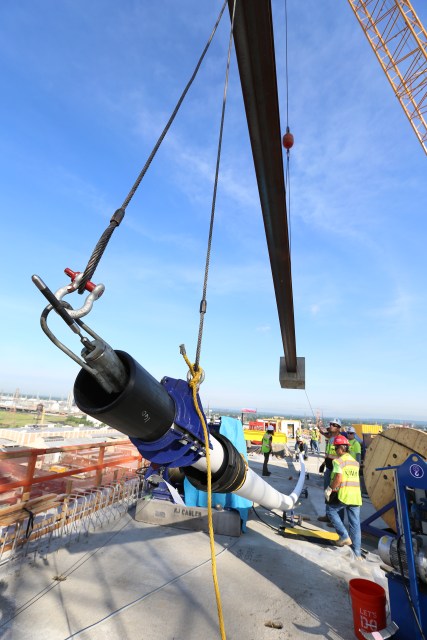
B- cable hook

A crane begins to haul the first stay into place on the Goethals.

As the process continues over the coming months, the stay cables will be installed in sets of four, with two pairs on either leg of the towers.
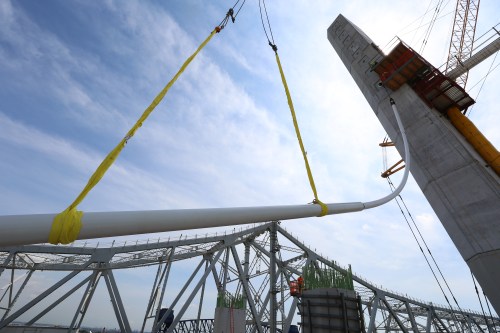
C - cable lift

A crane hauls the first stay cable into place.

As they are installed, alternating between the New Jersey and New York sides of the Arthur Kill, each set will provide the structural strength necessary for workers to build out a new section of roadway.  It will continue through the summer and fall, until the roadways extending from Elizabeth and Staten Island meet in the middle.
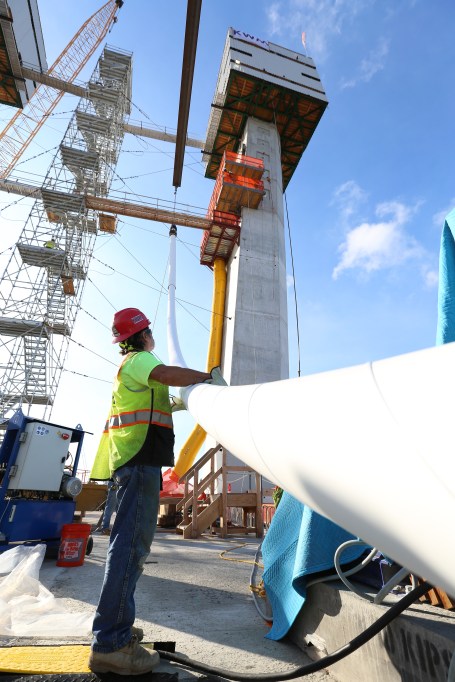
D - cable lift

Standing on the new bridge’s roadway, a worker helps hold the stay cable steady during installation.

The new bridge’s eastbound roadway is expected to open early next year, at which point the existing Goethals Bridge – 88 years old and functionally obsolete – will be taken out of service. The Goethals replacement project will be complete, with both eastbound and westbound structures carrying traffic and the old bridge demolished, in 2018.
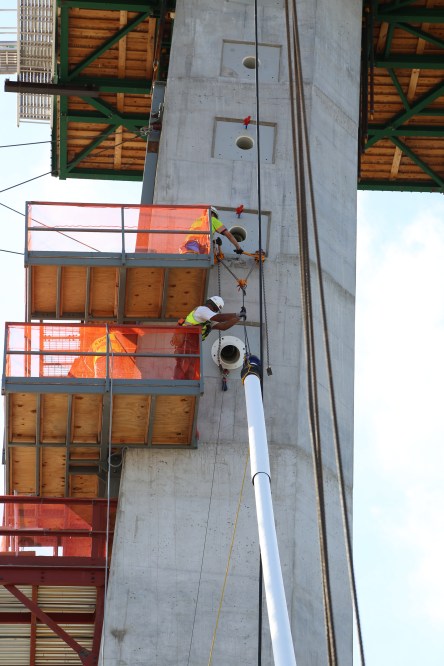
E - tower anchor

Workers guide the stay cable toward its porthole-like anchorage in the 272-foot concrete tower.

Extending out from the towers like giant harp strings, the Goethals stay cables are designed to embody the strength, endurance and beauty of a new era of bridges.
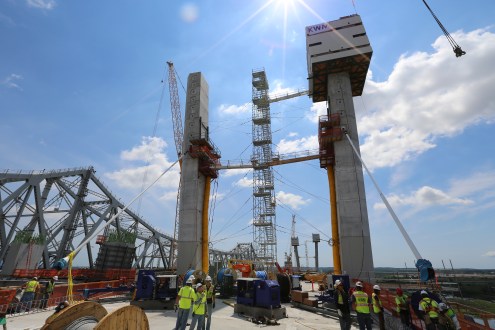
G - both cables in place

The outer shells of the first two stay cables are in place.  Bundles of steel cables, tightly twisted and covered in a protective coating, will be threaded through the pipes, then anchored at high tension.
Posted in bridges, cable-stayed bridge, Goethals Bridge, Goethals Replacement Bridge, NY/NJ region, NYC, Port Authority of New York & New Jersey, stay cable bridge, Uncategorized | Tagged , , | Comments Off on Goethals Bridge Stay Cables: the Muscle of a New Bridge-building Era

JFK International Airport: Terrapin Adventures on Runway 4L

By Jessica Hershman, Media Relations Staff

Photos by Mike Dombrowski

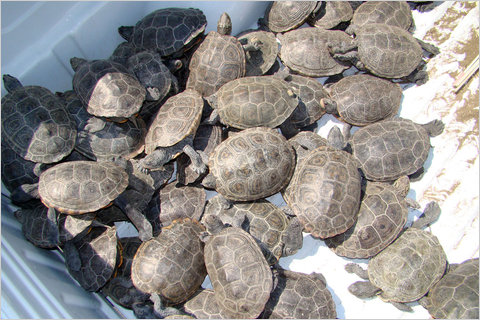
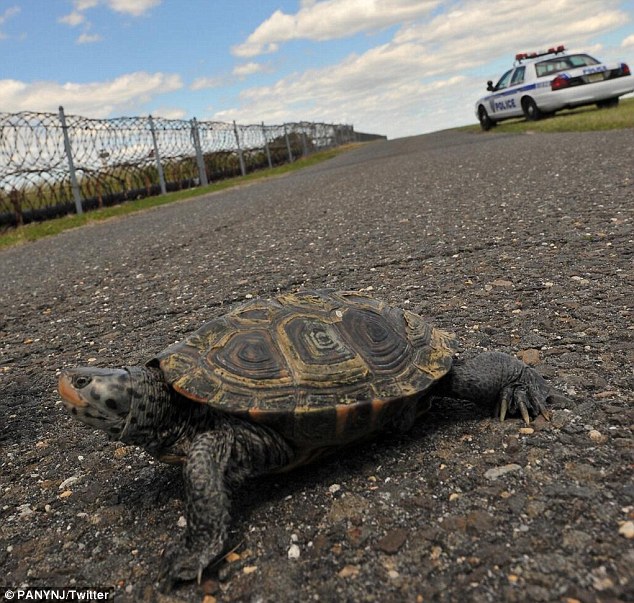
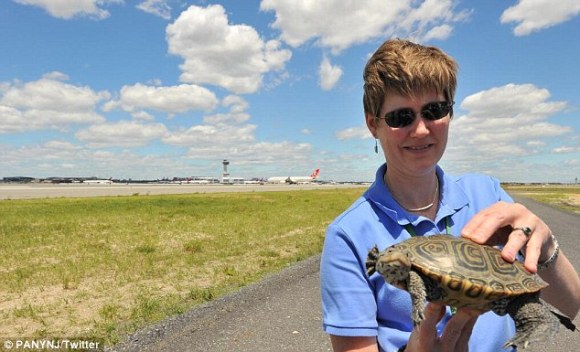
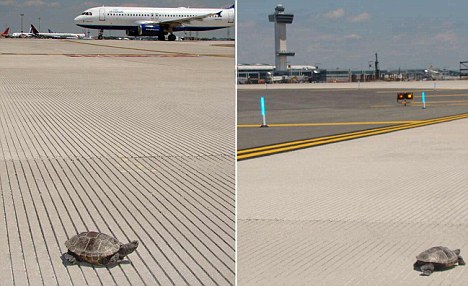
Even as Port Authority Wildlife Biologist Laura Francoeur and members of her team mark and then release to safety hundreds of Diamondback Terrapins that invade the runways at JFK Airport annually, nobody is sure exactly why they come. The answer defies easy explanation.

article-0-1A57A015000005DC-759_634x385

Biologists such as Francoeur and her assistant, Melissa Zostant, a Hofstra University Master’s candidate writing her thesis on why the turtles prefer JFK, believe the likely reason the turtles come ashore from Jamaica Bay is because of the sandy soil, which is above the high tide line.

“The original airport planners never could have imagined that all the sandy fill they put down would one day become the perfect nesting habitat for terrapins,” Francoeur said.

article-2009791-0CCBF60D00000578-896_468x286

“I think the terrapins also are attracted to Joco Marsh and the area surrounding the airport for the food and habitat provided.  They then nest at JFK since that’s the closest land that appears to have good nesting habitat – sandy, loose soil,” she said.

“The marsh around JFK is healthier than other marshes in the area too, which provides an ideal source of food,” said Zostant. “The turtles may prefer JFK because the fencing around the airfield keeps out raccoons, who prey on hatchlings and eggs.”  Once ashore, females use their powerful back legs to dig a hole, dropping their huddle of eggs into the hole, and then covering it up. The nests are then tagged and an enclosure is constructed to protect the eggs, leaving a small opening through which the hatchlings can escape.

TURTLE-blog480

In 2012, JFK personnel constructed a barrier from plastic piping to keep out the terrapins along much of Runway 4L, because the dozens of turtles crossing the runway were causing flight delays. The number of turtles on the airfield has gone down dramatically since fencing was installed.

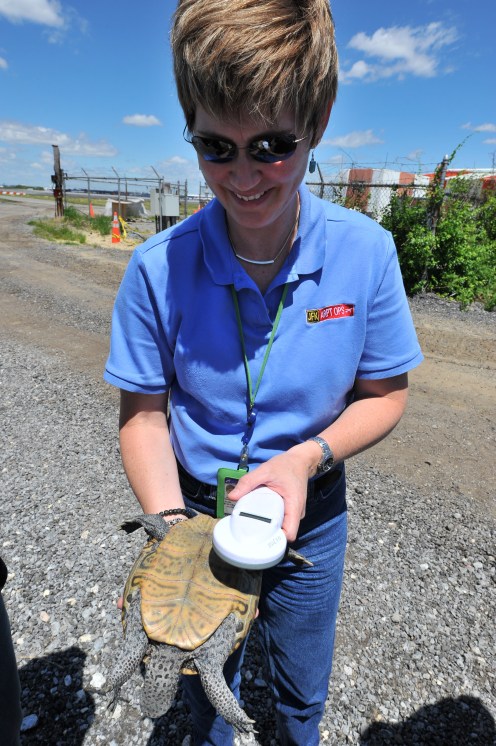
If turtles get past the barrier, the Port Authority wildlife team capture the animals manually and place them in the beds of JFK trucks before inserting microchips beneath their skin. Through this method, a turtle is assigned a number that is recorded each time the turtle is captured.  The microchip does not have GPS capability, however, and cannot track the movement of the terrapins.

The animal is marked with a single, triangle-shaped notch. Each year the notch is placed in a different location, but the terrapin only receives one notch over its lifetime, the first year it is captured.  The marking provides scientists with information about the year the terrapin was first collected, and it also provides a visual aid to know whether a terrapin has been collected previously.

jfkdiamondbackturtles-125-6-12-13

According to the Port Authority, 501 terrapins have been processed in 2016 to date. Since the terrapin program began in 2011, a total of 2,266 new terrapins have been processed.

Terrapins have green and yellow rings on their shells, which are encircled by actual ridges that are counted to estimate the age of the animal similar to the rings encircling a tree trunk. To assist in the counting of a turtle’s rings, a concoction of acids, salts and brown seaweed is applied to the turtle’s shell, creating a casting of the shell in much the same way a dentist creates a dental impression of his patient’s mouth.  The turtle is then returned to the wild.

article-0-1A579E71000005DC-59_634x603

Many of the terrapins at JFK are between seven and nine years old, which makes them younger than at other locations on Jamaica Bay, but a significant number of the terrapins are much older.

“It’s unclear whether the terrapins recognize the aircraft and vehicles as predators, but if they have previously nested successfully at the airport, that predator interaction is one from which they were able to return alive so they repeat it and it doesn’t pose a deterrent to them,” said Francoeur.

Posted in airport terminals, airports, aviation, John F. Kennedy International Airport, Uncategorized | Tagged , | Comments Off on JFK International Airport: Terrapin Adventures on Runway 4L

Port Authority: How to Speak Like a Native

By Port Authority Media Relations Staff

Take the George or the Martha past the Necklace, that’ll get you across the GWB. Heading through the Lincoln Tunnel to the Sputnik, keep an eye out for the Toothbrush.

Simple, right? Only if you speak Port Authority.

Every institution has its own language peculiarities, and the Port Authority is no exception. So, as a public service, here’s a short tutorial of nicknames commonly used throughout the agency. Origins and meanings to some will seem obvious; others have been lost to time and obscurity.

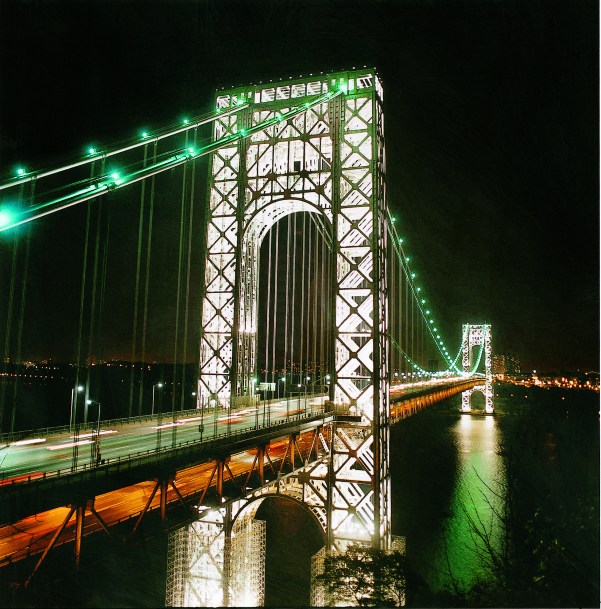
The Necklace – This refers to the 156 lights that adorn the George Washington Bridge cables, which can change in color to reflect special occasions – green for Girl Scouts Centennial Celebration recently, for instance, or pink during Breast Cancer Awareness Month in October.

AThe George – Upper level of the GWB.

The Martha – Lower level of the GWB.

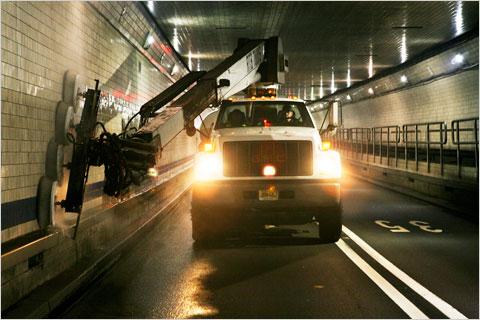
Toothbrush – A favorite of seasoned bridge and tunnel veterans, this is what they call the truck that is used to scrub the Lincoln and Holland tunnels. The Toothbrush is so named because it literally scrubs clean all of the tunnels’ white tiles with soap and water.

18lens_480

Sputnik – Back in 1957, about the same time the Russian satellite was orbiting the earth, the Port Authority created the first counter-flow bus lane on 42nd Street and Dyer Ave to improve travel times of outbound buses leaving the Port Authority Bus Terminal. Lots of things have changed over the years, but two certainties remain — counter-flow lanes keep the traffic moving, and Sputnik is a weird nickname for a counter-flow lane.

T-Rex – Left to its own devices, the Port of New York & New Jersey would silt up like the glass bulb of an hourglass, leaving cargo and cruise ships unable to navigate the harbor to other ports. To maintain adequate channel depth, a variety of dredging tools are used, but none more impressive than one of the biggest and most bodacious barge-mounted dredges in the world – T-Rex, with metallic teeth capable of biting down to 65 feet.

Donkey Trail – Initially a dirt road at Newark Liberty International Airport created as a short cut from a restricted service road on-to the aircraft movement area. Over the years, it’s been paved and now has the appropriate signage, but it’s never lost the original name.

Doghouse – This term described the 4-5 stories of temporary steel built by ironworkers at One World Trade Center, which allowed them and the construction cranes to work above the roof of One WTC.

Housetops – From our friends at PATH: the manufactured manganese plates that serve as a guard rail in a rail switch. These help guide the train wheels through the track switch while also protecting the opposite switch point.

Dogbones –Another from the world of PATH: The mechanical fasteners used to join two long concrete timbers in construction that would normally be too large to handle as one. One of those nicknames that seems a more natural – and much easier – way to describe this useful tool.

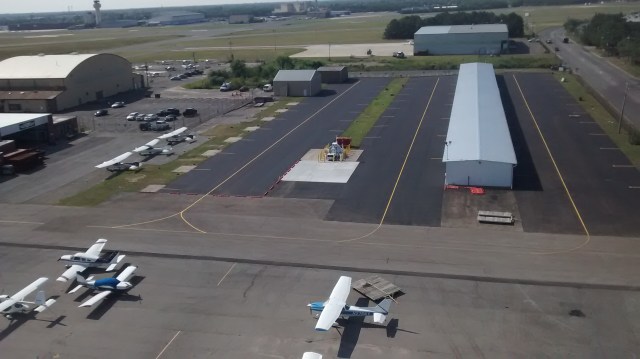
Sheep Run – This expression can be heard among the ground crew in and around airport terminals. It was coined by airline pilots to distinguish between themselves and the “Sheep Run,” the General Aviation area for private planes at an airport.

Photo-%20Sheltair%20ISP%20facility%20Upgrades

General aviation area


Posted in George Washington Bridge, Holland Tunnel, Hudson tunnels, John F. Kennedy International Airport, LaGuardia Airport, Lincoln Tunnel, Newark Liberty International Airport, NY/NJ region, One World Trade Center, PANYNJ, PATH, PONYNJ, Port Authority of New York & New Jersey, Port of New York & New Jersey, Uncategorized, World Trade Center, World Trade Center Transportation Oculus, WTC | Tagged , , | Comments Off on Port Authority: How to Speak Like a Native