Bringing Christmas to the Troops

By Cheryl Albiez, Media Relations Staff

Rockin’ around the Christmas tree, have a happy holiday. Everyone’s dancin’ merrily in a new old fashioned way.  Rockin’ around the Christmas tree let the Christmas Spirit ring.  – Lyrics and music by Johnny Marks

Traditional holiday celebrations and joyous memories are often centered around the Christmas tree. In New York, visitors from all over the world gather around the nation’s most famous Christmas tree at Rockefeller Center, the epicenter of the city’s holiday celebrations.

So what happens when celebrants can’t go to the tree? DHL, with help from the Port Authority, are making sure the trees go to them – in this case, to U.S. troops serving in Afghanistan, Iraq, Kuwait and Bahrain.

Since its inception in 2004, DHL’s Operation Holiday Cheer has delivered hundreds of Christmas trees, holiday decorations and messages of support to U.S. troops serving abroad, with flights originating from John F. Kennedy International Airport each year.
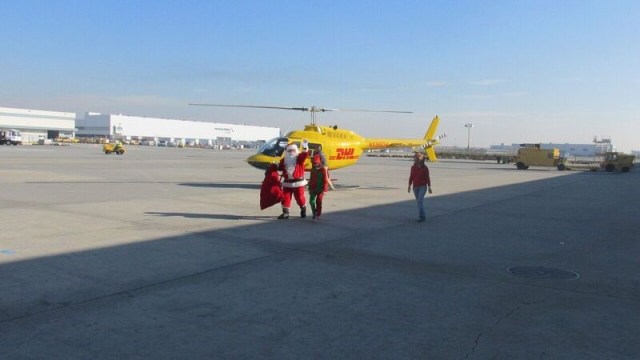
santa-with-dhl-helicopter

“It is an important tradition for all of us in DHL—the chance to work with community partners and deploy our global shipping network—and one we look forward to every year,” said Greg Hewitt, CEO of DHL Express U.S.. “For me personally, it’s one of the best presents I receive, because it’s a chance to give the gift of thanks to our soldiers.”
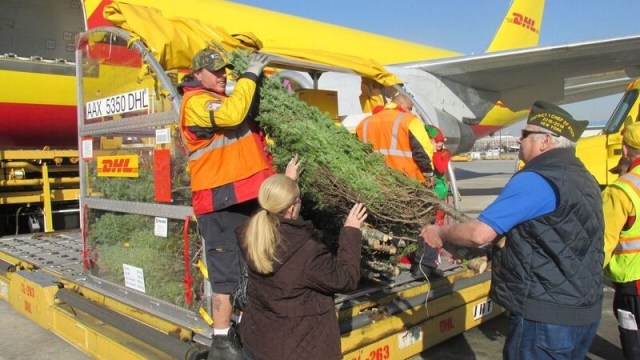
removing-tree

Operation Holiday Cheer began when the mother of a soldier asked Dees’ Nursery, located in Long Island, if she could purchase a Christmas tree to send to her son in Iraq. Although the nursery was willing to donate the tree to the woman, shipping would be expensive. With the help of a local businessman and a partnership with DHL Express and the Nassau County community, Operation Holiday Cheer was born.

“I am grateful to DHL for bringing this great program to our airport. This is a wonderful way to thank our military for their service and for the sacrifices they make year-round,” said Michael Moran, General Manager of John F. Kennedy International Airport. “We are helping make memories.”

Earlier this week, 500 Christmas trees donated by Dees’ Nursery, along with donated menorahs, gifts and decorations, were loaded onto a DHL 777 aircraft on a non-stop flight to the Middle East from JFK. Local community and veteran groups, as well as the Girl Scouts, performers from the USO Show Troupe, schoolchildren and Nassau County dignitaries — and, of course, Santa – all came to help and spread the holiday cheer.
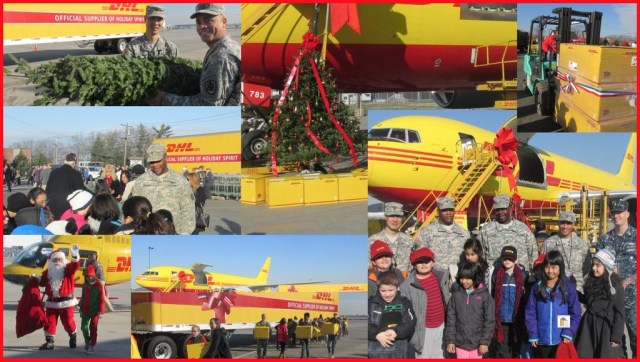
collage

Since the program began, more than 100,000 soldiers at hospitals, headquarters and bases overseas have received 9,000 trees, 450,000 feet of lights, hundreds of pounds of tinsel and 500 ornaments, holiday cards and menorahs.

“In delivering our heroes a tree, we are really sending a special holiday moment to cherish,” Moran said.

Posted in airport terminals, Christmas, DHL Express U.S., John F. Kennedy International Airport, Kennedy Airport, Kennedy International, Port Authority of New York & New Jersey, Port Authority of New York and New Jersey, Port Authority of NY/NJ, Uncategorized | Tagged , , , , | Comments Off on Bringing Christmas to the Troops

Maintaining the George Washington Bridge, One Bolt at a Time

By Roz Hamlett, Portfolio Editor

Frank Minervini oversees the structural maintenance of the George Washington Bridge — from bolts and joints to suspender ropes and cables, as well as the 77 lane miles of roadway, the tunnels, toll booths and the bus station at the east end of the span.

45075-09-120

Photo by Mike Dombrowski, Port Authority

It’s a labor of love for the 27-year Port Authority veteran, who leads a team of six workers covering every inch of the bridge. And it’s no easy task, given the dynamic nature of the bridge environment and the physically demanding work that must be performed.

“We treat every job as if our personal signature was going on it,” Minervini said. “In inclement weather especially, we feel we have a responsibility to all the nurses, doctors, fire, police and first responders, as well as our fellow Port Authority employees, who need to cross the bridge to do their jobs.”

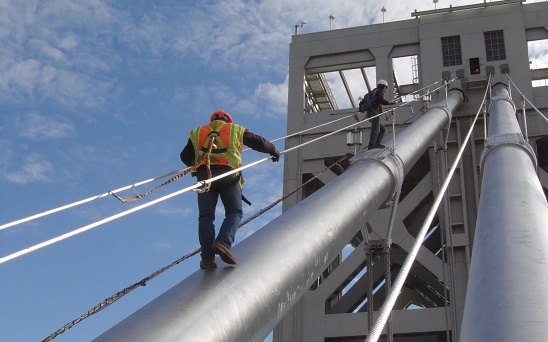
Working at the GWB has never been for the careless or faint of heart. To qualify for a spot on the structural maintenance crew, candidates must pass written and physical tests, including walking to the center of one of the bridge’s enormous barrel cables and straddling it.

gwbridge_walkingupcables

Those selected need to be able to navigate treacherous cables and ropes, withstand the driving snow, sleet and rain that comes with the job, and conquer the bridge’s breathtaking heights, which can send shivers down the spine of even the toughest worker.

“You may have it in your heart, but you have to pass the height test,” said Fred Grover, Minervini’s deputy. “It’s dangerous work, but we have the angels on our shoulders.”

img_4227

Structural Maintenance team members left to right:  Fred Grover, Frank Minervini and Bill Reilly

Assisted by the Port Authority’s Engineering Department, the structural maintenance crew performs all types of structural repairs generated by inspection reports. These include bi-weekly visual inspections and quarterly imaging of the finger joints, which are sensitive to temperature changes and prone to breakage.

The finger joints in the bridge road surface expand and contract vertically in response to the weather, and give the bridge flexibility.

Working at heights up to 600 feet above water in wind gusts that can approach 30 miles per hour, the team conducts some 150 hands-on inspections annually to make sure the 85-year-old bridge maintains its structural integrity. During the winter, there’s the dangerous task of knocking off ice that can collect everywhere, including the bridge’s four massive barrel cables.

czkq29kweaelnv

Blowing snow off the roof of the bus station

Minervini, who described himself as “in awe of the structure and its importance to the region” when he started work there in 1999, said his team’s approach to keeping the bridge structurally sound and safe for drivers comes from a pride of ownership.

“We take ownership of the facility and we care about what we do,” he said.

Posted in George Washington Bridge, George Washington Bridge Bus Station, GWB, Hudson River, Port Authority Trans Hudson, suspension bridge, Uncategorized | Tagged , , , | 2 Comments

Inside the Materials Engineering Unit: Putting Concrete to the Test

By Neal Buccino, Media Relations Staff

The lab near the Holland Tunnel opening in Jersey City resembles a kind of torture chamber, reminiscent of something a Bond villain might consider as a hideout. Inside, devices that could have come from a sci-fi movie pulverize concrete, electrify it, freeze it and thaw it – and then freeze it again to the point of destruction.

No, it’s not the set of a blockbuster Christmas movie release. It’s where the Port Authority keeps its Materials Engineering Unit lab, and the activity within is done all in the name of quality control and, more importantly, public safety.

concrete-photo-a

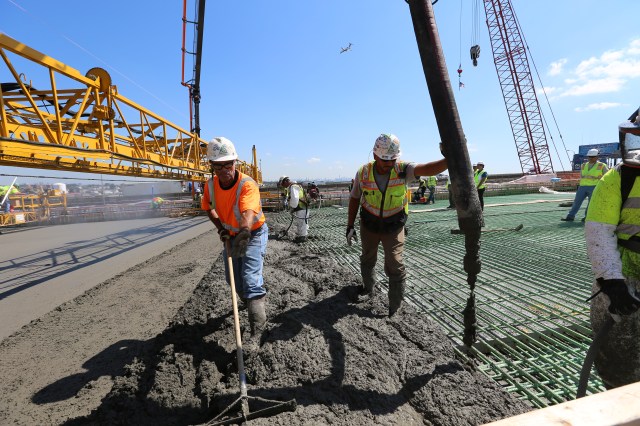
Concrete being poured for Goethals Bridge Replacement Program.  The thick, muddy liquid is poured over green steel rebar, then smoothed into shape to create an approach for the new bridge.  Photo by Mike Dombrowski, Port Authority

The MEU performs a vitally important job for the Port Authority. The agency requires safe, high-quality construction materials for products as varied as the Goethals Bridge replacement, the Bayonne Bridge “Raise the Roadway” initiative, a runway replacement at John F. Kennedy International Airport, and other investments in concrete, steel and asphalt.

Casimir Bognacki, the Port Authority’s materials chief, says the lab’s mission is to make sure all building materials used at agency facilities meet the high standards required in each contract and promised by the manufacturers.

For concrete used in transportation structures, the most important qualities are “durability first, and strength second,” Bognacki said.

concrete-photo-e

Casimir Bognacki, Chief of Materials in the Port Authority’s Engineering Department, examines a concrete puck, the size of a Big Mac, that’s about to undergo the electrical test.  Photo by Neal Buccino

Concrete doesn’t work alone. To create a roadway, tower or building, concrete that is uncured (or liquified) must be poured around steel rebar. If the cured concrete isn’t durable enough, water can infiltrate its pores and corrode the steel. Rusted steel will expand up to four times its original volume, breaking up concrete and setting up a cycle of further deterioration.

To get a sense of how the testing process works, let’s start with the Goethals Bridge replacement project. On a recent day in Elizabeth, N.J., workers poured 260 cubic yards for a segment of the roadway that will approach the new bridge. That’s the equivalent of filling four backyard swimming pools with concrete.

Engineers from the MEU scooped random samples of the thick, muddy liquid. Some they tested on site with a metal gallon jug connected to an air meter. This will ensure the proper distribution of tiny, pinpoint-size air bubbles needed to protect against weather-related damage.

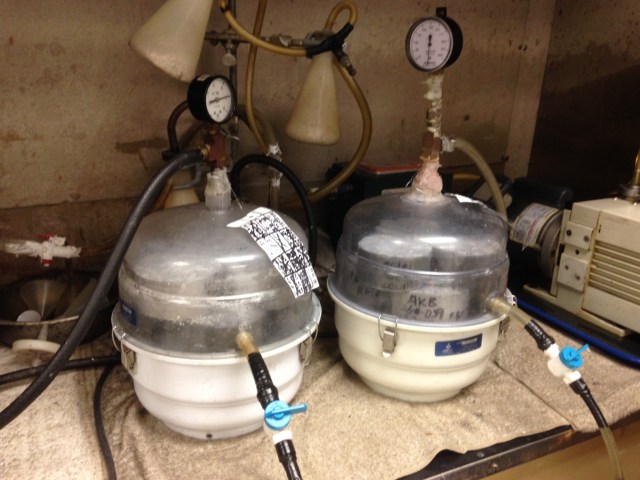
The engineers took more concrete samples back to the lab. There they will cure and solidify for about a month, before undergoing intricate torture. There is the electrical test, which requires some prep work. Concrete pucks the size of Big Macs are placed in a vacuum that sucks the air out of every pore and crevice. Then they are fully saturated with water – and, finally, clamped between the poles of a battery.

concrete-photo-f

To prepare for the electrical test. chunks of concrete are first placed inside these pressure cooker-like contraptions.  After all traces of air have been sucked from every pore and crevice, they will be saturated with water.

Why such an involved process? Concrete resists the flow of electricity, but water is a natural conductor. The amount of current that flows through is a good measure for the amount of water that has permeated the concrete. And that’s a good measure of vulnerability to the cycle of water infiltration and corrosion.

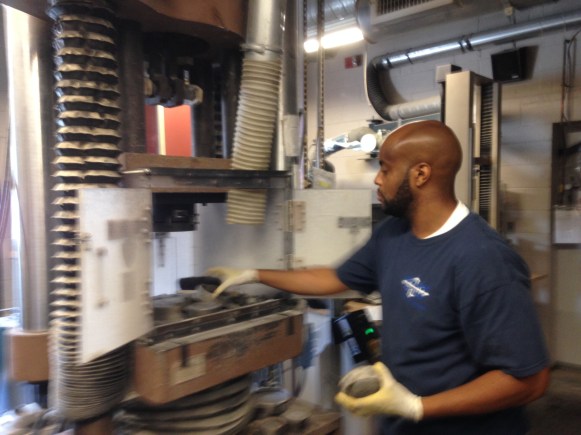
There is also the crushing test. Concrete cylinders are placed in a compression chamber and subject to slow, pneumatic pressure until they break. Not an easy feat as some of these concrete samples, roughly the size of a junior league football, can withstand pressure of more than 16,000 pounds per square inch.

concrete-photo-h

Technician Jared Vassell prepares a concrete sample for testing in the compression chamber, which subjects concrete samples to pneumatic pressure until they break.  Some samples withstand a load of 200,000 pounds.  Photo by Neal Buccino

Then there is the freeze-thaw test, which subjects concrete samples to 300 freezing and thawing cycles – equivalent to 30 years of hard winters – over six weeks. Concrete that is not durable will break apart during this process.

“Concrete is a universal constant throughout just about every one of our facilities,” Bognacki said. “This lab exists to make sure the public is getting what it needs, and what the Port Authority demands, in terms of quality and safety.”


Posted in Goethals Bridge, Goethals Replacement Bridge, Holland Tunnel, Jersey City, John F. Kennedy International Airport, PANYNJ, Port Authority, Port Authority of New York & New Jersey, Uncategorized | Tagged , , , | Comments Off on Inside the Materials Engineering Unit: Putting Concrete to the Test