WTC’S Koenig Sphere, Back Where It Belongs

By Joseph Iorio and Ashley Germinario, Media Relations Staff, photos by Mike Dombrowski and Catherine DeJesus

After more than 15 years away, the celebrated Koenig Sphere that once stood between the Twin Towers of the World Trade Center is back home. It has resettled nicely into the old neighborhood, at a permanent location in Liberty Park not far from its original site.

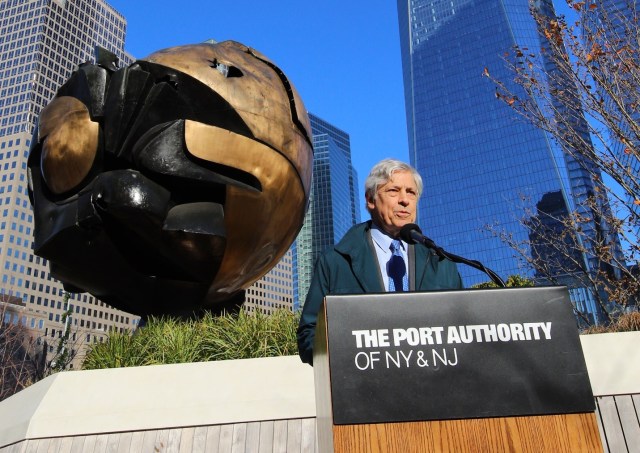
In a ceremony earlier today to mark its return to the WTC, Port Authority Executive Rick Cotton spoke of what the iconic sphere has meant to the people who visit, work and live within the WTC community over the years.

“As the new World Trade Center began to take shape during the past decade, it became crystal clear that the sphere needed to come home. Today, we rededicate this sphere in its permanent home in Liberty Park, where it will be housed in perpetuity for future generations,” said Cotton, who noted that the Northeast Region of the National Park Service has recommended to the Secretary of the Interior that the sphere be designated a national landmark.
0003

Port Authority Executive Director Rick Cotton at Koenig Sphere ceremony

Cotton was joined in offering remarks by Michael Burke, whose brother Capt. William F. Burke, Jr. of Engine Co. 21, died on 9/11; Alice Greenwald, president and CEO of the National 9/11 Memorial Foundation, and Christiane Fischer, president and CEO of AXA Art Americas Corporation, the insurance company that owns the sphere.

Burke, a driving force in the campaign to relocate the sphere from its most recent home in Battery Park, described the structure as “a beautiful tribute to the 84 members (of the Port Authority) who lost their lives on 9/11.”

0004

PA’s Color Guard and special guests, during singing of the National Anthem

For residents, workers and the many thousands of tourists visiting the area who’ve had the chance to view the sculpture – created by the German artist Fritz Koenig – it remains a powerful sight to behold.

“It’s remarkable,” said Michael Lucas, a Newark, N.J resident, during a recent tour of the landmark’s new home. “I think this sphere represents the resiliency of New Yorkers and Americans. After everything that was destroyed on 9/11, for this to still be standing – it’s just amazing. I think it really adds a lot of character to Liberty Park.”

The sphere today…

…and as it was pre-9/11, anchoring the plaza outside the Twin Towers

Originally installed at the foot of the towers at Austin Tobin Plaza in 1971, the sphere, 25 feet high and weighing 25 tons, was damaged extensively during the 9/11 attacks. In the ensuing years, it has come to symbolize the toughness and courage of the region and its people. The sphere was moved to Battery Park in 2002, with the intention the park would serve only as a temporary home. In August 2016, the Port Authority Board of Commissioners authorized its relocation to the WTC site.

Before his death earlier this year at the age of 92, Koenig was informed that his masterpiece was finally returning to the WTC, and was said to be overjoyed and thankful that its future would be in good hands.

Visitors to the landmark concur. “I saw it when it was in Battery Park, and it just wasn’t the same,” said Anders Trieber, a frequent visitor to the city and the WTC neighborhood. “This is where it belongs.”

For more on today’s ceremony, please watch here.

Posted in Uncategorized | Comments Off on WTC’S Koenig Sphere, Back Where It Belongs

Lights, Camera, Accidents: Full-scale Training at the GWB

Photos and video by Rudy King, Media Relations Staff

The George Washington Bridge is the world’s busiest bridge, with more than 100 million vehicles crossing the span each year. That volume of traffic, under the best of circumstances, means a lot of accidents will occur – some simple fender-benders, others more serious and even deadly.

To prepare for worst-case scenarios, the GWB hosts periodic, full-scale emergency response drills, directed by the Port Authority’s Office of Emergency Management (OEM). These exercises bring together members of the Port Authority Police Department, the agency’s Operations staff and emergency response representatives of federal, state and local agencies.

The OEM creates these elaborate exercises, which take place at all Port Authority facilities, to test emergency plans for mutual aid response and enable personnel from different emergency response organizations to train together and validate response procedures.

With sirens blaring, lights flashing and radio communications squawking, the multi-agency response team conducted such an exercise on a recent early Sunday morning along the bridge’s lower level. Volunteer “actors” were sprawled across the roadway near flipped-over cars, in makeup that simulated car injuries. The scene seemed as much a live-action movie set as an emergency response drill designed to save lives and get medical attention quickly to those in need.

Check out the video and photos below for a deeper look at the high drama of a GWB training exercise:

This slideshow requires JavaScript.

Posted in George Washington Bridge, GWB, PAPD, Uncategorized | Comments Off on Lights, Camera, Accidents: Full-scale Training at the GWB

The Holland at 90: A Drive Down Memory Lane

By Media Relations Staff

Today marks the 90th anniversary of the opening of the Holland Tunnel, the first trans-Hudson vehicle crossing linking New York and New Jersey and designated as a National Historic Landmark by the U.S. Department of the Interior in 1993.

The Holland has had its share of unique, innovative and entertaining moments over the past nine decades.

 Seven years in the making. The New Jersey Interstate Bridge and Tunnel Commission and the New York State Bridge and Tunnel Commission decided they needed something new, different and more efficient to move traffic between the two states. On October 12, 1920, construction began on what initially was called the Hudson River Vehicular Tunnel.

New hands on the wheel. While the two state commissions were the original operators of the new tunnel, their stewardship didn’t last long. In April 1930, the Port Authority of New York & New Jersey – then called the Port of New York Authority – assumed operations of the three-year-old underwater conduit.

Holland Tunnel 001

The Holland Tunnel from the Jersey City side, circa 1930

What’s in a name? Not surprisingly, few thought Hudson River Vehicular Tunnel would last as the project’s permanent name. That honor would go to Clifford Millburn Holland, the first tunnel chief engineer who designed the tunnel but didn’t live to see his dream completed. Holland died of a heart attack the day before the two halves of the tunnels were scheduled to finally connect in October 1924. 

Key to success. Even the President of the United States had a key role, literally speaking, in its unveiling. From his yacht in the Potomac River, President Calvin Coolidge turned a gold telegraph key – the kind used to send Morse code – to signal the parting of two flags situated at the front of the tunnel at 4:55 p.m. And the HT was officially open.

Walk, don’t drive. The tunnel was opened to foot traffic before it allowed cars to pass through. In the first two hours, more than 20,000 people walked the 1.6 miles from the Jersey City side to Lower Manhattan.

 The price was right. The Holland Tunnel cost $48.5 million to build, an extraordinary financial commitment at the time – and a fraction of what it would cost today. If the project were undertaken now, the estimated price tag would be well in excess of $1 billion.

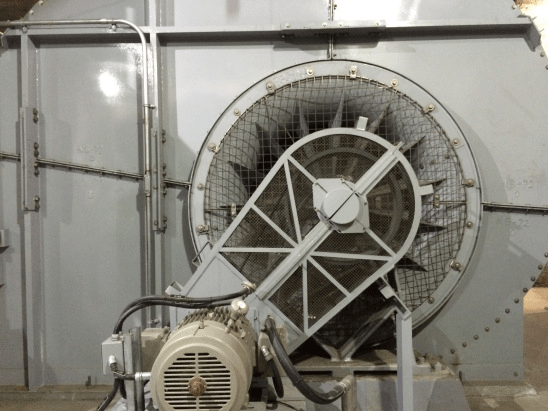
Fanning the fame. None of the Holland’s “firsts” is as important as its celebrated ventilation system. Ole Singstad, one of the facility’s original engineers, designed an automatic ventilation system with a total of 84 blowers and exhaust fans and four ventilation buildings, two on each side of the Hudson. The fans cleared exhaust fumes every 90 seconds. That made the Holland the first mechanically ventilated underwater vehicular tunnel, setting an engineering standard still in use today.

Holland Tunnel 002

One of the Holland Tunnel’s exhaust fans

Driving the catwalk. State-of-the-art ventilators weren’t the only novel idea attached to the Holland. In 1955, the facility’s newest invention, the so-called catwalk car, made its debut. The electric vehicle allowed police to patrol the entire length of the tunnel to avoid getting stuck in traffic.

Holland Tunnel 003

An officer gestures to a motorist in the south tube of the tunnel

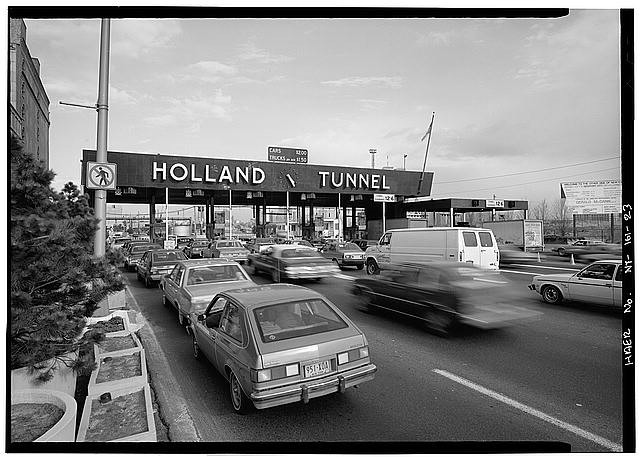
By the numbers. Clifford Holland and his team originally predicted the tunnel eventually would carry about 15 million vehicles a year. During its first full year of operation (1928) the tunnel handled more than 8.74 million vehicles.  By the 13th year of operation, the tunnel was handling more than 20 million cars and trucks, and the tubes today accommodate more than 34 million vehicles a year.

Holland Tunnel 004

A typical commute at the Holland Tunnel in the 1980s

Posted in Uncategorized | Comments Off on The Holland at 90: A Drive Down Memory Lane