

By Gregory Quinn, Special to the Port Authority
Books have been written about it. It inspired a symphony by William Schuman. Famous movies have been filmed there like How to Marry a Millionaire and The French Connection. It’s depicted on a U.S. postal stamp. And a pair of rare falcons even live there.
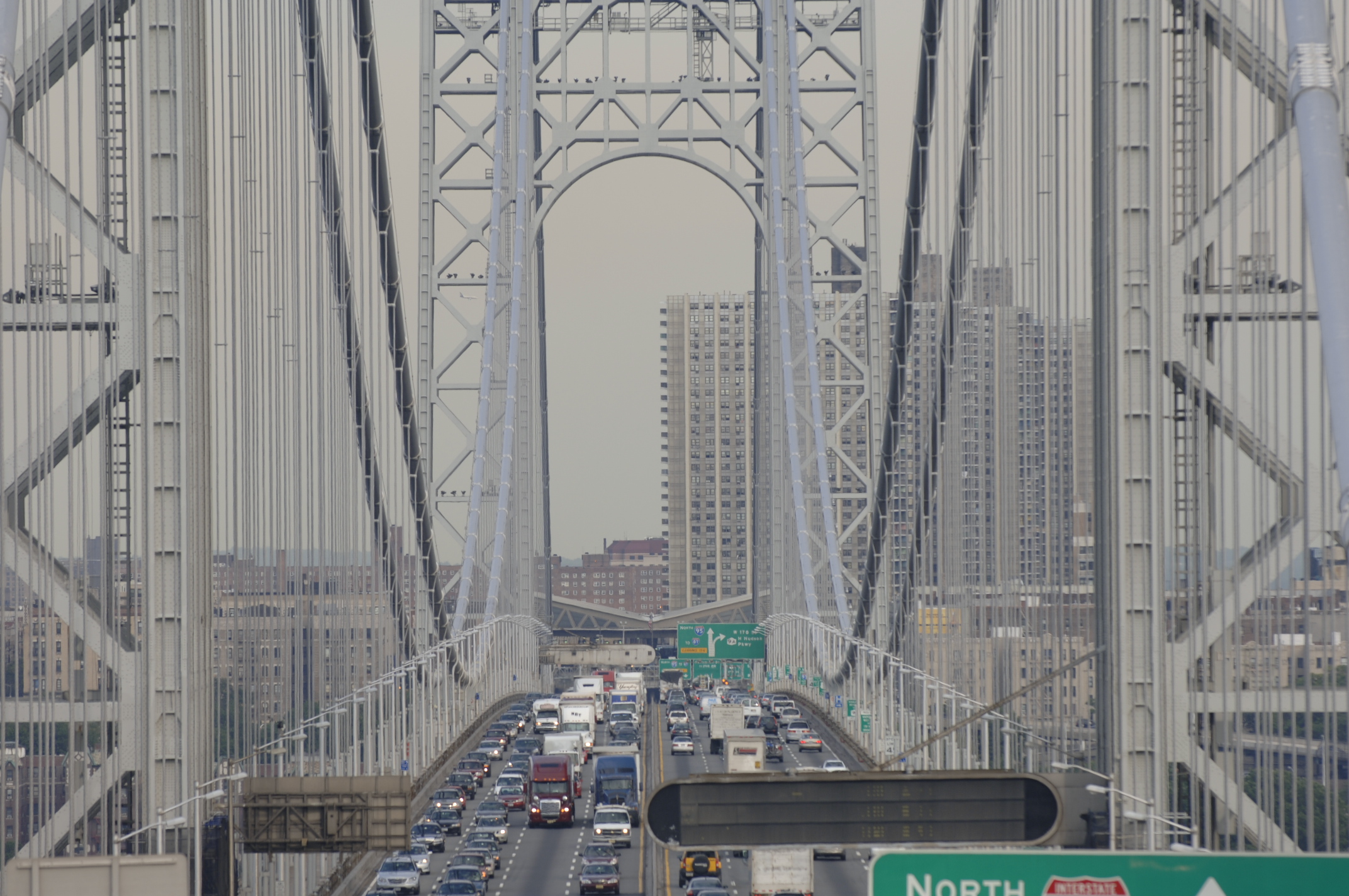
When the George Washington Bridge first opened to motorists in 1931, “the George” was the longest main-span suspension bridge in the world. While this record has been eclipsed, the GWB remains to this day the most heavily traversed bridge on the planet. More than 102 million motorists cross every year.
Owing to its continual usage, Port Authority engineers have been carefully monitoring the state of the George, and – after careful tests and evaluations – determined it was time to replace the suspension ropes, which are made of steel strands.
So, you might be tempted to ask, how exactly do you replace ropes on the GWB without it falling down?
Rope by rope, gentle reader, rope by rope. . .
There are 592 suspension ropes on the George Washington. Each individual rope is closely inspected on a regular basis. Several ropes have been removed, taken to a laboratory and tested for tensile strength, corrosion and general wear and tear.
Using the most rigorous standards, Port Authority engineers have also employed a recently developed technology to monitor corrosion that may develop in the ropes. A sensor sends an electro-magnetic impulse through the rope that provides engineers with an individual signature for each specific rope. This signature shows probable deficiencies that may exist in each rope. The test will be repeated every few years to monitor the signature, i.e., the corrosion level in each rope.
It’s a little like tuning the world’s grandest Steinway piano.
Engineers have removed and tested some ropes up to the point of breaking to measure the tensile strength so they can understand the amount of weight and stretch a rope can handle, after taking into account variables such as weather exposure and stress that can change resistance over time. Changes in the rope’s signature caused by breaking or corrosion of individual wires are indications of imperfection.
After 83 years of virtually non-stop use, Port Authority engineers are now replacing these venerable ropes, which have supported generations of motorists since the Great Depression.
In order to replace the ropes, the engineers put in place a temporary hanging system next to the existing rope. This is done by attaching a sling around the main cable running next to the old rope and then carefully taking the pressure off the old rope (a process called de-tensioning). This technique ensures the bridge is always fully supported while workers switch the ropes. Engineers also study each removed rope to identify problem areas and prevent similar future issues.
Each rope is anchored to the roadway steel members via a socket below the sidewalk. Water, dirt and salt travel down the suspended rope and collect at the socket. While the socket and rope can be cleaned, the dark and wet conditions make them an easy target for rust. Because of this, engineers also are replacing the existing sockets. These new sockets will be anchored to the top of the roadway members, ensuring they remain cleaner and dryer, making them easier to maintain and inspect. Since the ropes’ sockets are located below the sidewalks, this work will be done with minimal impact to the public.
The Port Authority also will install a dehumidification system for the four main cables that are draped over the bridge’s towers. This installation involves wrapping each of the main cables with Hypalon (synthetic rubber) to hermetically seal the cables and protect them from the environment. The system will force the dehumidified air through the wrapped cables on a continuous basis and remove moisture-laden air through exhaust ports. This process will give the main cables a longer life span.
With the advanced technology and research used for this project, the new ropes and dehumidified main cables will be able to last much longer than 80 years.




 portfolio.panynj.gov