Ellis Island Scrapbook

By Roz Hamlett, Portfolio Editor with Gregory Quinn

Photos Courtesy of the Library of Congress Archives

Regular followers of Portfolio will know that we post many historic photographs from the Port Authority vault. Few images of New York history are as iconic as those of Ellis Island during the height of immigration in the first decades of the 20th century. Pictures of huddled masses, in grainy black-and-white, looking simultaneously exhausted and hopeful—these images capture the American Dream.  They are etched in New York iconography as firmly as the Empire State Building or the Statue of Liberty. These newly-arriving Americans — the grandparents and great grandparents of many in this region — were destined to become the major labor source that built both New York City and its transportation infrastructure. We here at Portfolio still marvel at these images, and we wanted to share them with you.

From 1880 to 1924, more than 2 million Eastern Europeans, mainly Catholics, immigrated to the U.S. Of those, immigrants of Polish ancestry were the largest group. During the same period, roughly two million Jews came to the U.S., seeking opportunity and fleeing the political massacre taking place in Eastern Europe. Italian immigration to the U.S. reached its peak of over 2 million between 1910 and 1920. Immigration quotas passed in the 1920s tended to favor earlier generations of immigrants by giving preference to Northern Europeans.

Posted in historic photographs, history, history buffs, New York, Port Authority, Port Authority of New York and New Jersey, Port Authority of NY/NJ, Uncategorized | Tagged , , , , | Leave a comment

Happy Holidays from PATH

By Lenis Rodrigues, Media Relations

Juan Sanvicente, a second-grade student at Jersey City’s P.S. 28, beat out a crowded field of competitors to capture first place in PATH’s Annual Holiday Poster contest with his eye-catching, carrot-nosed snowman.  PATH unveiled the winning poster for PATH’s annual Holiday Poster Contest last week in a tradition that began 27 years ago.

Juan’s winning illustration will be on display at PATH stations and rail cars throughout this year’s holiday season. He also received a $50 American Express gift card and four tickets to the Radio City Christmas show.  Placing second was Jenna Espedilla, a sixth grader from Academy 1 in Jersey City. Mahnoor Ahmed, a fifth grader at the district’s P.S. 16, won third place.  PATH Director and General Manager Mike Marino and other PATH officials as well as representatives of Jersey City Public Schools honored Juan and the two runner-ups at an awards luncheon at Journal Square.

The contest was open to all Jersey City public school children attending elementary and middle schools, and a total of 562 holiday posters were entered in this year’s contest.  The holiday event included a performance by the Jersey City Arts Choir, an unveiling of the top three posters and a luncheon.  The contest brings out the artistic abilities in Jersey City’s children but lest we forget the fun that Port Authority PATH representatives get out of the contest:  every year they get to review the artwork and select the winning entries.

Posted in Port Authority of New York and New Jersey, Port Authority Trans Hudson, Uncategorized | Tagged , , , , , , , | 1 Comment

How Four Port Authority Facilities Got Their Names

By Gregory Quinn, Special to the Port Authority

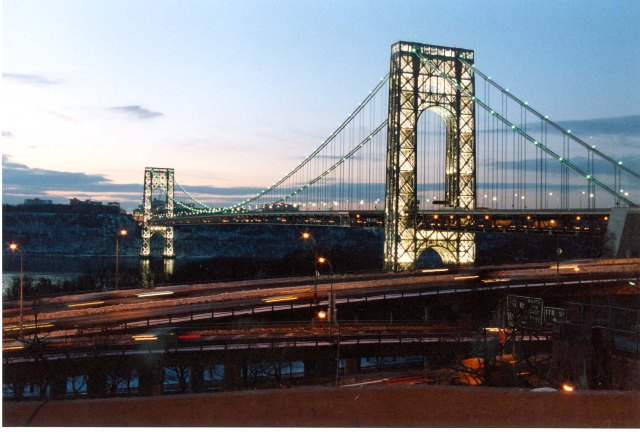
George Washington Bridge  GWB lit across Hudson
One of the most-used bridges in the world, the double-decked suspension George Washington Bridge connects Northern Manhattan to New Jersey via Interstate 95. The namesake for this bridge is certainly no mystery—but why was it named after our first president? The bridge is situated near Fort Washington in New York and Fort Lee in New Jersey, fortified positions used by General Washington and his American army in order to fend off the British during the Occupation of New York City during the American Revolutionary War. The resistance was unsuccessful of course, and General Washington fled over the river at a point near the present-day bridge.

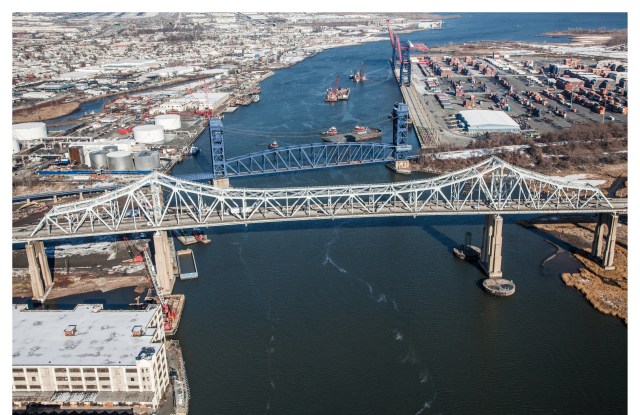
Goethals Bridge


A steel-truss, cantilever bridge, the Goethals Bridge connects Staten Island to New Jersey via Interstate 278. The Goethals, which opened in 1928, replaced a system of three ferries, and is situated next to the Arthur Kill Rail Bridge. The bridge was named for General George Washington Goethals, a United States Army officer and civil engineer. In addition to serving as the Port Authority of New York and New Jersey’s first consulting engineer, General Goethals is perhaps best known for his administration and supervision on the Panama Canal.  A $1.5 billion project to replace the 87-year-old Goethals Bridge is underway.  The project is the first public private partnership of its kind in the Northeast for surface transportation.

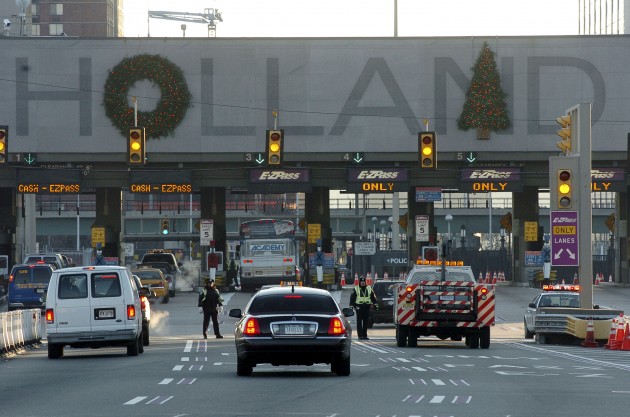
Holland Tunnel


Completed in 1927, the Holland Tunnel connects Interstate 78 in New Jersey with Lower Manhattan. The tunnel remains one of the busiest in the regions, with approximately 35 million automobiles using it each year. It’s named for the tunnel’s Chief Engineer, a Harvard-educated Civil Engineer who would tragically die before he would see his most famous project completed. The tunnel was named for him to honor his work.

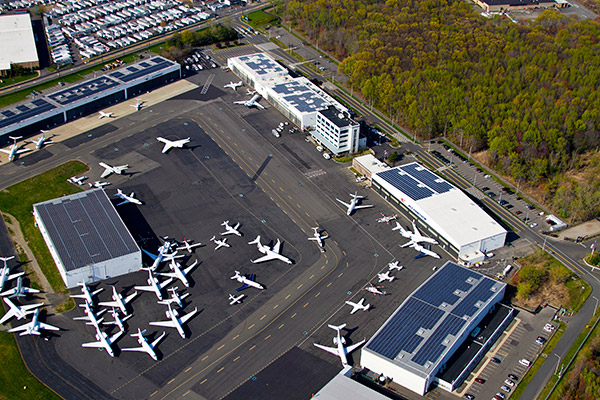
Teterboro Airport


Teterboro Airport, located in Northeast New Jersey, is the oldest operating airport in the New York City region; its first flight took off nearly 100 years ago, in 1919. The airport is named after Teterboro, a borough of New Jersey in which part of the airport is located. The borough, in turn, was named for Walter C. Teter, a New York investment banker who purchased the land in 1917, aiming to repurpose marshland in order to build a race track, a golf course, and ultimately the airport.

Posted in airport history, airport terminals, airports, bridges, Holland Tunnel, Uncategorized | Tagged , , , , , | Leave a comment