LaGuardia Airport history: Bessie Coleman, the first African-American to fly airplanes

By Roz Hamlett, Portfolio Editor

In the same year that Amelia Earhart took her first flying lesson – 1921 – Bessie Coleman received her pilot’s license, making her the first African-American licensed pilot in the world.  The following year, her first air show took place at Curtiss Field, a flying field that later would become part of LaGuardia Airport.

When Coleman decided she wanted to learn to fly, the double stigma of her race and gender meant that she would have to travel to France to realize her dreams, a fact that makes her accomplishment even more remarkable.

In truth, very few American women of any race held pilot licenses during the 1920s. Those who did were predominantly white, wealthy and a world apart from Coleman, who grew up poor and picking cotton in the fields of an east Texas town, where being black was tough.  The school she attended was a one-room shack four miles from home, a distance the six-year-old Bessie covered by foot.  Despite all this, she thrived, particularly at math.  When she was 18, Coleman went to college, but the small amount of money she was able to put aside lasted only a single term, and she soon returned home.

Determined to make something of herself, at age 23, she took the decisive step of moving to Chicago, where she supported herself with work as a manicurist in a beauty parlor.  As men returned home from the First World War, they shared daring and wild tales about airplanes they had seen in the sky.  Her brothers taunted her about French women who had learned to fly, which surely lit the fire in her belly to find someone who could teach her how to fly.  But even in the Windy City, there was not a soul willing to train a black woman as a pilot.

Coleman learned French at a Berlitz school in Chicago, withdrew her accumulated savings, and attracted the attention of Robert Abbott, the owner of the Chicago Defender Newspaper and one of the first African-American millionaires. Abbott encouraged her to learn to fly in France.  In June 1921, the Federation Aeronautique Internationale awarded her an international pilot’s license.

She received a celebrity’s welcome when she returned to the U.S.   Scores of reporters were on hand to herald her achievement as “a full-fledged aviatrix, the first of her race.”  As the guest of honor at the all-black musical “Shuffle Along,” the entire audience rose to its feet – including several hundred whites in the orchestra seats – to give the first African-American pilot a standing ovation.

Unlike the celebrity endorsements that helped Earhart finance her flying career, Coleman’s career suffered due to a lack of money and sponsors.  At the end, this lack of money may have, in part, caused her death.  Unable to afford a new plane, she purchased an older, faulty one.  In a practice flight for a show on April 30, 1926 in Jacksonville, Fla., the plane’s controls became stuck.  At 3,500 feet, and with  her mechanic William Wills at the controls, the plane stalled and plummeted toward the earth, killing them both.

While Coleman is gone, she’s not forgotten.  In 1977, a group of African-American pilots established the Bessie Coleman Aviators Club.  Almost 25 years later, a Chicago City Council resolution requested that the U.S. Postal Service issue a Bessie Coleman stamp.  The resolution noted that “Bessie Coleman continues to inspire untold thousands even millions of young persons with her sense of adventure, her positive attitude and her determination to succeed.”

Posted in airport history, airports, aviation, aviation geeks, historic photographs, history, history buffs, history of aviation, LaGuardia Airport, Port Authority of New York & New Jersey, Uncategorized | Tagged , , , , , , , , , | Leave a comment

High Praise for Lt. Joseph Macaluso

By Roz Hamlett, Portfolio Editor

Photography by Mercedes Guzman, Police Blogger  

The praise for Lt. Joseph Macaluso was widespread as family and friends, members of the Port Authority Police Department and hundreds of others gathered at the Holland Tunnel this week to give “Joe Mac” a proper goodbye as he retired from the PAPD after 35 years of service.

“I’m here to thank you and salute you,” said Lt. Macaluso.  “Thank you for listening to me and learning from me.  I tried my best to teach you the best I knew.”

The Holland Tunnel Maintenance Garage had been transformed overnight into an event hall festooned with balloons and a feast laid out on buffet tables stretching from the back of the garage to the front.  But it was not until Lt. Macaluso made his appearance flanked on both sides by a deep brigade of officers was anyone really sure he was actually going to retire.

In between the camaraderie and ceremony, there was a bittersweet undercurrent  – part sadness mixed with hilarity – as old-school PAPD leaders stood shoulder-to-shoulder with a younger brotherhood of blue, many of whom “Joe Mac” had trained and mentored, and who were now detectives and Bosses.

Superintendent of Police, Chief Mike Fedorko, called Lt. Macaluso a “consummate leader, teacher, overall good guy. . . a true leader.”

Lt. Robert Vargas of the Holland Tunnel Command first met Joe Mac in 1997 when they were in the PAPD Sergeant’s Supervisory School together.  Lt. Vargas shared many funny stories about the man he knew so well. There was the one about how Joe Mac chose law enforcement as his career.  The story goes that a young Joseph saw a red bicycle in a store when he was eight years old.  His mother told him to save money and he could buy his bicycle.  So Joe used his Communion money to purchase the bicycle.  He was one happy young man until he saw a thief break into his shed and ride away with his bicycle.  “This was the beginning of Joe Mac the law enforcer,” said Lt. Vargas.

Or the one about the day he single-handedly cleared a major traffic jam after a rainstorm and flooding had backed up traffic into NYC.  Noticing that the catch basin was full of debris, Lt. Macaluso first used his nightstick to poke unsuccessfully at the debris.  Next, he stuck his arm into the basin and started removing debris with his bare hand to break open the clog.  The water went down like a whirlpool, the roadway drained and two lanes of traffic cleared immediately.

During his 14 years at the Holland Tunnel, Lt. Macaluso made some 3,000 arrests that included weapon possessions, robberies, narcotics, DWIs, theft and larcenies.  He received 14 meritorious medals during his Port Authority career.

In 2013, for example, Lt. Macaluso played a major role in nabbing a motorist suspected of taking part in the shooting of nine people in East Flatbush by hatching a plan to use more than a dozen PAPD vehicles that would give the wanted man nowhere to run.

Joe Tuzzolino, a friend and retired detective at the Clifton Police Department compared retirement for a police officer to the process of grief. “[Lt. Macaluso’s] retirement is a loss for him.  The hours and the dangers associated with the job are connected to such an extent that it takes awhile to get it out of your system.”

Lt. Macaluso’s career in law enforcement began at the Clifton, NJ Police Academy in 1978, and two years later he joined the PAPD, where his first assignment was JFK International Airport.  He worked his way up the ranks to his next assignment at the Lincoln Tunnel, where he spent 18 years earning the rank of Sergeant before assuming command at PATH.  Ultimately he was assigned the Holland Tunnel Command.

As his Final Roll Call ended, Lt. Macaluso closed out his command with the same words he had used countless times before, “Please stay alert and be alive.”

Posted in PAPD, police history, Port Authority, Port Authority of New York and New Jersey, Port Authority of NY/NJ, Port Authority Police Department, transportation, transportation police, Uncategorized | Tagged , , , , , | 1 Comment

What was up with PATH?

By Roz Hamlett, Portfolio Editor

While PATH workers were working against the clock to clear massive snow drifts left by Winter Storm Jonas, frustrated riders wanted to know why PATH service between Newark Penn Station and Journal Square wasn’t back up and running.

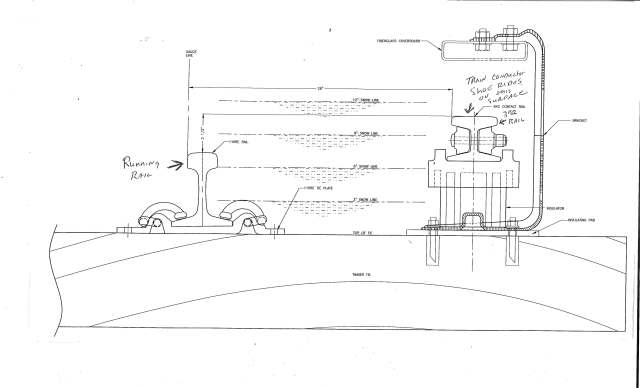
Restoring full PATH service in the aftermath of Jonas was a tougher challenge than it appeared. PATH operations use a third rail to power its trains through a semi-continuous rigid conductor placed alongside or between the rails of the  track.  And third rails are highly vulnerable to thick accumulations of snow, and ice formed from refrozen snow.

During the storm, the PATH third rail was buried, with 2-3 foot drifts above the protection board in some areas.

Crews worked diligently to clear snow from a total of 12 miles of track, which includes two mainline tracks between Newark and Jersey City.  The third rail needs to be cleared by hand – a snowplow couldn’t be used as it could damage the electrical system wiring, switches, and track signal equipment.  Additionally, the use of snowplows can cause the entire third rail to topple over.  Some of PATH’s snow removal equipment could not be used, as it requires third rail power, and the third rail was completely inundated with snow.

Mike Marino, General Manager of PATH, is a veteran railroad man, with more than 40 years in the rail business at Amtrak, the MTA and PATH.  He says the effects of Jonas have been among the worst he’s seen on any operating railroad.  Mike says PATH forces have worked tirelessly around the clock since Friday night when the storm began.

“Our PATH crews and contractors are to be commended for their commitment to getting this done in the face of freezing temperatures, significant manual labor and staggering snowdrifts. We thank them and also NJ Transit for cross-honoring PATH tickets on their trains and buses, and for providing extra bus shuttle service between Newark, Harrison, and Journal Square to help ease the inconvenience for our riders.”

   Mike Marino, Director and General Manager, PATH

In comparison, other rail systems, including New Jersey Transit and Amtrak trains running along the Northeast corridor, use a catenary system, which is an overhead line or overhead wire that provides electrical power to the trains.

In extreme temperatures, the tension that supports the catenary wires increases or decreases, which can cause components in the catenary system to fail. So overhead wires can have problems in severe storms, but getting buried in a blizzard never happens.

PATH drawing

This drawing depicts the running rail, the third rail and the part of the third rail that the train conductor shoe makes contact with to electrify and power the train for movement, and also to operate all the systems on the train (including lighting, heating, etc).  When we have snow precipitation that is over this surface (which is 10 inches high), we begin to have problems running trains.  Winter Storm Jonas dropped 3 times that amount of snow.

Posted in PATH Trains, Port Authority Trans-Hudson, Winter Storm Jonas, Uncategorized | Tagged , , , , , , | 1 Comment