The Fokker Aircraft Corporation of America built the Fokker F-32 in 1929 in their Teterboro, N.J. factory. It was the first four-engine commercial aircraft built in America and the largest land plane in the world. It had a capacity of 32 seated passengers and 16 sleeping passengers. From wingtip to wingtip, the massive craft had a wing area of 1,350 square feet. Its length was 69 feet, 10 inches, with a wingspan of 99 feet and height of 16 feet, 6 inches. Its high cost – $110,000 – made the aircraft a hard sell from the beginning, especially during the Depression.
Its biggest problem, however, was the design. The airplane was underpowered for its size, made worse by its unusual back-to-back engine configuration. The front engine had two-bladed props; the rear had three.
The prototype of the F-32 crashed Nov. 27, 1929, during a three-engine takeoff for certification from Roosevelt Field en route to Teterboro Airport. One of the two port engines was stopped on purpose, but the other engine failed shortly after takeoff. No one was killed, but the aircraft was destroyed. While climbing, the aircraft stalled and then crashed into a house on Long Island. Remarkably, a baby inside the house survived.
As the Great Depression worsened, the F-32s were phased out by the end of 1930. Western Air Express was its only purchaser, buying two of them, which flew between West Coast destinations. They were replaced by the Boeing 247 and the Douglas DC-3.
By Neal Buccino, Senior Public Information Officer
Photography by Rudy King and Mike Dombrowski
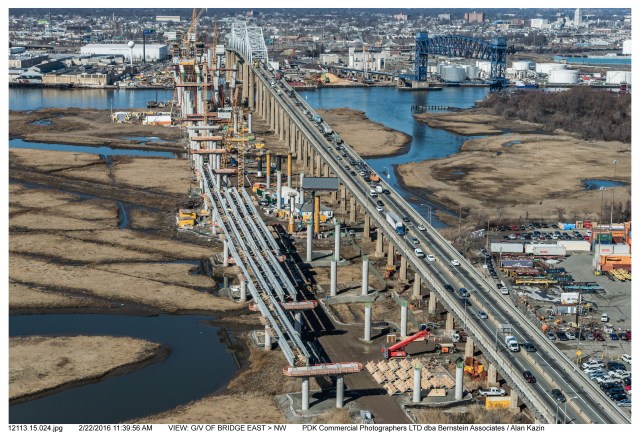
Picture a standard I-beam, the type you might see at a construction site. Now imagine it’s taller than the Statue of Liberty’s height from feet to torch and twice the distance of an NBA basketball court. Oh, and heavy. This megalith, composed of concrete surrounding densely packed steel rebar, weighs as much as 80 cars or a trio of Sherman tanks. (Below image courtesy of PDK Commercial Photography)
The massive structure is a bridge girder. A total of 397 girders, each up to 176 feet long, three-and-a-half feet wide, nearly eight feet tall and weighing 110 tons, will support the approach roadways for the Goethals Replacement Bridge, currently under construction in Staten Island, N.Y. and Elizabeth, N.J. to straddle the Arthur Kill.
They dwarf the construction workers who guide them atop column caps ranging from 20 to 120 feet above the ground, as well as the heavy-duty cranes needed to lift them and even the columns themselves. For more on the project, see today’s photo essay by the Port Authority’s Rudy King and Michael Dombrowski, and Dombrowski’s time-lapse video of their installation.
As the images show, there is nothing small about hauling these mammoth girders to the Goethals Replacement Bridge construction sites in Elizabeth and Staten Island, or in their installation high above ground.
This slideshow requires JavaScript.
Each beam is manufactured in central Pennsylvania, then shipped as a 16-axle truckload for the 130-mile trip to the New Jersey construction site on the western side of the Arthur Kill. The trip is issued permits for overnight travel hours to minimize traffic impact.
At the construction site, workers outfit each girder with tubes that will carry water for the bridge’s fire suppression system and electrical wiring for its lights. About half of these vast beams are then driven over the existing Goethals Bridge to the construction site on the New York side. That final journey begins promptly at 4:30 a.m., and requires a half-hour traffic hold to ensure safety.
Once each girder arrives at the Elizabeth or Staten Island construction site, it’s hoisted into place atop the column caps. The job requires heavyweight cranes, as well as experienced workers guiding the girders into place. Two sets of columns and caps will each be joined by five girders, until a final pour of concrete at their ends unites them into a single monolithic structure. To date, a total of 75 girders are in place on either side of the bridge.
These concrete leviathans won’t be immediately noticeable when the Goethals Replacement Bridge is complete. They certainly won’t be its most distinctive feature. That honor will belong to four sets of 272 foot-tall V-shaped towers or pylons, which will hold 72 stay cables to support the bridge’s main span across the Arthur Kill.
But through a lifespan expected to surpass a century, the girders will play an essential role in the transportation of tens of millions of vehicles and tens of billions of dollars worth of cargo each year, and for the needed replacement of a functionally obsolete bridge with a much-improved 21st century crossing.
By Cheryl Albiez, Senior Public Information Officer
Today, Portfolio launches “Boots on the Ground,” an occasional series spotlighting Port Authority women managers who possess the ability, knowledge and experience to handle critical positions of responsibility. These strong, bright and innovative women make significant contributions in executing the agency’s core mission by providing efficient, reliable and safe movement of people and goods throughout the region. They are “boots on the ground” women ready to take action.
First up: Lysa Scully, General Manager of LaGuardia Airport.


 portfolio.panynj.gov