WTC: A Rubik’s Cube of Collaboration

By Judith Dupré, Portfolio Guest Blogger

One World Trade Center boasts some staggering statistics—the tallest building in the Western Hemisphere, the fastest elevators in the Americas and the strongest concrete ever used, among many record-busters. It is the most advanced skyscraper ever built, after all.
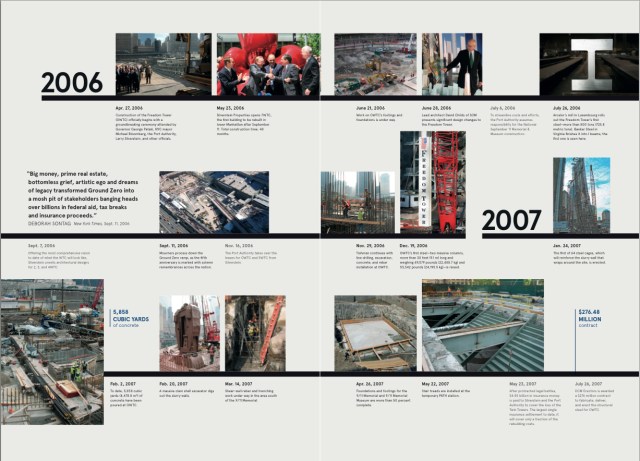
Construction Timeline Courtesy Little Brown and Co

A timeline of historic construction photographs, shot by the Port Authority over the past decade, provides a glimpse into the heroic business of building a skyscraper.

But the most extraordinary statistic about the new World Trade Center is this: No lives were lost during the rebuilding. More than any other measure, this is the benchmark of the extreme care, precision and experience that the Port Authority has devoted to this most precious of sites.

My father, who has a knack for coining new phrases, speaks of events marked with the “asterisk of sorrow” to describe circumstances whose outcome has been influenced by grief. The WTC’S reconstruction was so asterisked—and inspired an unprecedented outpouring of ingenuity and hard work. A state-of-the-art enterprise, the project required the skills and brawn of thousands of Port Authority employees and contractors. Their numbers included architects, engineers, planners, financiers, as well as welders, electricians, riggers, painters and plumbers.

Everyone was the best at his or her job, that was a given.  But each person also had to possess the wisdom and expertise to collaborate — so everyone else could give it their best.  And they did. For the past fifteen years, the people of the Port Authority have stepped up, given it their all and gotten the job done, no matter what.

No great enterprise is without controversy.  Many hurdles—political, financial and structural—had to be overcome. Despite One World Trade’s minimalist appearance, every single floor, and nearly every piece of steel on the building is different. Similarly, nearly every one of the 13,000 glass panels that comprise its façade is unique.  The concrete core demanded that New York City unions work together in a new way, so the lessons learned from 9/11 could be implemented.

Moreover, One World Trade went up in tandem with eight other buildings—2 WTC, 3 WTC, 4 WTC, 7 WTC, the Oculus Transportation Hub, the Vehicle Security Center, St. Nicholas National Shrine, and the National 9/11 Memorial and Museum—all of it intensely scrutinized, controlled by dozens of owners and subject to the tightest security measures ever implemented. Hovering like a black cloud was the 2008 recession, which stalled construction everywhere. From this demanding framework, the World Trade Center emerged. Frankly, given all the challenges, it should not have, but it did because so many people cared so much.

As remarkable as the above ground structures are, much of what is marvelous about the WTC cannot be seen. An invisible world exists underground. There, each structure depends on its neighbors—one building’s roof is another’s floor. Interdependent, they form a Rubik’s Cube of shared foundations, utilities and mechanical systems. Linked to the Transportation Hub, they connect to a vast network of commuter lines and welcoming, underground pedestrian routes. Together, they represent one of the most profound collaborations in human history.

Many people shared personal, moving stories with me. Steve Plate, chief of major capital projects, cited the dedication of the 9/11 Memorial, when the Port Authority pulled out all stops so it could be completed for the tenth anniversary.

“The workers knew that September 11 was really for the families,” Steve said, “but on their own accord they got together and decided to have a moment.” On the Friday morning before the dedication, everyone stopped working and took off their hard hats for a moment of silence. “All the cranes . . . blew their horns at the same time, and they dropped the booms of the cranes, and faced them toward the pools in reverence,” Plate recalled.

One World Trade Center soars. With the other Trade Center buildings, it provides thousands with a place to reflect, work, eat and shop. The belief that all those things could be accomplished—backed up by the Port’s strenuous efforts, unparalleled expertise in large-scale construction and unswerving devotion to the people of New York, New Jersey and the nation—qualifies it as a masterpiece in my book.

Judith Dupré is the New York Times best-selling author of the new book, One World Trade Center: Biography  of the Building
 

Posted in 9/11, 9/11 Memorial and Museum, books, historic photographs, history, NYC, One World Trade Center, PANYNJ, Port Authority, Port Authority of New York & New Jersey, September 11, skyscaper, The Oculus, Twin Towers, Uncategorized, WTC | Tagged , , , , , , , , , , , | Leave a comment

Retired PAPD Superintendent Henry DeGeneste: At the Forefront of Change and Diversity

By Mercedes Guzman, Media Relations Staff

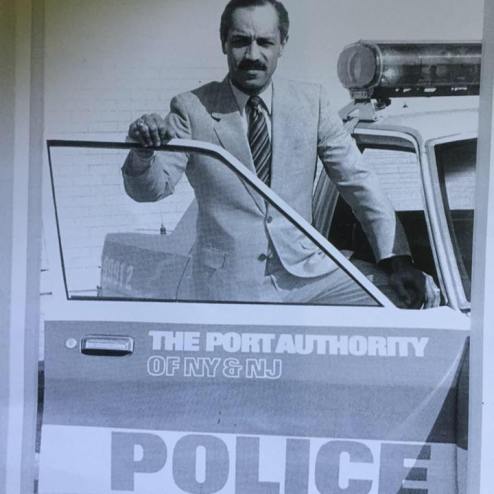
When now-retired Port Authority Police Superintendent Henry DeGeneste first came on the job as a young recruit, he joined a police force that was predominantly male and white. As he moved up through the ranks, DeGeneste made it his mission to change the department’s hiring practices to promote diversity.

Henry Degeneste

“The best way to challenge an institution is by working from the inside and being extra vigilant to change attitudes. Be the change you want to see,’’ he said in a recent interview from his home in Florida, where he continues to serve as president of his own security consulting firm.

DeGeneste recognized from his earliest days at the PAPD that his job was to help build a more professional and diverse police force. His own career began against the turbulent backdrop of the civil rights movement.  As black communities protested segregation throughout the country and faced violent responses from some police forces, it became clear that convincing African Americans to become cops was going to be a tough sell.

So DeGeneste went on the road. He excited young African American college students about becoming a PAPD officer, even going south to historically black colleges like Howard University and Morehouse College.  He sat down with frontline civil rights leaders from the NAACP and the Urban League and discussed opportunities for employment that the Port Authority offered.

His efforts paid off.  Although more work remains to be done, today, the 1,700-member PAPD has a far greater number of minority and women officers than when DeGeneste was appointed superintendent.

Born in Newark, N.J., he grew up wanting to be a police officer and graduated from the Port Authority Police Academy in 1967 at the top of his class.

Former Chief John Rakowski, his commanding officer at the Police Academy told him, “I believe you will go far. You are smart, full of energy and personable. I believe you can become the superintendent.”  DeGeneste couldn’t know then how accurate this statement would be. Not only did he become the first African American PAPD police superintendent, he was the youngest and the last superintendent to ever rise through the ranks instead of being appointed from the outside.

Following his graduation, he was assigned briefly to the city of Newark to assist Newark and New Jersey State Police departments during the riots that took place that summer. It pained him to return to his hometown as a police officer during such a chaotic time, he recalled.

In 1981, he advised London police during the Brixton riots on how to recruit minority officers among ethnic minorities in a racially charged atmosphere over issues of social injustice.

Towards the end of his 23-year career with PAPD, he was a top candidate for police commissioner in New York, a position that eventually went to the former police chief of Houston.  At that point, DeGeneste pursued a different route and became senior vice president of global security at Prudential Financial.

He also spent more than a decade teaching courses on criminal justice, security, and public policing at John Jay College, where he developed a course on transportation policing. Impressed by one of his students, he offered John P. Sullivan an opportunity to co-author his textbook “Policing Transportation Facilities,” published in 1994. The textbook was included on college reading lists and used as an influential guide for policing.

When asked what advice he would give today, he said, “minority officers have an obligation to vigorously challenge what they see as discriminatory which delays the growth and understanding of society and how it affects law enforcement.”


Posted in Black History Month, Civil Rights, Dr. Martin Luther King holiday, PAPD, police history, Port Authority Police Academy, Port Authority Police Department, transportation police, Uncategorized | Tagged , , , , | Comments Off on Retired PAPD Superintendent Henry DeGeneste: At the Forefront of Change and Diversity

Port of New York and New Jersey: The Seamen’s Church Institute, Home Away From Home

By Portfolio Editor Roz Hamlett and Lenis Rodrigues, Media Relations Staff

Located on Export Street in the heart of Port Newark, amid the bustling trucks and stacks of cargo containers, a little-known oasis awaits mariners who work aboard the big ships: the Seamen’s Church Institute (SCI).

Thanks to the interfaith pastoral care provided by The Rev. Marjorie Lindstrom, SCI’s Senior Port Chaplain and The Rev. James Kollin, mariners from around the world can enjoy a bit of home away from home when they arrive at Port Newark. In addition to providing spiritual guidance, the two chaplains help seamen connect to family and friends with cell phones and phone cards. They facilitate precious shore leave opportunities and even drive them to local malls if called upon to shop.

11418956414_d4a7e95786_z

“For us, this work goes beyond the walls of the church,” Lindstrom said. “It’s taking pastoral care on the road, up the gangways and on board ship to a whole new world waiting to be explored. It’s where ‘the rubber meets the road,’ as my father used to say.”

SCI hired both chaplains as full-time employees:  Kollin has been at SCI for 15 years, while Lindstrom has been a chaplain for 10 years. They both reside in New Jersey and are  Episcopalian, though SCI is ecumenical and not under the auspices of any one diocese.

The close working relationship between the Port of New York and New Jersey (PONYNJ) and SCI goes back to 1834.  Yet most people know next to nothing about the lives of the seafarers.

Life as a mariner is tough. They come from around the world – places like the Philippines, Greece, Russia, Ukraine, India and the U.S. They spend months aboard vessels away from their homes, families and friends. The pay is relatively high, which allows them to support their families and handle the high costs of college educations for their children.

Jovic Delgado, a seaman from the Philippines, has been away from home sometimes for as a long as six months.  While taking a quiet moment in the SCI chapel recently, he explained that for him, the toughest part of being a mariner is leaving the family behind.  “My two girls become very sad and there’s a lot of crying when I leave.”

Kollin, who also is from the Philippines, said he often runs into compatriots he knows or that know him.  “Sixty percent of the seafarers I see at PONYNJ are Filipino,” he said.

Aboard a tanker once, Kollin discovered to his surprise that the man with whom he was chatting was a relative.  “We exchanged contact information and I told him to contact me at any time.”

Seafarers confront real-life dangers unique to their profession of the sort Tom Hanks encountered in the movie Captain Phillips, when the U.S. containership Maersk Alabama was overtaken by a band of Somali pirates near the Horn of Africa and the crew was taken hostage at gunpoint.  Delgado said that ship crews are trained on how to handle pirates, and recalled an anxious incident when a Nigerian boat pilot attempted unsuccessfully to board his vessel.

“I’ll never forget the time I was asked to visit an oil tanker,” said Lindstrom. “The ship had come through extremely rough seas in the North Atlantic, and the crew was exhausted.”  While they all had proper U.S. visas, the terminal would not allow anyone to leave ship due to security reasons, she recalled.

“After a 45-minute wait to get on the ship, I was met with many sullen faces. They were upset because they couldn’t get off ship. They needed things like toothpaste and toothbrushes, and white cotton crew neck Hanes tee-shirts. One person needed maintenance medication for his diabetes,” she said. “I asked if I could offer grace. As we assembled around the tables, I asked God to bless the crew, and I gave thanks for their safe arrival despite the terrible winds and the walls of water.”

Lindstrom is a second-generation chaplain to the mariners. She credits her father, The Rev. George Dawson, a former chaplain at SCI, with her choice of profession. Before her career in pastoral care, she worked for 30 years teaching learning-disabled boys.

“The highlight of our school year was the class trip to Port Newark. My father had befriended a few captains, who allowed my small classes to board ship, tour the engine room and bridge, and we ended the day with ice cream and cookies in the Officer’s Mess,” she said

Later as a student at General Theological Seminary in Manhattan, she completed her final semester at SCI, visiting ships and driving seafarers to the local mall. That’s when the sense that she might have a true calling at Port Newark began.

“It has been a joy and privilege to minister to our seafarers over the past 11 years,” said Lindstrom.

Watch the video below as Rev. Kollin describes what life was like for the mariners during Superstorm Sandy.


Posted in Maersk, New Jersey, North Atlantic shipping, PONYNJ, Port Commerce, Port Newark, Port of New York & New Jersey, Port Region, Seaman's Church Institute, shipping, Uncategorized | Tagged , , , , , , | Leave a comment