Port Newark: How Malcom McLean Changed the World

By Portfolio Editor Roz Hamlett

Sixty years ago this week, Malcom McLean, trucking mogul turned shipping magnate, tilted the shipping world on its axis when the 524-foot Ideal X cast off from Berth 24 at the foot of Marsh Street in Port Newark en route to Houston, Texas carrying 58 containers on its maiden voyage.

Malcolm_McLean_at_railing,_Port_Newark,_1957_(7312751706)

Malcom McLean

To many in the shipping world, Ideal X signaled a sea change in the maritime industry, putting into practice a powerful idea that had played at the back of McLean’s mind since 1937 when he was the sole driver for his company, McLean Trucking. McLean was a man born to set trends, not follow them.  Had he not spent what seemed to be wasted hours idling at Hoboken, frustrated, waiting to unload his truckload of cotton bales and thinking there had to be a better way to load cargo aboard ships than piece by piece, containerization might not have turned out the same.

The Ideal X

The crane placed a container on the deck of the Ideal X every seven minutes. The ship was loaded in less than eight hours and set sail on her maiden voyage the same day, April 26, 1956.

After Ideal X came the 450-foot Gateway City, which left Port Newark the following year on Oct. 4, 1957, the same day the Soviet Union launched Sputnik I, the world’s first earth-orbiting satellite. The pioneering Gateway City carried more than three times the number of containers as the Ideal X.  With her voyage came the awareness of a new normal in shipping:  the era of modern containerization was underway.  Containerships were transforming the industry by enabling more cargo to be placed on board and creating efficiencies, making shipping more profitable and opening up new global markets.
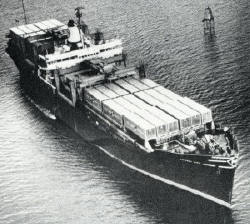
SS GatewayCity

With two cranes, each loading and unloading 15 boxes an hour, the Gateway City could be emptied and reloaded in just eight hours.

“I knew what was going on [in containerization] was revolutionary.  That’s why I wanted to be a part of it,” said Charles Cushing, who was McLean’s first full-time engineer at the Pan-Atlantic Steamship Company, eventually becoming Chief Naval Architect at McLean’s Sea-Land Service.

The year before Ideal X sailed, McLean had sold his trucking company for $25 million and purchased Pan-Atlantic, (which eventually became Sea-Land), and the Gulf Florida Terminal Company from Waterman Steamship Corporation, with the idea of using Pan-Atlantic’s vessels and operating rights to carry containers.

McLean wanted the best people.  To get them he conducted the shipping world’s equivalent of the NBA lottery.   He wanted only top picks, well-educated people who were still down to earth enough to mix it up with the truckers and pitch pennies with the best of them.  Many were invited to Newark for an interview; a handful were chosen.  Cushing went to work fulltime for McLean in 1960.
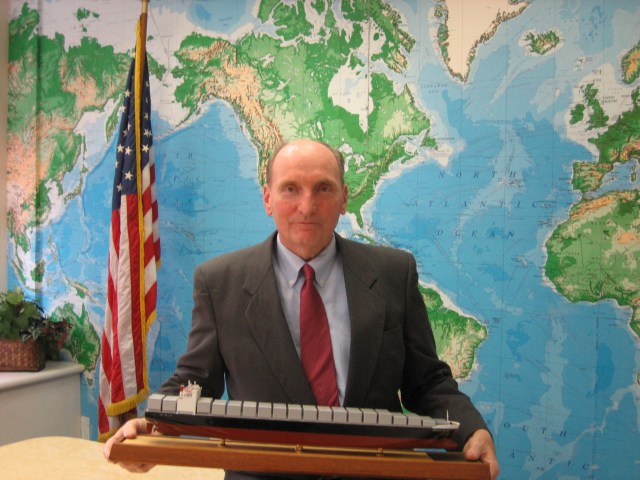
CRCushing

Charles Cushing, Naval Architect and President & CEO of C.R. Cushing & Co. He is President of the McLean Container Center at the U.S. Merchant Marine Academy

“I was extremely lucky to get a job at Pan-Atlantic,” Cushing recalled. “Malcom started out by putting truck bodies on ships. [Then] in 1957, he bought six old World War II break bulk cargo ships, gutted them and began putting cells in them to hold containers – The first cellular ship was the Gateway City.  I was still a student at MIT in 1958, but I sailed on the Gateway City during a vacation.”

After joining McLean at Pan-Atlantic, Cushing began working on the basic design features that became characteristic of modern containerships – stacks of containers in customized cells below deck and additional stacked containers atop each other as deck cargo.

McLean ran into fierce resistance in his effort to transform the industry. Venerable ocean-going steamship operators, particularly British companies, regarded McLean as an unwelcome maverick and considered containerization a marginal idea. They threatened distilleries in an effort to keep their product off the first containerships.  However, J & B Scotch broke from the pack and was among Pan-Atlantic’s first shipments across the Atlantic.  Other distilleries would follow.  By 1963, J&B Scotch was a huge hit in the U.S. and selling one million cases per year.

McLean persisted and expanded his shipping operations to Puerto Rico in 1958, to the West Coast via the Panama Canal in 1962, and north to Alaska that same year.  In 1972, Sea-Land acquired eight new containerships able to reduce ocean crossings by a full day, the fastest merchant ships ever built.  They could carry more than 1,000 containers compared to Gateway City’s 226 and the Ideal X’s 58.  Ever-larger ships continue to this day with vessels able to carry 20,000 containers and more.

Cushing worked for McLean until 1968, before founding C.R. Cushing & Co., a naval architecture firm in New York City that has designed more than 250 vessels built in the U.S. and abroad, and completed some 3,000 projects. Cushing and other shipping industry leaders established the McLean Container Center at the Merchant Marine Academy at King’s Point to preserve records, photographs, and other items documenting the history of containerization.

On the morning of McLean’s funeral in 2001, container ships around the world blew their whistles in his honor.  Cushing delivered the eulogy.  A newspaper editorial stated that “McLean ranks next to Robert Fulton as the greatest revolutionary in the history of maritime trade.”  Forbes Magazine called him “one of the few men who changed the world.”

Excerpted from the documentary, Winds of Change, produced in part by the Port Authority of New York & New Jersey, Malcom McLean explains the deceptively simple idea behind containerization.


Posted in Atlantic Ocean, commerical shipping, containerization, Elizabeth, New Jersey, history, history buffs, Maersk, Malcom McLean, North Atlantic shipping, Port Authority of New York & New Jersey, Port Authority of NY/NJ, Port Commerce, Port Newark, Port Newark/Elizabeth Marine Terminal, Port of New York & New Jersey, Port Region, shipping, Uncategorized | Tagged , , | Leave a comment

One World Trade Center: The Stranger Who Wrote a Book and Changed My Life

By Rudy King, Media Relations Staff

As a 9/11 World Trade Center survivor, there have been few days throughout the past 15 years that I haven’t been reminded of the impact that dreadful day had on my life. But rarely did I discuss it.

For the last two years, I had an opportunity to work with New York Times bestselling author, Judith Dupré, as she wrote One World Trade Center:  Biography of the Building.   It turned out to be a project that changed my life.

On the morning of 9/11, I never made it to my desk.  I was later than usual because a food delivery guy ran into me with his cart on Tobin Plaza outside Tower 1 (North Tower), injuring my ankle.  I had just made it to the Sky Lobby in Tower 1 when the first plane hit.  I heard a deafening roar and then boom.  Suddenly everything shook with the intensity of 20 rollercoaster rides all at once.

Like everyone else exiting the building, I went into survival mode. Once outside, I witnessed unimaginable horror:  bodies, debris and fuel raining down on the plaza, people jumping from the tower and hitting the ground.  I made it to a phone behind a kiosk in Tower 2 (South Tower) to warn my coworkers on the 68th floor of Tower 1 they needed to get out.

Shortly after my call, the second plane struck Tower 2.  I heard the sounds of the floors collapsing above me, the building shaking like an earthquake, the emergency sprinklers activating and everything going dark, the steel of the towers grinding like the sound of ships hitting against a pier.  I felt like I was on a movie set, as if this couldn’t really be happening.

Emergency personnel told everyone to clear away from the towers and head toward the bridges.  As I made my way up Dey Street, I heard the city scream, and suddenly a strong gust of loud and hot smoke filled with debris and glass came barreling towards us.  The force of its wrath moved cars, knocked people down and snatched me off my feet; shards of glass pierced my scalp; I couldn’t breathe; I hit the ground, and I asked God to make this as painless as possible.

I survived, but my life was changed.  As I crossed over the Manhattan Bridge, I watched the last tower collapse in slow motion, its antenna slowly disappearing from view.  Later, as I walked home up Atlantic Ave. in Brooklyn, battered, bleeding and emotionally drained, a barefoot homeless woman, with a shopping cart and many bags, walked over and gave me a hug.  She said, “You are God’s child and you will be alright,” before continuing on her way.

A decade later in 2011, and after 13 years of service to the Port Authority, I was promoted to the position of Public Information Officer and began working on the World Trade Center (WTC) portfolio.  Although pleased with my new assignment, I worried about how I would handle being at the WTC construction site on a regular basis — a place where I’d nearly lost my life.

In 2014, I began working with Judith.  My initial role was helping to arrange interviews and access images for the book from the Port Authority.  I became so immersed in the work that sometimes it felt like I alone was managing the entire project, although 25,000 workers raised the tower and dozens of others were contributing their talents to the book.

My anxiety about being at the construction site was overwhelming at times.  For many years following the 9/11 attack, noises, planes or helicopters flying overhead sometimes would trigger flashbacks and frightening panic attacks that I could not control.  There were times I could hardly breathe.  There was a recurring nightmare too:  I’m in a dark room with only one light switch, and I have to find it.

I recall as a teenager growing up in NYC during the 80s seeing shell-shocked war veterans drop to the ground or run for cover after hearing a sudden loud noise.  I used to think this was humorous.

But after 9/11, I knew firsthand the psychological confusion and trauma that happens when people experience a near-death event.  I kept my struggles a secret and soldiered on because I had to function and take care of my family.

There are many people like me, the Port Authority faithful, who have not missed a beat since that beautiful morning turned deadly. Many PA staff stayed in hotels and worked 10-12 hour rotations for months after the attacks.

During the book project, I had many intense conversations with Judith about my survivor experience.  She shared her vision of a book that captured one of the most complex collaborations in human history—and also acknowledged the site’s rebirth. We became friends.

I arranged interviews for her with some of the world’s best engineers, builders and top executives.  I observed her work and determination to get the story right. I was excited to be smack dab in the middle of something that would uplift and help so many people, as it did me.

In the end, the process of helping her on the book freed something in me that had been caged since 9/11.  I’ve begun to let go of some of the fear and negative energy that I have carried for years and feel more comfortable sharing my experience with others who weren’t there, but who feel connected.

The events of 9/11 touched the world.  I feel blessed to now be able to share my story.  Thank you Port Authority and thanks to Judith Dupré.  It’s been both healing and an honor to do my job.

The video below details the vision behind the iconic One World Trade Center. 

Posted in 9/11, 9/11 Memorial and Museum, NYC, One World Trade Center, PANYNJ, Port Authority, Port Authority Managers, Port Authority of New York & New Jersey, Port Authority Police Department, Uncategorized, World Trade Center, World Trade Center Transportation Oculus, WTC, WTC PATH station | Tagged , , , , , , , , | 4 Comments

#DYK: Port Authority Earth Day Facts

By Nate Kimball, Environmental and Sustainability Specialist, Aviation

Earth Day is commemorated each April 22, but the Port Authority’s commitment to clean air, land and water is a 24/7 proposition 365 days a year, whether it’s electric vehicle charging stations at local airports or innovative microgrid strategies designed to conserve energy. For all Port Authority facilities, green means go as the agency works to maintain environmentally sound operations and contribute to a sustainable, thriving economy.   At the airports, green initiatives are positively impacting facility operations and the traveling public.

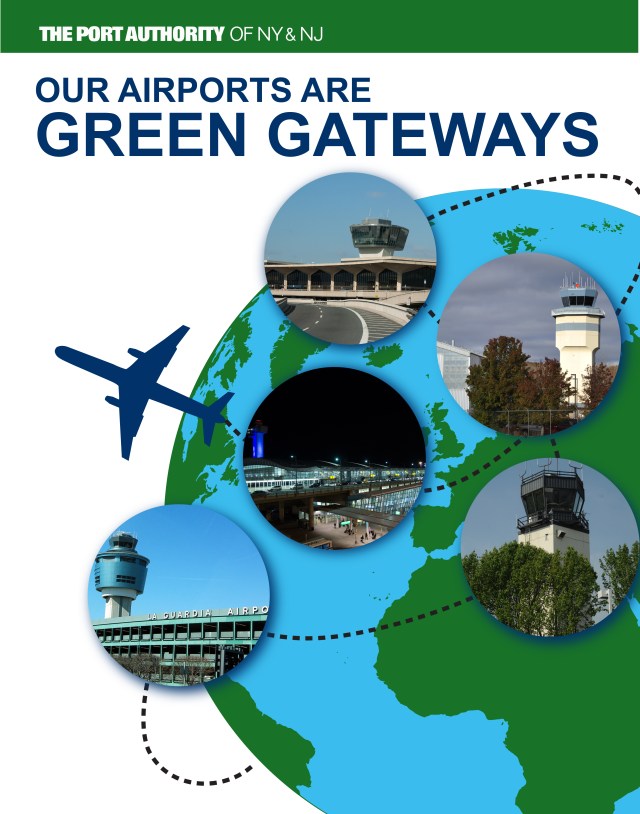
Green Gateway _revised2

Here are just some of the current environmental and energy efforts:

  • Energy efficiency projects will save the Port Authority an estimated $1.6 million per year in energy costs, while providing improved lighting and heating, ventilation and air conditioning for customers.
  • Microgrid feasibility studies are under way at Stewart Airport to increase energy independence during emergencies. Microgrids can operate independently of a local power grid, allowing operational continuity if power grids are disrupted.
  • Compost programs at LaGuardia Airport (LGA) and John F. Kennedy International (JFK) are diverting more than 10 tons of food waste monthly from landfills.
  • Supplying parked airplanes with electricity, heat and air conditioning from the terminal, rather than plane engines,  reduces jet fuel use.
  • Fifteen electric vehicle charging stations are available in public parking garages at LGA, JFK International and Newark Liberty International airports.
  • Using green cleaning products in terminals and office areas to support healthy work and travel environments.
  • A reduction in aircraft ground delays means a savings of more than four million gallons of jet fuel per year. That’s enough for a Boeing 777 to complete 150 round trips between JFK and Europe.
  • Eighty-five percent of the Port Authority’s fleet uses alternative fuels, earning the agency recognition from Government Fleet Magazine as the nation’s third-greenest fleet among 38,000 government fleets in 2014 and 2015.


Posted in airport terminals, airports, aviation, international flight, John F. Kennedy International Airport, LaGuardia Airport, Newark Liberty International Airport, PANYNJ, Port Authority of New York & New Jersey, Teterboro Airport, Uncategorized | Tagged | Leave a comment