Newark Liberty International: Doolittle Sets Coast-to-Coast Records

By Portfolio Editor Roz Hamlett

While more famous aviators such as Charles Lindbergh were capturing America’s imagination in the 1920s and ‘30s, General James “Jimmy” Doolittle was flying a little below the radar.

But he was a thoroughly accomplished and pioneering aviator in his own right, accumulating a long and impressive list of aeronautical achievements as a flight instructor and test pilot until his exploits as a combat flight leader over Tokyo during World War II made him a national hero.

Doolittle was the first test pilot to “fly blind,” as instrument flying was called in the early days of aviation, recognizing that a pilot could be trained to fly through clouds, fog, weather and darkness relying on navigational instruments and not senses.  He also helped develop and test the now universally used artificial horizon and directional gyroscope.  These accomplishments made all-weather airline operations practical.

Newark Airport, which opened in 1928 and was acquired by the Port Authority two decades later, served as an important East Coast terminus for Doolittle’s many coast-to-coast record flights. From its beginning, Newark Airport was associated closely with celebrated flyers, its history intertwined  with the most famous of American aviators: Lindbergh, Wiley Post, Amelia Earhart, Howard Hughes – and Doolittle.

Doolittle spent much of the 1930s developing and testing high octane fuels as manager of the aviation department at Shell Petroleum, also founded in 1928.  In 1931, he set the coast-to-coast record in just over 11 hours from Los Angeles to Newark, averaging 217 miles per hour, with his apparently unflinching wife, Josephine, by his side in the cockpit.

In 1935, during a cross-country test flight from California to Newark, ice began to form at 15,000 feet, striking Doolittle’s airplane like gunshots, but he held that altitude for most of the journey.  Afterwards, his wife described a pitch black and harrowing night as pieces of ice the size of her fingernails came through the plane’s ventilators and pelted her throughout the flight.

Once back on the ground, Doolittle admitted that it was perhaps the toughest flight of his career as a test pilot.

In addition to his many record-breaking flights, and his best-known role as leader of the bombing raid on Tokyo during World War II for which he was awarded the Medal of Honor, Doolittle invented a funnel and tube-based “pilot dehydrator,” the earliest airplane toilet.  Doolittle also received the Presidential Medal of Freedom, two Distinguished Service Medals, the Silver Star, three Distinguished Flying Crosses, the Bronze Star, four Air medals and decorations from five countries during his career.

Additionally, he was one on the first men in the country to earn a doctorate in aeronautics.  As part of his doctoral thesis, Doolittle determined there was no accurate way for a pilot to know how the wind was blowing or the altitude of the plane unless he had visual aids or instruments.  His studies are believed to be the first to directly combine data from the lab with data from the flights of test pilots.

Married to Josephine for more than 70 years, Doolittle died in September 1993 at the age of 96, five years after his wife’s death. He is buried next to her at Arlington National Cemetery near Washington, D.C.
Posted in airport history, airport terminals, airports, aviation, aviation geeks, first nonstop flights, historic photographs, history, John F. Kennedy International Airport, LaGuardia Airport, modernized airport, New Jersey, New Jersey Air Transportation, Newark Liberty International Airport, Port Authority of New York & New Jersey, Teterboro Airport, Uncategorized | Tagged , , , , , , , | Leave a comment

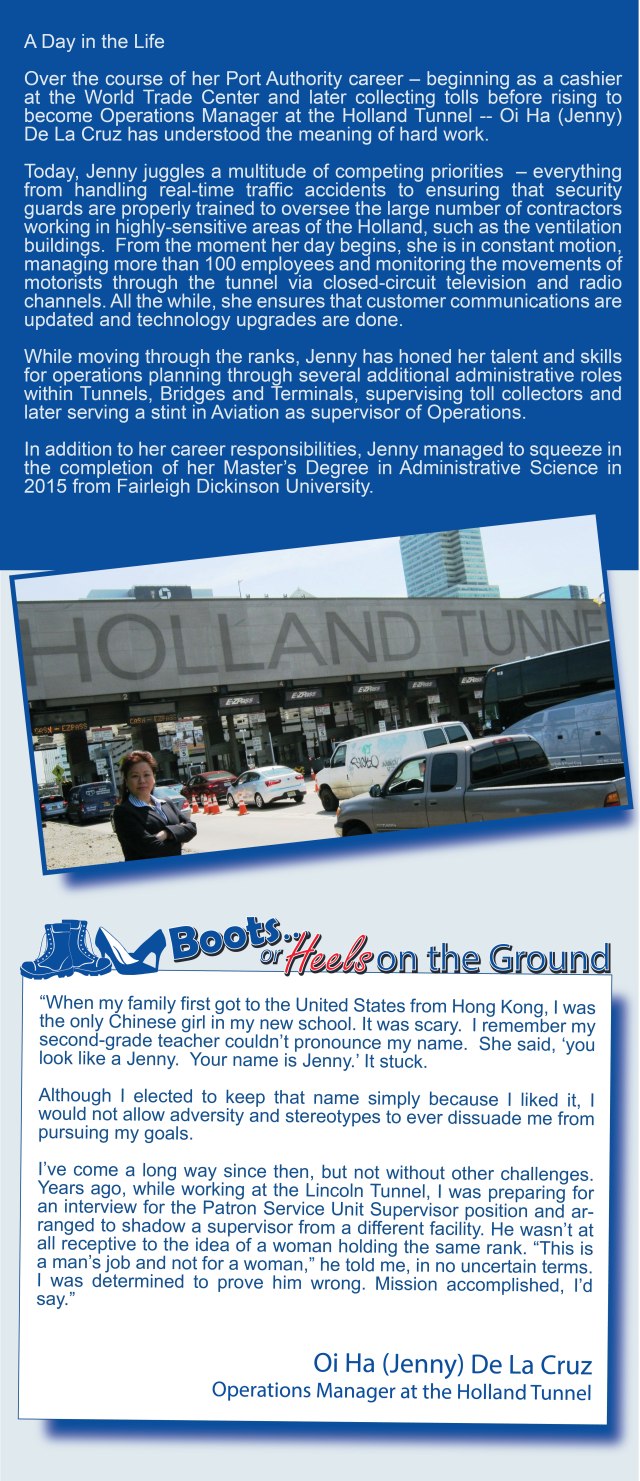
Boots on the Ground at the Holland Tunnel: Jenny De La Cruz

By Cheryl Albiez, Media Relations Staff 

Jenny-DeLaCruz


Posted in Holland Tunnel, One World Trade Center, Port Authority of New York & New Jersey, Uncategorized, Women's History Month, WTC | Tagged , , , , , , , , | Leave a comment

Port Authority: 95th Anniversary of the Port Compact of 1921

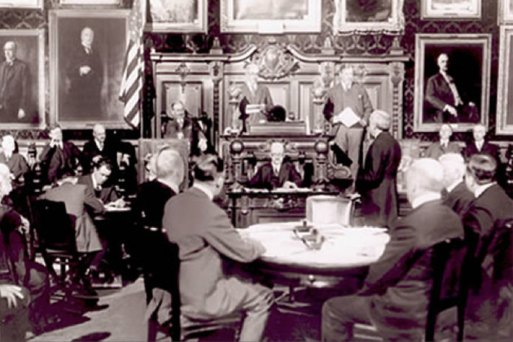
1921 Signing of the Compact

Signing of the Compact of 1921

By Portfolio Editor Roz Hamlett

As far back as the 19th century, New York and New Jersey squabbled over the jurisdictional rights of the Hudson River, once even drawing an imaginary line down the middle of the river, which didn’t really help matters along.  The rivalry only got worse during World War I when congestion in New York Harbor became unmanageable.

That is, until the leaders of the New York Chamber of Commerce, Chairman Eugenius Outerbridge and Julius Henry Cohen, saw the harbor problem as more than the latest round of bickering and turmoil between the states.  For them, it was an opportunity to develop a unified port; they understood that cooperation between the two states would ultimately benefit both.

The end of April marks the 95th anniversary of the day their vision was realized and the Port Authority was born.  On that momentous Saturday in 1921, a group of men from New York and New Jersey, gathered in a spirit of civility inside the elaborately paneled Great Hall of the New York Chamber of Commerce in Lower Manhattan to sign the Port Compact, creating the Port District of New York & New Jersey, the first authority in the country.

They pledged their “faithful cooperation in the future planning and development of the Port of New York.”  By the following year, the agency had begun its mission of transportation and trade that has continued uninterruptedly for nearly a century.

In 1921, the Port District had 105 organized municipalities, was served by 12 trunk line railroads and transported more than 75 million tons of freight annually.  There were at least 8,000 foreign and domestic steamships maneuvering in and out of the Port, moving 45 million tons of goods.

During the ensuing years, the modern Port Authority of New York & New Jersey moved beyond the port to reshape completely the region and adapt the agency to the modern demands of the 20th and 21st centuries, giving rise to some of the most ambitious and breathtaking works in the history of civil engineering, including the Lincoln Tunnel, and the George Washington Bridge, the Bayonne Bridge and the Goethals Bridge.  The agency acquired jurisdictional rights to the Holland Tunnel in 1931.

After World War II, the bi-state agency spread its wings further to claim as one historian put it, “the skies and the seas,” emerging as a major political and economic force in the New York region and nationally, developing the busiest airports in the nation and participating in the containerization revolution at the port, as well as constructing the largest and busiest bus terminal in the world and acquiring and rehabilitating the PATH system.

There is no comparable transportation organization in the country, a documentarian once wrote, “which is so little known or understood by the people it serves – let alone by the tens of millions of Americans around the country whose lives have been influenced directly and indirectly by the [Port Authority].”

Did You Know:

1921 wasn’t notable only for the birth of today’s Port Authority.  Many incomparable brands and organizations launched that year have become famous and familiar trademarks.

  • The wildly popular Chanel No. 5 was introduced in 1921 by French couturier “Coco” Chanel, so named because Coco chose the fifth fragrance presented to her by her perfumer.
  • Guccio Gucci started out in Florence, Italy, with a small family-run luggage company.  Today, a vintage 1921 Gucci bag retails at close to $10,000.
  • Betty Crocker never lived, but the company of the same name was founded to handle thousands of responses to a contest promotion for Gold Medal flour.
  • Land O’Lakes butter was created after 320 dairy farmers met in St. Paul, Minn. to form the Minnesota Cooperative Creameries Association.
  • Sardi’s restaurant was founded by Northern Italian immigrants Vincent Sardi and Eugenia Pallera, not long after they landed at Ellis Island, and not far from the Walter Kerr Theater and the landmark Ambassador Theater, which also opened in 1921.
  • The first Miss America Pageant was held in Atlantic City, N.J.  
Posted in Austin Tobin, historic photographs, history, Hudson River, NY/NJ region, NYC, PONYNJ, Port Compact of 1921, Port of New York & New Jersey, Port Region, Port Region of New York and New Jersey, Trans-Hudson, Uncategorized | Tagged , , , , , , , , , , , , , | Leave a comment