George Washington Bridge: A New Defense System Against Corrosion  

By Neal Buccino, Media Relations Staff

For 85 years, the George Washington Bridge has stood majestically above the Hudson River’s swirling waters.

But ironically, the most insidious enemy facing the iconic span is water in another form — specifically, the gradual damage moisture can inflict by corroding more than 100,000 steel wires within its yard-thick main cables.

The bridge can’t escape the elements completely, given its river proximity. As part of a major Port Authority rehabilitation program called “Restoring the George,” however, it is soon to become only the third suspension bridge in America to receive the equivalent of a supercharged, water-fighting immune system.

The system to dehumidify the bridge’s main cables will employ a computer-controlled array of fans and tubes for a fairly simple purpose: to drive moisture out and keep it out by continuously pumping dry air through the entire length of the cables.

“This project is historic,” said Paul Crist, Assistant Director of the Port Authority’s Department of Tunnels, Bridges & Terminals. “The rehabilitation and upgrading of the main cables, and complete replacement of the suspender ropes, is a once-in-a-lifetime project – not just for the bridge itself, but for the engineers at the Port Authority.”

The bridge’s four main cables are each composed of 26,474 tightly bound, pencil-thick wires that stretch 5,235 feet between the New York and New Jersey anchorages. The dehumidification system will force dry air through the tiny spaces between those wires to absorb any trapped moisture before exiting through exhaust ports. An elastic polymer wrap will encase the cables to maintain a properly pressurized, dry atmosphere. Once in place, it will take approximately two years for air inside the cables to reach the target of 40 percent humidity – a level at which corrosion is greatly reduced.

“The George has served for 85 years as an important link for the regional economy,” Crist said. “This and other projects will keep it operating for future generations.”
Such dehumidification systems for the main cables of suspension bridges were introduced about 20 years ago in Japan after corrosion was found at several bridges that were less than a decade old. They have since been used across Europe and Asia, and have become a standard feature in new suspension bridges.

The practice of retrofitting these systems into older suspension bridges, however, is still new to the U.S. The 64-year-old Chesapeake Bay Bridge was the first to use a dehumidification a system, in 2014. The Delaware Memorial Bridge, at the age of 61, is the second, with a project currently underway.

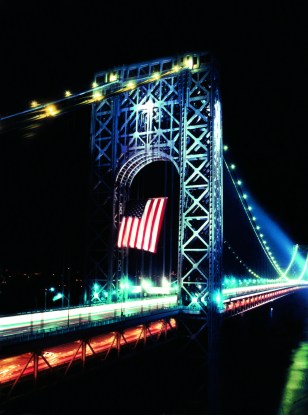
The George Washington Bridge remains structurally sound, thanks to aggressive maintenance and extremely high standards used in its original design and construction.  It opened in 1931 with just one roadway, although it was designed to add a lower level with four electric rail lines. The lower level, added in 1962, is much lighter than the planned rail bed and leaves much of the crossing’s strength in reserve.
g

Today, less than 1 percent of the main cables wires have any level of corrosion. But the new dehumidification system is an important investment in the future. It will coincide with the replacement, beginning next year, of all 592 steel suspender ropes that hang from the main cables to support the two road levels.

The bridge, the world’s busiest, is truly one of America’s great engineering marvels and a source of inspiration not only to architects, engineers and travelers, but writers and artists. Emily Dickinson was inspired by the invention of the suspension bridge.  She compared their giant steel cables to a parent’s protective arms, and their strength to that of religious faith.  Not needing intermediate supports, they are “pierless” as well as peerless, she wrote in 1855:

Faith – is the Pierless Bridge …

It bears the Soul as bold

                As it were rocked in Steel

                With Arms of Steel at either side …

For modern-day poets – and drivers — the new dehumidification process and other restorative measures envisioned by “Restoring the George” should ensure that sense of safety and security endures well into the next century.

Posted in bridges, cable-stayed bridge, George Washington Bridge, GWB, history, New Jersey, New York, NY/NJ region, Port Authority of New York & New Jersey, Uncategorized | Tagged , , , , , , , | Leave a comment

Teterboro Airport: Gateway for the 50,000th Grateful Cancer Patient

By Lenis Rodrigues, Media Relations Staff

Teterboro, the oldest operating airport in the New York/New Jersey region, serves as a vital gateway for the families of thousands of cancer patients who are seeking lifesaving treatments all over the country, thanks to the efforts of the Corporate Angel Network (CAN).

Since its inception in 1981, CAN has facilitated some 50,000 flights for cancer patients.  with about 5,000 flights flying in and out of Teterboro since 1982. CAN marked a major milestone in April when the company flew its 50,000th cancer patient.

16

That flight originated from Teterboro. The patient, one-year-old Baron Yerby, was diagnosed with retinoblastoma, a rare form of eye cancer, at the age of 3 months. CAN reached the 50,000flight milestone when it transported Baron and his family back home to Atlanta after he received cancer treatment at Memorial Sloan Kettering in New York City.

Baron’s father, Johnathan, is grateful to the people at CAN because he doesn’t have the added stress of worrying about flight logistics.  Were it not for the angel flights, the family typically would have to fly commercially and Baron would sit on his parent’s lap the entire flight.  “So it’s also a great deal easier and more comfortable for Baron, too,” he said.

The family will be flying back to Teterboro Airport on May 15th because Baron is scheduled for medical procedures. “We are so thankful for everyone involved,” said Johnathan. “CAN is really living up to the “Angel” portion of the network.”

CAN is the only charitable organization in the United States whose sole mission is to arrange transportation for treatment for cancer patients using seats that are donated on corporate aircraft. More than 500 major corporations participate. The organization arranges an average of 225 patient flights each month to cancer centers.

Teterboro, the general aviation relief airport for the New York metropolitan area, handles the lion’s share of the region’s smaller business jets. A relief airport provides additional capacity to an area when the primary airports are at capacity.  Teterboro is one of four such facilities in the New York/New Jersey area.

“We waive the landing fees for these flights in support of the angel flight program,” said Renee Spann, General Manager of Teterboro, “It’s a small amount, but we’re happy to do it because every little bit makes a difference.”  Every part of the angel flight operation depends upon the generosity of others; even the pilots donate their time.

“Having flown 50,000 cancer patients to specialized and often life-saving treatment using empty seats in corporate jets already flying to the desired destinations is a remarkable milestone for our organization,” said CAN’s Executive Director Emeritus, Peter H. Fleiss.

“We want to let cancer patients know that they have an option to travel to the best possible treatment for their specific type of cancer while at the same time, making their lives, and the lives of their families, considerably less stressful during a very difficult time,” Fleiss said. “We also hope to bring new corporate partners into the fold to expand our ability to help more people.”


Posted in aviation, New Jersey, New York, NY/NJ region, Port Authority of New York & New Jersey, Teterboro Airport, Uncategorized | Tagged , , , , , , | Leave a comment

PATH: The World’s Most Special Souvenir

EDITOR’S NOTE:  This is the story of what Kevin Duchi and Evelien Delagrange decided to do one day while riding the PATH train together into Manhattan, and the amazing souvenir they’re taking back home this week.

By Evelien Delagrange, PATH Rider, Guest Blogger 

Photography By Sascha Reinking

Our story began on May 29, 2011 in Kortrijk, a small city in Belgium. Kevin and I met first at a local bar, and it was love at first sight.

Working as a private banker in Belgium, it was always Kevin’s big dream to attend NYU and take a special course in finance.  We cleared things with our respective employers, made our plans and arrived at Newark Liberty International Airport in February 2016.

PATH became an integral part of our lives.  We picked an apartment in Jersey City because of its proximity to PATH.  It was the most convenient commute for Kevin to NYU.  So I started, very gently, talking with him during this time about what might be the most unforgettable souvenir from our stay in New York/New Jersey.

The rest is history. Kevin proposed to me at the beautiful waterfront Exchange Place in Jersey City, followed by a sunset visit to One World Trade Center, where we toasted our engagement and drank champagne.

Luckily, our parents approved, and in four weeks we arranged our big day:  the blue shoes (you gotta have something blue), the suit, the photographer and the marriage license at the City Clerk’s Office in Manhattan.

It was the perfect day.  Our photographer, Sascha Reinking, captured all our moments and served as our witness as well. We began the day at Exchange Place, where he photographed us with the lower Manhattan skyline in the background. We rode the PATH to the WTC station, and we were on our way into the Oculus when we were surprised by a cloud of dusty smoke coming toward us and the sounding of the fire alarm. Everybody was asked to evacuate the station.  We stayed long enough to allow Sascha to capture us alone in the Oculus – WOW!

Later, we found out the ventilation system had caused dust to trigger the alarm. What was a frightening moment inside the Oculus turned into the most beautiful wedding picture of all.

We celebrated with Belgian beer, mussels and fries in a Belgian restaurant – the perfect combo of Belgium and New York. At the moment, I am writing this blog from Mexico, where we are enjoying our honeymoon. Sadly, our great New York adventure is coming to an end this week.  Our lives in Belgium are awaiting us – our new house, our cat Lucy, our jobs, our friends and our family with whom we will celebrate with an intimate wedding party.

When we return to Manhattan in the future, we will retrace our steps, ride the PATH train and be reminded of our wedding day every time we hear ‘Stand clear of the closing doors!’

Posted in 9/11, Big Apple, daily commute, Exchange Place, Jersey City, New Jersey, New York, Newark Liberty International Airport, NY/NJ region, NYC, One World Trade Center, PANYNJ, PATH, PATH Trains, Port Authority Trans-Hudson, Winter Storm Jonas, The Oculus, Trans-Hudson, transportation, Uncategorized, World Trade Center Transportation Oculus, WTC PATH station | Tagged , , , | Leave a comment