The Holland Tunnel: Did You Know?

Did you know that the Holland Tunnel was named after Clifford Milburn Holland, the chief engineer in charge of its design and construction? Holland was a brilliant young engineer who gave his life for the tunnel.  As construction on the New York and the New Jersey tube neared the joining point beneath the Hudson River, Holland collapsed from exhaustion and died soon after at the age of 41.

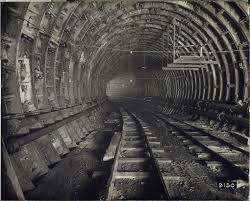
Did you know that the tunnel tubes are made of cast iron segments bolted together?  Fourteen of these sections are required to make a complete ring. Each section weighs 1-1.5 tons and is held in place by bolts weighing 10 pounds.

imagesNW88DDPY

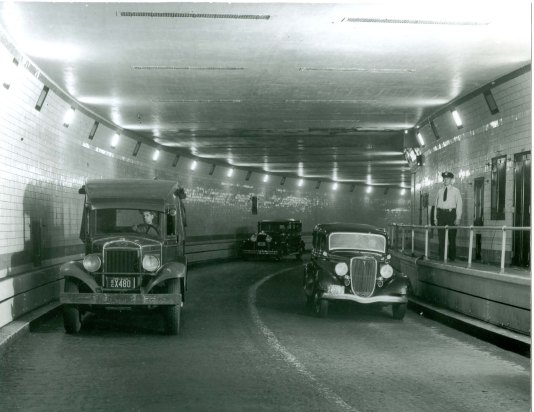
Did you know that during its first full year of operation in 1928, the Holland Tunnel handled 8,744,600 vehicles?

HT_2

Did you know that the Holland Tunnel has four large ventilation buildings, two on each side of the Hudson River that house 84 huge fans, which change the air direction in both tunnels every 90 seconds?

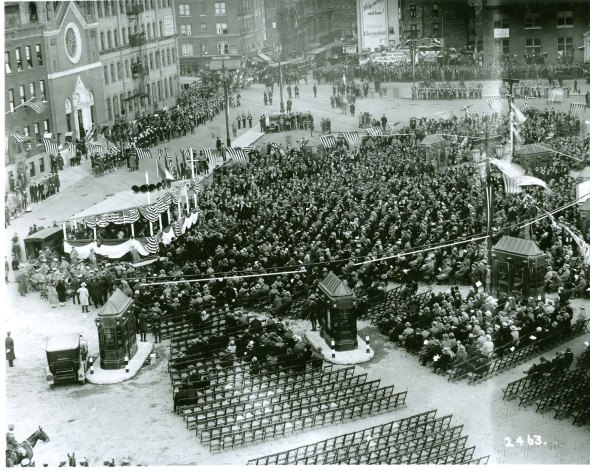
Did you know that in 1930 the Holland Tunnel was considered by many as the eighth wonder of the world because it was the longest underwater tunnel in the world?

HT7

Did you know that the Holland Tunnel cost $48.5 million to build? Today the cost would be more than $1 billion.

Did you know there is only 13 feet, six inches between the roadway and the ceiling of the tunnel?

HT_3

Did you know that the Holland is under the floor of the Hudson River? It is 72 feet from the surface of the river to the top of the tunnel.

Did you know that the outside diameter of the tunnels is 29 feet, six inches?

Did you know that construction of the Holland Tunnel took seven years?  Construction began Oct. 12, 1920 and was completed on Nov. 12, 1927.

HT_1

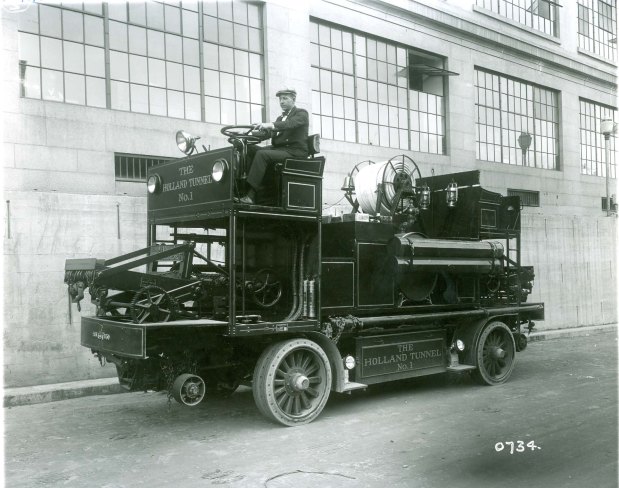
Did you know that the methods used in the design and construction of the Holland Tunnel still form the basis for construction of underwater vehicular tunnels throughout the world?


Posted in historic photographs, history, history buffs, Holland Tunnel, Hudson River, Hudson tunnels, New Jersey, New York, NYC, PANYNJ, Port Authority of New York & New Jersey, Uncategorized | Tagged , , , | Comments Off on The Holland Tunnel: Did You Know?

Before PATH Became PATH: The Wonder Years

By Portfolio Editor Roz Hamlett
path_history_1962

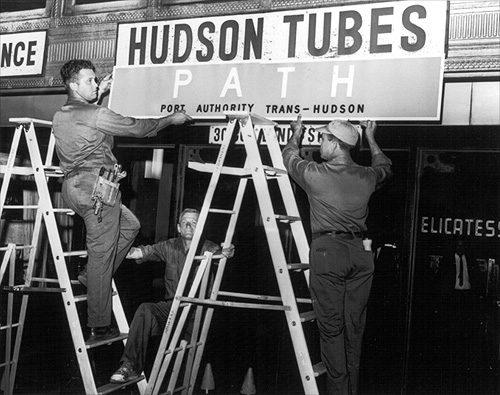
More than 50 years ago, in 1962, the Port Authority Trans-Hudson Corporation (PATH) acquired the title to rehabilitate the Hudson & Manhattan (H&M) Railroad Tunnel and begin operations.  Ten years later, two bronze plaques were unveiled designating the old H&M tunnel as an Historic Civil Engineering Landmark.  One plaque was placed in the Hoboken Terminal (at the west end of the platform between Tracks 1 and 2, above the dispatcher’s booth) and another was placed in the World Trade Center.  But the backstory of PATH had begun years earlier, during the late 1800s, as America opened its eyes and ears to new possibilities.  From Thomas Edison to Alexander Graham Bell, the country was transmitting light and sound across great distances like never before.  Bridges were built, and railroads lines were extending in a crisscross of intersecting track and signals both above and below ground.

5/26/1873:  The history of the PATH system dates back to the incorporation of the Hudson Tunnel Railroad Company on May 26, 1873, led by Colonel De Witt Clinton Haskin, a businessman from Upstate New York, who made his fortune on the construction of the California Pacific Railroad and in the Utah silver mines.

11/17/1874:  Tunnel construction began with the sinking of a shaft on Fifteenth Street in Jersey City, N.J.  Work halted for five years because of litigation by Delaware, Lackawanna & Western Railroad for the amount of compensation for property acquired through eminent domain.

9/22/1879:  The injunction was dissolved and construction of the first tunnel under the Hudson River got underway.

7/21/1880:   A major blowout occurred when a leak developed on top of the tunnel, letting out compressed air into the 30 feet of silt between the tunnel and the river bottom.  As the hole grew larger, river water flooded the tunnel, trapping 28 men inside.  Miraculously, eight men escaped through the air lock, but the rest of the men died.

11/4/1882:  Construction progressed for the next two years until the death of Trevor W. Park, Haskin’s associate and financial backer.  At that time, the north tunnel extended 1,542 feet from the New Jersey side and 75 feet from the New York side, while the south tunnel extended 562 feet from the New Jersey side.

2/11/1902:  After work halted again in 1892 because of financial difficulties, the New York and New Jersey Railroad Company was formed to complete the project.

9/29/1905:  The Uptown Tunnel – North Tunnel “holed” through on March 11, 1904. Six months later, the South Tunnel holed through.

12/1/1906:  The New York and New Jersey Railroad Company was later consolidated into the Hudson and Manhattan Railroad (H&M), which has nothing to do with the H&M retail clothing store for men, women, teenagers and children.

2/25/1908:  On the afternoon of February 25, President Theodore Roosevelt pressed a button from the White House that turned on electrical power to the system.  The first train was filled with dignitaries and celebrities, including New York Governor Charles Hughes, New Jersey Governor John Fort, August Belmont, Cornelius Vanderbilt and George Westinghouse.  They journeyed from Sixth Avenue and 19th Street in Manhattan to the Lackawanna Terminal in Hoboken in just 10 ½ minutes.  The H&M Railroad began operating at midnight and nearly 100,000 passengers used the system during its first day of service.

7/19/1909:  Service on the downtown H&M tunnels began between Jersey City and the Hudson Terminal in Lower Manhattan to what is now the World Trade Center Transportation Hub Oculus.

11/10/1910: The Uptown Tunnels were extended north to a new terminal station at Sixth Avenue and 33rd Street, then known as Greeley Square . Each of the terminal stations was designed with platforms on both sides of the track so that passengers could exit one side of the train while passengers could enter on the other side.

11/26/1911: The system was extended to Newark.

Posted in historic photographs, history, history buffs, Hudson & Manhattan Railroad, Hudson River, Hudson tunnels, New Jersey, New York, Newark, NYC, PATH, PATH Trains, Port Authority Trans-Hudson, Winter Storm Jonas, Port Authority, Port Authority of New York & New Jersey, Port Authority Trans Hudson, Trans-Hudson, Uncategorized, World Trade Center, World Trade Center Transportation Oculus | Tagged , , , , , , , | Comments Off on Before PATH Became PATH: The Wonder Years

PAPD & Music: Two Intertwined Passions

By Mercedes Guzman, Media Relations Staff

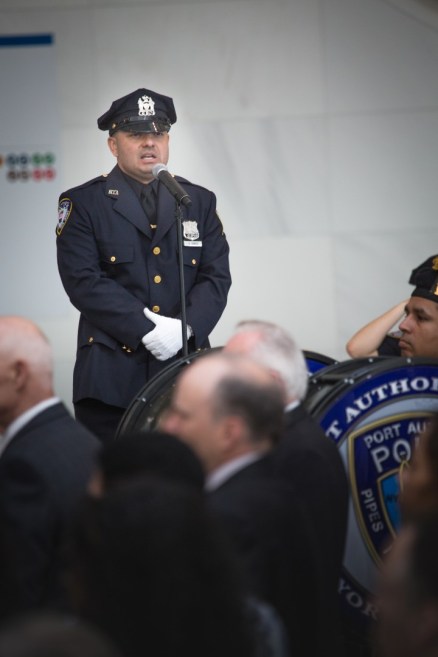
When a new section of the WTC Transportation Hub Oculus opened last week, connecting the PATH station to nine New York City subway lines, PAPD Officer Gilbert Sinuet’s patriotic and soulful rendition of the National Anthem filled the grand hall during the ceremony marking the historic occasion.

Oculus Opens

PAPD Officer Gil Sinuet

Once, Sinuet was among the top 30 competitors on the hit television show American Idol where he performed Stevie Wonder’s “Ribbon in the Sky.” He’s also sung back-up for well-known freestyle and salsa singer George Lamond.  Not every singer has the lung capacity to belt out the National Anthem at an NFL game, but Sinuet does. His a cappella voice has soared over the crowds at MetLife Stadium.

Sinuet discovered his voice while in high school when a friend paid him to sing to a love interest. He sang “Together Forever” by Shai, and his buddy got the girl.  That’s when he knew for sure he had a special gift. Yet despite his obvious talent and musical successes, Sinuet considers himself fortunate to be living his other dream: a true calling to law enforcement.

“I get the chance to serve and protect Port Authority facilities as well as sing,” said Sinuet, 37, who began pursuing a career in law enforcement with the PAPD after his mother survived the September 11 attacks.

After the attack, Sinuet shifted his attention away from singing and focused on becoming a police officer.  After completing his exams and waiting patiently for a phone call, PAPD called him just before he reached the PAPD’s age limit of 35.

Towards the end of his Police Academy training, someone discovered videos of him singing on YouTube and began showing it around.  Everyone quickly found out that Sinuet had a wonderful voice and that’s how he became the PAPD singer. He now sings the National Anthem at major Port Authority events.  As the saying goes:  follow your bliss and the rest will follow, which has been the case for Sinuet, who is assigned to the Newark Liberty International Airport Command.

“I have a rare opportunity.  It’s the best of both worlds to be able to share the gifts that God has given me,” he said.

Posted in 9/11, 9/11 Memorial and Museum, New York, NY/NJ region, NYC, One World Trade Center, PAPD, Port Authority, Port Authority Police Academy, Port Authority Police Department, Uncategorized, World Trade Center, World Trade Center Transportation Oculus | Tagged , , , , , , | Comments Off on PAPD & Music: Two Intertwined Passions