One WTC: Lightning Always Strikes the Same Place Twice

By Portfolio Editor Roz Hamlett 

The New York/New Jersey region isn’t ‘lightning alley’ – that distinction belongs to Tampa, Fla. Being home to One World Trade Center, the tallest skyscraper in the Western Hemisphere, does mean the metropolitan area experiences its share of intense lightning strikes, especially on hot, humid days.   Lightning is drawn to the tallest of buildings like tourists to New York City attractions. Does that mean that being anywhere near One WTC during a storm is particularly dangerous? In most instances, the answer is no, not really.

“One WTC being the tallest building in North America will attract more lightning than the Memorial Pools or Liberty Park because its height significantly reduces the insulating air gap between the ground and the clouds,” said Alan Reiss, director of WTC construction.

In fact, there even was concern in the aftermath of 9/11 that Lower Manhattan would become more vulnerable to lightning strikes in the absence of the towers, which averaged more than 20 strikes a year. Even before One WTC opened to the public, its spire had attracted multiple strikes.

Rather than increasing the risk of a lightning strike in its vicinity, One WTC actually protects the surrounding area due to a phenomenon known as “the degree of influence.” Notwithstanding lightning’s preference for tall objects, the general rule of thumb is that an object will only attract lightning at a distance that is at or less than the object’s height.

“Because One WTC is 1776 feet high, the tower essentially protects anything within a circle centered around it with a radius of 1776 feet,” said Reiss. “Perhaps one in 100 lightning strikes might occur within that zone, but I never heard of lightning ever striking the pools.”  One WTC is safe during lightning strikes because of its state-of-the-art protection system, which is based on the same concepts pioneered by Benjamin Franklin. Lightning rods now are mounted on the roof tops of buildings, houses and 4 World Trade Center.

Following Franklin’s modern lightning protection system, One WTC is a super-sized Faraday cage that distributes electrical current around the outside of the tower, with none of it passing through the interior space of the building.  The current discharges into the bedrock below the tower and dissipates into the earth. A Faraday cage is an enclosure made of conductive material that blocks electric fields.  Elevators, MRI scan rooms and aluminum insulated bags are all examples of Faraday cages.

Reiss offers the following safety tips for keeping safe during lightning strikes:

  • If thunder is heard or lightning is seen, get inside a completely enclosed building or a metal car.
  • If you cannot reach shelter, avoid being the tallest object in the area.
  • Never shelter beneath a tree. If you’re in the woods, shelter beneath the shortest trees.
  • If only isolated trees are nearby, crouch down on the balls of your feet.
Posted in New Jersey, New York, NY/NJ region, NYC, One World Trade Center, PANYNJ, Port Authority of New York & New Jersey, Uncategorized | Tagged , , , , , , | Comments Off on One WTC: Lightning Always Strikes the Same Place Twice

PONYNJ: Ten Things You Don’t Know About Shipping

Compiled by Port Authority Staff

When it comes to commercial shipping, history is being made across the New York/New Jersey region. From raising the Bayonne Bridge to accommodate larger ships to dredging the port harbor to 50 feet to allow adequate draft for the bigger ships coming to call on the East Coast, the local Port Authority ports are busier than ever.

MPDD0022a

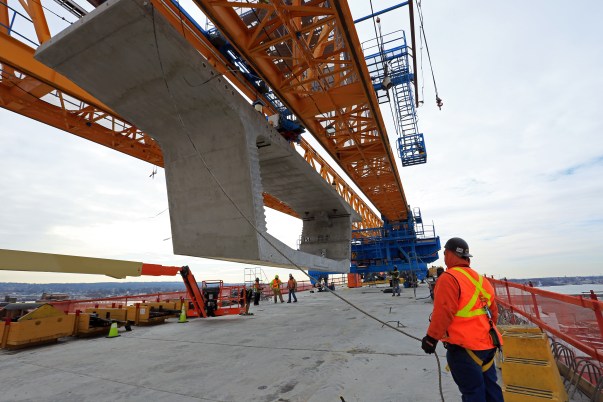
New section of roadway being installed at the Bayonne Bridge. Photo by Mike Dombrowski

The world of shipping is reinventing itself. But before that reinvention is complete, here are 10 fascinating (and little-known) facts about the shipping industry, courtesy of the blog Humans at Sea. 

  • A container ship travels the equivalent of three-quarters of the way to the moon and back in one year during its regular travel across the oceans.
  • The largest ships can store 745 million bananas in nearly 15,000 containers – about one for every person in Europe and North America.
  • Worldwide, less than 10 percent of containers are actually inspected. U.S. ports normally inspect roughly 5 percent of the 17 million containers arriving at the border every year.
  • Shipping is cheap. So cheap, in fact, that rather than fillet its own fish, Scotland can send its cod 10,000 miles across the ocean to China to be filleted, and then sent back for less than the price of doing it themselves.
  • There are roughly 20 million containers crossing the world, in ships that have about 1,000 times more power than the family car.
  • The largest container ships can cost more than $200 million to build.
  • About two-thirds of ship crews in the world have no means of outside communication while they are on the open sea. Only about 1 in 10 will have freely available Internet.
  • It can be a dangerous career: every year, more than 2,000 sailors die at sea, and two ships are lost every day. In 2010, Somali pirates held 544 seafarers hostage.
  • Stack up the containers from a ship and it would reach nearly 7,500 Eiffel Towers; unload their cargo onto trucks and the traffic would stretch 60 miles.
  • It’s still a man’s world on the high seas: only 2 percent of seafarers are women.
Posted in Bayonne Bridge, commerical shipping, containerization, Elizabeth, New Jersey, North Atlantic shipping, NY/NJ region, PANYNJ, PONYNJ, Port Authority, Port Newark/Elizabeth Marine Terminal, Port of New York & New Jersey, Port Region, Uncategorized | Tagged , , | Comments Off on PONYNJ: Ten Things You Don’t Know About Shipping

The Holland Tunnel Takes a Breather

By Portfolio Editor Roz Hamlett

In 1927, hours before the Holland Tunnel was due to open officially, Chief Engineer Ole Singstad wanted a final moment alone with his new tunnel.   Singstad’s major contribution to the tunnel was its ventilation system, which has since become the worldwide standard for all vehicular tunnels.


HT_1

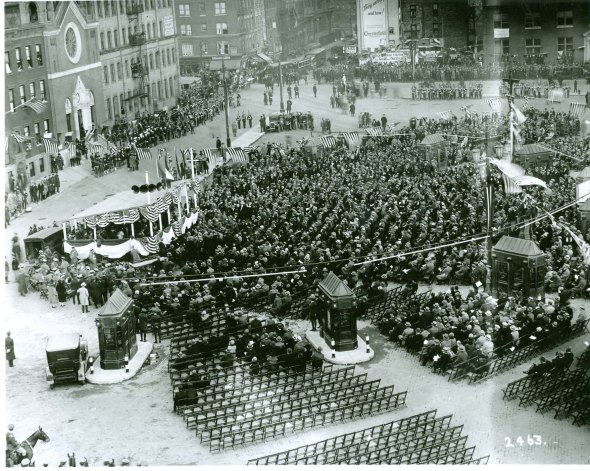
For political reasons, all the speeches given at the eastbound tunnel in Jersey City had to be repeated at the entrance to the westbound tunnel in Manhattan.

Singstad later told the New York Times, “I couldn’t wait to enjoy my tunnel, and so I set out to walk it alone.  Soon I heard a rumbling, shuffling sound in the distance. ‘Good God!’ I thought, ‘it sounds like an ocean, like the tunnel’s caved in.’”

Singstad had the jitters anyway because of widespread predictions of a ventilation system failure or some other major tunnel disaster, but his fears were unfounded. Jumping up to the sidewalk, he was relieved to discover the noise wasn’t water, but only a wave of pedestrians who had been allowed a tunnel preview.

***

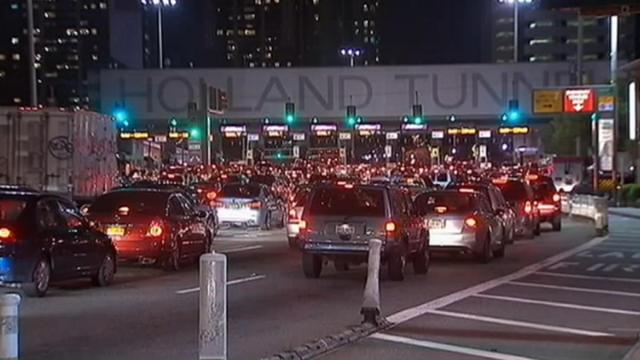
The tunnel built by Singstad, Clifford Holland and a legion of others never suffered a catastrophic failure.  Rather, it has proven itself sturdy and remarkably resilient through the ages, connecting lower Manhattan and Jersey City for more than 34 million motorists annually.  As the tunnel has aged, the Port Authority has made upgrades to keep its operations state of the art, including to its ventilation system, which has inhaled fresh air and exhaled toxic carbon monoxide every 90 seconds for almost 90 years.

HT 1935 NJ to NY

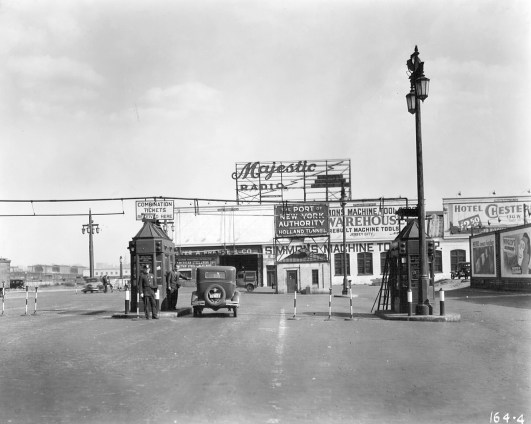
The eastbound tunnel entrance in Jersey City. When enabling legislation for the Holland was passed in 1919, lawmakers assumed the tunnel would be used by pedestrians, horse-drawn wagons, trucks, and a few “pleasure vehicles” aka cars.

As Stephen Ansine, Physical Plant Manager, described it recently, “The ventilation system is the heart and lungs of the tunnel. Without a properly functioning ventilation system, the Holland Tunnel doesn’t operate. It’s just a hole in the ground.”

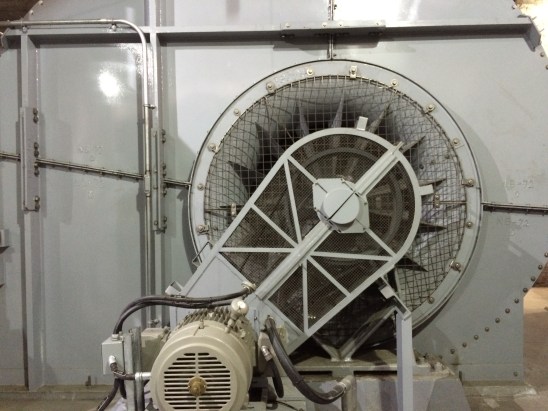
Proper ventilation inside the tunnel relies on 84 massive fans, which the Port Authority currently is replacing with more energy-efficient and quieter models in an ongoing state-of-good repair project due for completion in 2017.

IMG_3217

One of the new fans recently installed at the Holland Tunnel

Tunnel Systems Controllers operate the ventilation system 24 hours a day, seven days a week and 365 days a year to ensure the safety of the public using the tunnels. The system has 14 sets of intake and 14 sets of exhaust fans, with the air divided among 14 exhaust ducts and 14 intake ducts.  Each duct is equipped with three adjustable speed fans for a total of 84 fans.  The system operates by drawing fresh air from the outside through the Ventilation Buildings, with a land and river building located in both New York and New Jersey.

IMG_3216

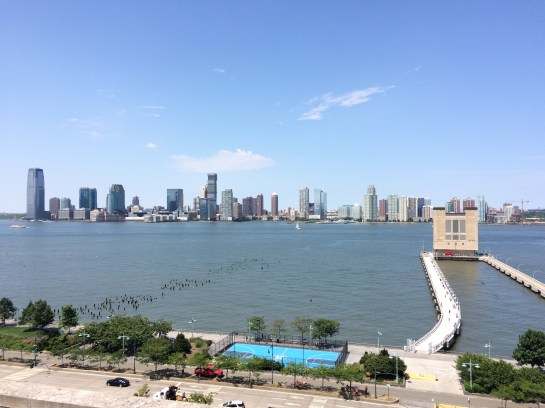
New York river ventilation building with downtown Jersey City in the background.

A roaring air stream is divided among ducts and blown into the main duct underneath the roadway in each tunnel, where it passes through ports located along the roadway.  The fresh air mixes with vehicle exhaust before being drawn up toward the ceiling, which then is pumped out through slits in the ceiling into the exhaust air duct.

Maintaining healthy air quality requires that someone monitors the fans and makes adjustments as necessary 24 hours a day. Two fans operate a single duct during peak times of traffic congestion. During less busy times, one fan is sufficient to maintain air quality.  A third fan serves as backup.  Ansine is assisted in his responsibilities by two supervisors, Dan Brijlall and Robert Reilly, who share more than a half century of Holland Tunnel experience between them. “There isn’t much that has happened at the Holland Tunnel over the years they haven’t handled,” said Ansine, “Folks like Dan and Bob make it happen. Whatever arises, I always ask them, ‘what have we done in the past’?” he said.

Holland Tunnel people are a bit like sports fans when it comes to the natural rivalry between the Holland and the Lincoln. They like to brag that the Holland’s white tile is cleaner, and the air inside is cleaner than the air outside. Said Ansine, “It’s all in good fun, but we’re fortunate to have a great team.  We do what we have to do to make good on the guarantee that every motorist can make it through safely.”

holland+tunnel+tolls

Annually, more than 34 million motorists use the Holland Tunnel.

Posted in historic photographs, history, Holland Tunnel, Hudson tunnels, Jersey City, New Jersey, New York, PANYNJ, Port Authority of New York & New Jersey, Uncategorized | Tagged , , , | Comments Off on The Holland Tunnel Takes a Breather