World Trade Center Liberty Park: “America’s Response Monument” Finds a Home

By Portfolio Editor Roz Hamlett

A larger-than-life sculpture of a Green Beret mounted on an Afghan mountain horse has finally found a permanent home at the World Trade Center Liberty Park, nearly five years after its 2011 debut during the Veteran’s Day Parade in Manhattan.  Steve Plate, the Port Authority’s Chief of Major Capital Programs, called the statue, “a resolute symbol of strength, dedication and sacrifice.”

9-13-2016-wtc-6d-169

Photo by Mike Mahesh

Completed by artist Douwe Blumberg in 2011, the sculpture debuted on a float in the Veteran’s Day Parade down Fifth Avenue on Nov. 11, 2011. That year, it camped out temporarily in the West Street lobby of One World Financial Center opposite the World Trade Center. Amid ongoing discussions and varying opinions on where it should go, the sculpture was placed in front of the Vesey Street and West Broadway entrance to the WTC PATH rail station the following year.

Lt. General John Mulholland, the associate director of the Central Intelligence Agency for Military Affairs, along with veterans, top U.S. military personnel and other leaders, traveled to Lower Manhattan for the rededication event. Compared against the overwhelming size of the Taliban army, Mulholland’s elite corps of Green Berets seemed barely more than a few good men. But following 9/11, 34 U.S. Special Forces commandos eventually routed a Taliban army 50,000 strong in Afghanistan with grenade launchers attached to M4s.

Lt. Gen. John F. Mulholland speaks at America's Response statue dedication

Lt. Gen. John F. Mulholland Jr., Associate Director for Military Affairs at the CIA, gives the keynote speech during the America’s Response statue rededication. Mulholland served as the Task Force Dagger commander in Afghanistan following the 9/11 attacks. (U.S. Army photo by Cheryle Rivas, USASOC Public Affairs.)

Made of bronze and weighing some 3,500 lbs., the sculpture stands 13 feet tall and is mounted on a three-foot-tall granite plinth. Blumberg was inspired to create a smaller version of the statue after he saw a photo of the special ops team on horseback in Afghanistan.  An anonymous group of Manhattan businessmen who lost friends and co-workers on 9/11 commissioned the sculptor to build a large-scale version for the Veteran’s Day parade.

9-13-2016-wtc-6d-393-00000002

Steve Plate, Chief of Capital Programs with General Mulholland.


Posted in 9/11, 9/11 Memorial and Museum, Ground Zero, One World Trade Center, PANYNJ, Port Authority of New York & New Jersey, September 11, Steve Plate, Uncategorized, Veteran's Day Parade | Tagged , , , , | Comments Off on World Trade Center Liberty Park: “America’s Response Monument” Finds a Home

Flashback: Early Air Traffic Controllers

By Portfolio Editor Roz Hamlett

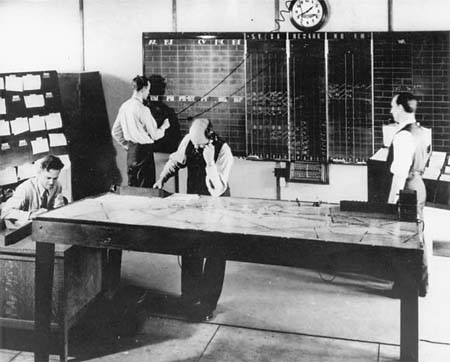
A flashback to Newark Airport’s history: operations at the first Airway Traffic Control Station in 1936 on a bleak and drizzly January afternoon.  At the time, Newark Airport was becoming the busiest commercial airport in the nation.  The airspace above Newark was growing more crowded.  This was the same month and year that Howard Hughes would fly into Newark, after completing his record-breaking flight across the United States from Burbank, California.
1stctr

By today’s standards, the air traffic control station was getting by on a wing and a prayer with tabletop maps, about four air traffic controllers and a blackboard of the sort used to teach school children.

The Newark control station had come into existence after a TWA flight crashed outside Kansas City, killing five persons, including the U.S. Senator for New Mexico. This accident sparked a Congressional probe and helped sow the seeds for the creation of an airline consortium in December, 1935.

Prior to the early 1930s, there wasn’t any need for a large organized system of air traffic control. Most flights took place on clear sunny days anyway.  According to Newark Airport legend, William “Whitey” Conrad, who died in 2000 at the age of 95, “there was no controlling air traffic back then. It was a free for all – a half-assed operation, but it worked,” he said in a 1996 interview.  Conrad is credited with developing the flag system at Newark for daytime traffic and the “biscuit gun” for use at night. The biscuit gun was a hand-held flashlight with reflectors.

_text_image

The bill introduced to name the air traffic control tower at Newark Liberty International after “Whitey” Conrad.

Flights during periods of restricted visibility were not permitted. Still on the horizon were advances in aircraft control and navigation that would permit flight at night under conditions of restricted visibility. That is, with one notable exception – among the first attempts to illuminate an airfield at night took place at Newark Airport in 1929, with a bank of floodlights mounted on a platform and pointed at the runway. Unfortunately, the floodlights only threw light onto a small portion of the runway.  By the late 1930s, the capability of aircraft to fly at night in marginal weather had improved.

The radio equipment of the 1930s was limited; there was no automated flight tracking system of any kind. Air traffic controllers did not have direct contact with the aircraft.  Rather, communication between pilots and controllers was accomplished through a third party – an airline dispatcher or a radio operator.

If pilots had to fly in bad weather, they first had to file an instrument flight plan with the airline. The plan included the type of aircraft, departure and arrival information such as airports and times, and other information.  The airline dispatcher forwarded this information to the Air Traffic Control unit, which then determined whether the route and altitude might conflict with other aircraft.

The controller wrote the flight plan on a chalkboard, and a note card was attached to a brass holder called a shrimp boat because it looked like a small fishing boat. These shrimp boats would be moved along the map, indicating the approximate positions of the aircraft as they flew toward their destinations.  The positions were measured with calipers. This manual tool worked similarly to a compass – one end was set in a fixed location and the other used to measure distance.  This is how controllers kept aircraft safely separated as they moved between airports.

plot

The early air traffic controllers tracked flights with markers called “shrimp boats” and using calipers.

Earl Ward organized the Newark facility. He is pictured above (left) tracking a flight with the aid of a caliper.

As each plane progressed through airspace, the pilots transmitted their position to an airline company radio operator, who then relayed this information to the ATCU controller by telephone or telegraph. As information was updated on the blackboard, the shrimp boats inched across the map.

(Under such rudimentary circumstances, it’s a minor miracle that the inadvertent tossing of a pair of calipers into a trashcan, or a shrimp boat that slips beneath a table, were never cited as underlying causes of an aircraft collision.)

On June 7, 1937, the Department of Commerce (DOC) began to acquire the ATCUs from the airlines and staff them with federally-certified controllers. The federal government renamed these facilities airway traffic control stations.  In May 1938, DOC became the licensing authority for all civilian air traffic controllers.  This began federal air traffic control, and the stations became the forerunners of today’s Air Route Traffic Control Centers.

shrimp-boats

Air traffic control modernizes with navigation technologies such as radar.


Posted in airport history, aviation, first nonstop flights, historic photographs, history of aviation, Newark Liberty International Airport, Uncategorized | Tagged , , , | Comments Off on Flashback: Early Air Traffic Controllers

Behind the Scenes at LaGuardia Airport: The Making of Sully

By Portfolio Editor Roz Hamlett

Smashing the weekend box office as the 2016 fall movie season kicks off, Sully is the true-life story of the rescue drama and the National Transportation Safety Board investigation that followed Capt. Chesley ‘Sully’ Sullenberger’s heroic Jan. 15, 2009 landing of US Airways flight 1549 on the Hudson River, after a geese strike caused both engines to fail.

hanks-and-clint

Nearly seven years to the day after the damaged airplane landed on an icy Hudson, Hollywood descended upon LaGuardia Airport to film the movie’s runway and terminal scenes. Oscar-winning Director Clint Eastwood brought with him Oscar-winning actor Tom Hanks, along with a full production crew and a massive 53-foot food truck with a kitchen big enough to feed hundreds in short order.

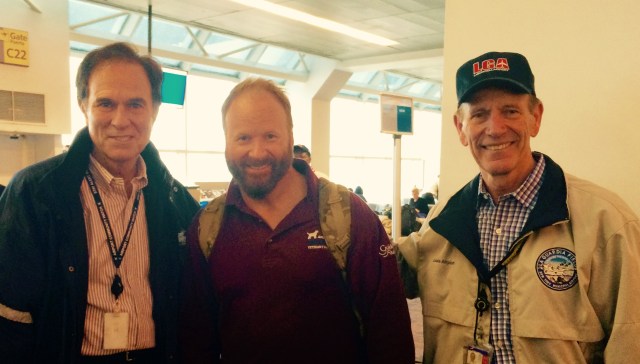
Brian Rohlf, LaGuardia Airport’s manager of Landside Operations and Customer Service, worked most directly with producer Tim Moore and his Location Director to pull together the logistics and support needs for Eastwood, Hanks and many others. Rohlf was not a newcomer to the behind-the-scene requirements of film productions at LaGuardia, but they were nothing like Sully.  “This one was incredible,” said Rohlf. “They brought in more than 300 extras and another 200-member production crew just to film this one-day shoot.”

rohlf-and-mundy-with-vet

Brian Rohlf (left) pictured with the wounded vet and Jim Munday (right).

There also was a supporting cast of Port Authority people, including Jim Munday, manager of Airport Operations, and airport staff, Port Authority police, and representatives of the Security, Operations and Maintenance departments, with support from the legal and risk management teams.

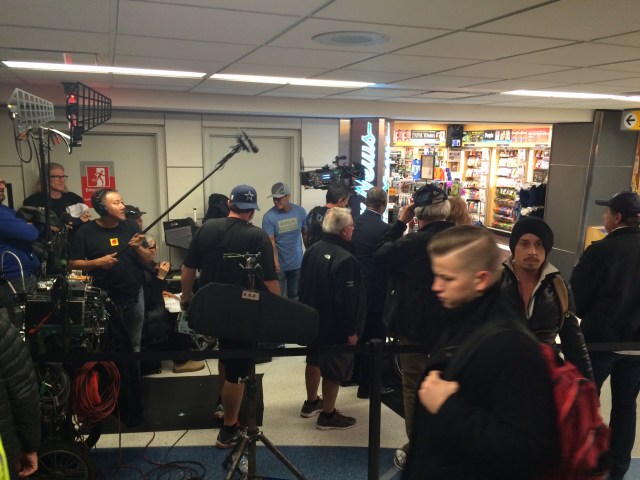
Most memorable was the filming of a scene that eventually required 20 takes. It took place on Concourse D in Terminal B as “Sully” is picking up a few things at the Hudson News stand before boarding the flight.

“Tom accidentally hit a candy display inside the store with his carry-on tote,” Rohlf recalled. “The candy flew all over the place. They had to pick it all up and start again.  Tom laughed, right along with everyone else.  During the 15th take, the Port Authority intercom system blurted out a loud recorded message that startled Hanks.  At that point, he just stopped and enjoyed the moment with Clint, who was standing off to the side.”

hudson-news-scene

Filming outside Hudson News.  The scene took 20 takes.

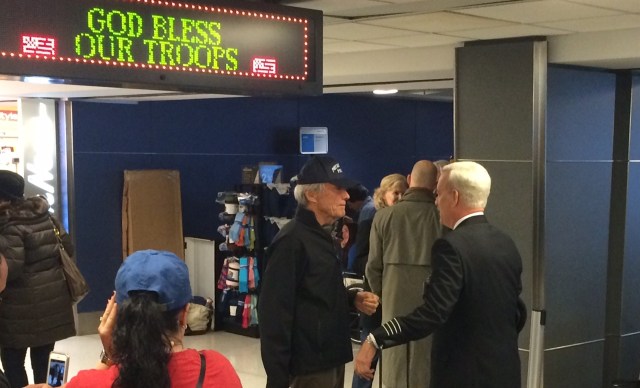
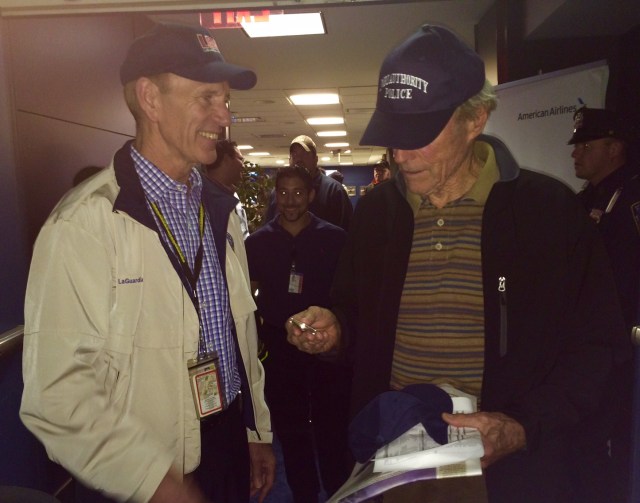
According to Rohlf, the A-listers were generous with their time and chatted casually with real-time passengers, extras and LGA staff. But Munday had the unenviable job of negotiating some of the many logistical demands of the film. “Initially they wanted as many large trucks/tractor trailers airside as possible to facilitate the shoot. They had to settle for less than half of it, but it all worked and they still accomplished what they needed to do,” he said.  At the end of the day-long filming session,  Jim Munday presented Eastwood with an LGA Challenge Coin and hat as a thank you for his support of the LGA community.

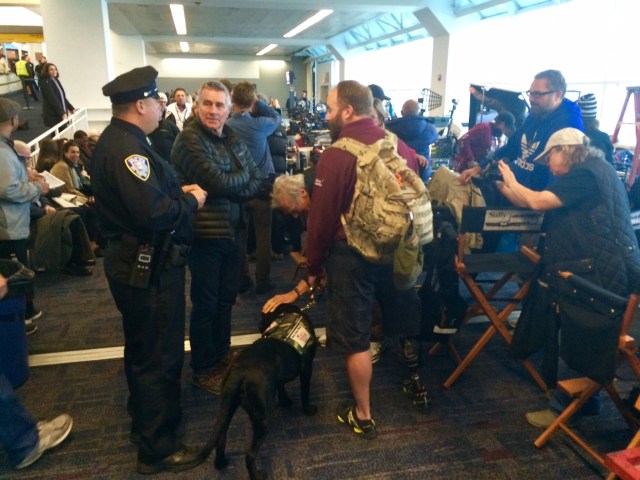
At the end of the first ‘movie shoot’ at the departure gate, Munday and Rohlf arranged a meeting with Eastwood for a wounded ex-Army Gulf War vet, who was watching the filming with his service dog. “What ensued was amazing,” Rohlf recalled, “Clint came over and spent the next 15 minutes talking to him.  Later the vet told us that he thanked Clint for the film American Sniper, which he had seen with his wife.  She’d had difficulty understanding what her husband had been through in the Gulf, but after the film, finally she understood his strong feelings for his Army buddies he’d left behind.”

fullsizerender-00000004

Gulf War vet and his service dog.

The making of a Hollywood blockbuster at an extremely busy airport is a challenge. But according to Rohlf, the job had its perks, including the opportunity to glimpse the off-camera personalities of both Hanks and Eastwood. “Tom and Clint were both great people.  In spite of a very long day of filming at multiple airport locations, Clint was on his feet nonstop and engaged with the people.  “He was a warrior in his role as director,” said Rohlf.

fullsizerender-0000000b

Jim Munday presents Eastwood with an LGA Challenge Coin and a baseball cap as thanks for Clint’s support of the LGA community.

Posted in airports, Chesley Sullenberger, Clint Eastwood, Flight 1549, LaGuardia Airport, Port Authority of New York & New Jersey, Tom Hanks, Uncategorized | Tagged , , , , , | Comments Off on Behind the Scenes at LaGuardia Airport: The Making of Sully