PATH Tracks a Steady Course Through the Pandemic

By Abigail Goldring, Media Relations Staff

PATH Assistant Operations Analyst Gretchin Noel spent a recent morning on the phone with electricians, signal repairmen, and structural and track maintainers, laying out the week’s assignments for the 100 or so people dedicated to performing crucial infrastructure work. Under normal circumstances, the task would be busy and fast-paced. But these aren’t normal circumstances.

During the pandemic, the maintenance and construction crews have kept PATH running on schedule day in and day out. Track and signal repairs, upgrading security systems, and maintaining high tension electrical systems continue 24/7 across the system, rain or shine, to ensure that essential workers and commuters get to their destinations safely.

Organizing the “track rights,” as PATH refers to it – who can go out to what track at what time – is an essential task, and Noel is a key part of the process. The scheduling takes into account the Port Authority’s long-term goals for the railroad, such as increasing capacity and reducing delays as detailed in the ongoing PATH Improvement Plan, as well as solving day-to-day issues and performing regular maintenance work.
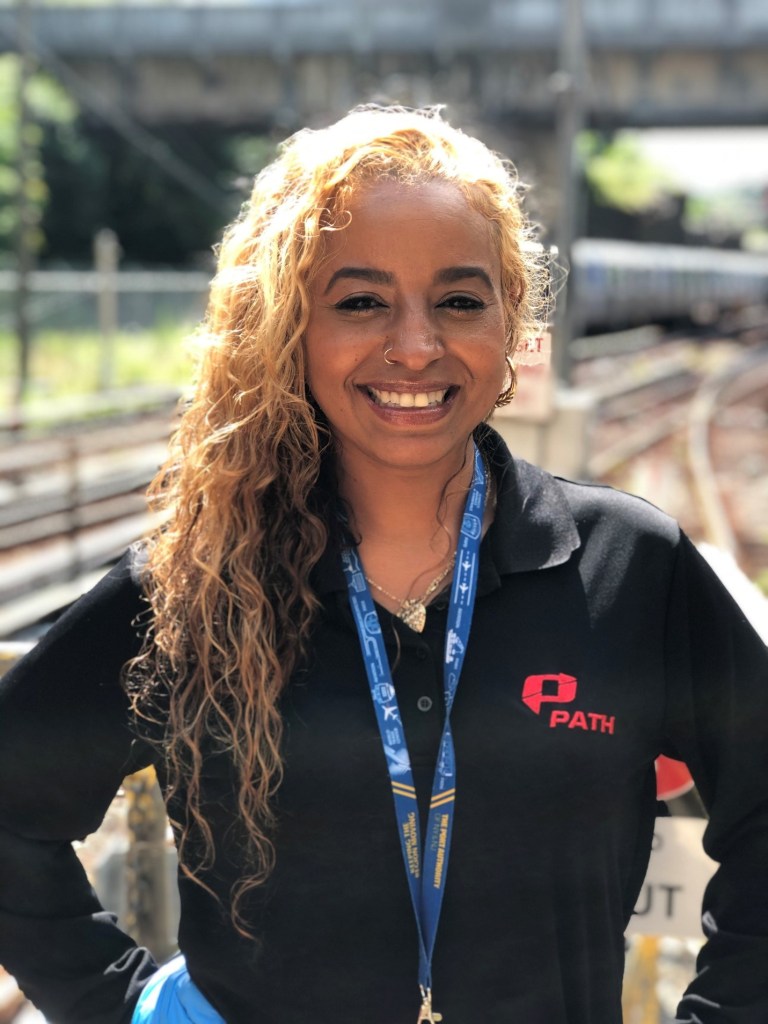
Noel’s Wednesday mornings used to involve gathering staff in a conference room at PATH’s headquarters in Jersey City, where they would use an intricate magnetic board to visualize where workers, their vehicles, and the trains would be at any given moment. All that changed when social distancing and working from home became the norm. Noel had to figure out how to conduct her meetings remotely.

“You have to be adaptable in this job. It can be stressful at times, but I love it,” she said.

Noel added that she never thought she’d be in this position, facilitating complicated logistics for one of the nation’s most critical rail systems – and commanding a room of mostly men to do it. Over time, she’s had to learn how to speak up and put her foot down when required. “I credit my mother with teaching me how to be tough. I know my voice matters just as much as anyone else’s in that room,” she said.
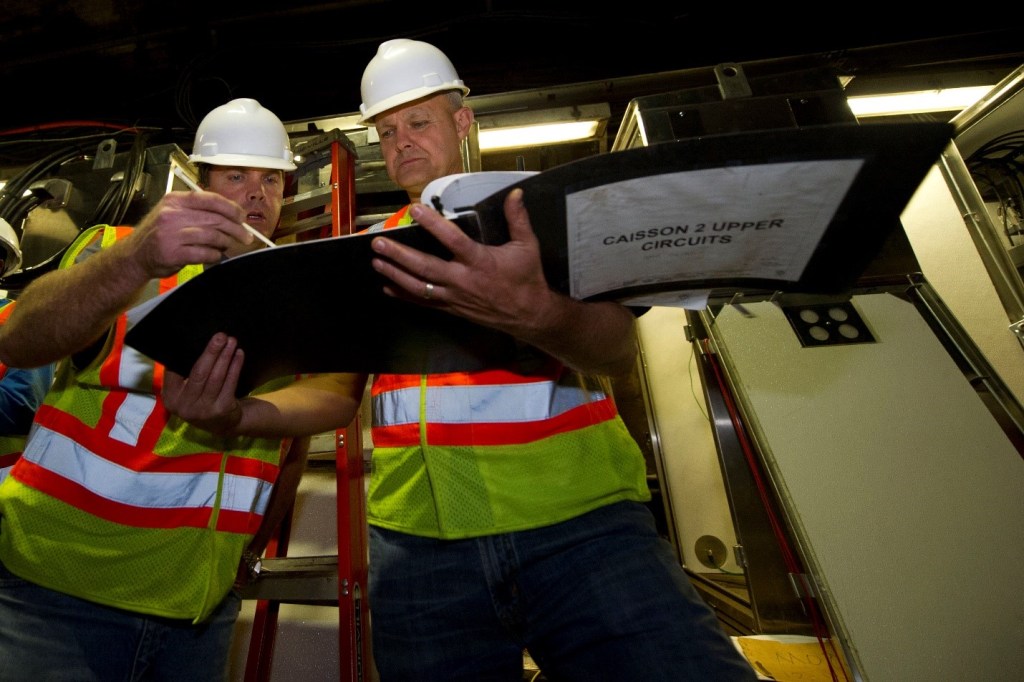
Regular maintenance and improving the customer experience go hand in hand. The PATH Improvement Plan, unveiled in June 2019, calls for measures like extending 8-car trains to 9-car trains on the Newark-WTC line and decreasing headways between trains. Without Noel and her team’s attention to detail and unwavering diligence, tasks like extending the platforms at Grove Street to accommodate these longer trains and maintaining a new signal system so that trains can run closer together, would not happen.

“We strive for reliability and quality every day,” PATH Transportation Superintendent Kevin Lejda said. “As long as our customers get where they need to go safely and efficiently, then we’ve done our jobs right. The less the public sees or is impacted by our work behind the scenes, the better.”
Posted in Uncategorized | Comments Off on PATH Tracks a Steady Course Through the Pandemic

Lincoln Tunnel Flooding: Pouring Cold Water on a Viral Video

By Amanda Kwan, Media Relations Staff

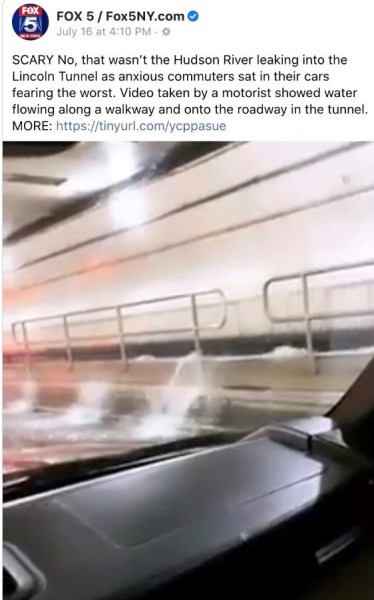
Late on a recent Tuesday afternoon, crews at the Lincoln Tunnel were notified of a water main rupture in an area inside the Tunnel’s Center Tube. Water streamed over the catwalk into the tube, captured on video by a motorist whose posted social media images went viral and generated discussion about the tunnel’s safety.

A damaged water pipe was quickly identified and isolated by maintenance staff. Crews closed one New York-bound lane to set a portable pump to force the water onto the catwalk and down to the roadway, where drains could carry the water to the New York City sewer system. The system worked as designed, pumping out the excess water as repairs to the water main began.  For the Lincoln Tunnel maintenance team, a pipe rupture is just one of any daily emergencies that can pop up and be readily handled at a moment’s notice.

For some, the video recalled the plot of a 1996 action movie in which a police chase results in a truck explosion inside another famous Hudson River underwater crossing, causing a collapse and subsequent flood.

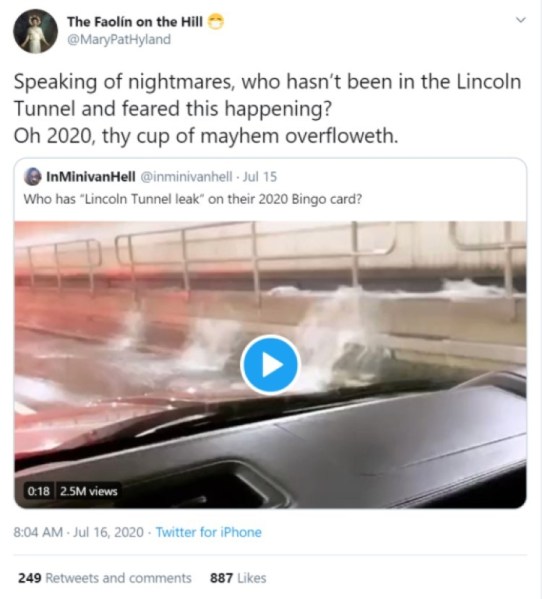
“This reminds me of the old Sylvester Stallone disaster movie ‘Daylight’ in the Lincoln Tunnel. 2020 is half following every disaster movie plot so far,” tweeted Eric Feigl-Ding, a Harvard University epidemiologist.

But while 2020, with its global pandemic and threat of murder hornets, seems to be following the plots of multiple Hollywood movies at once, a Lincoln Tunnel collapse is not among them.

LT

A video screenshot of the flooding, shared on multiple social media platforms.

“The Lincoln Tunnel is one of the world’s greatest feats of engineering,” said Hanson Lee, assistant director of operations for the Port Authority’s Tunnels, Bridges & Terminals Department. “Its skeletal structure is made up of hundreds of massive 21-ton iron rings that were bolted together. In addition, the interior of the rings is encased in concrete, thereby sealing out the Hudson River.”

The tunnel was built in portions, with one team digging from the New Jersey side and another from New York, aligning precisely both horizontally and vertically on August 3, 1935 when a hydraulic engineer from the New Jersey side was pushed by his feet through to the awaiting New York crew. Each of its three tubes carries two vehicle lanes for a total width of 21 feet, 6 inches.

LT2

One of many social media reactions to the viral video.

Beyond the vehicle travel lanes within each tube, other infrastructure inside the tunnels supports operations and maintenance. Catwalks allow maintenance crews safe access to lighting, power, communications and pump rooms, which house cables, ducts and various equipment. Each tube also houses a complex water discharge system that consists of multiple pumps and sump collection points that drain water out of the tunnel and into the New York City municipal sewer system. During Superstorm Sandy, the Lincoln Tunnel did not flood, unlike many other under-river tunnels around Manhattan.

Regular routine maintenance keeps the Lincoln Tunnel in a state of good repair, allowing millions of personal autos, commercial trucks and commuter buses to cross between New York and New Jersey each year, ensuring that interstate commerce flows freely. Even with pandemic-related travel restrictions in place, more than 700,000 vehicles took the Lincoln Tunnel into New York in May.

And all of the drivers and passengers can drive with confidence that the Lincoln Tunnel of real life – not a Hollywood fiction — will continue to transport them safely to dry ground.

“The Lincoln Tunnel is a critical link between New York and New Jersey for people who live and work in both states and for the supply chain for the entire region,” said Gerard Lindenmeier, the general manager of the Lincoln Tunnel. “Our goal is, and will always be, to maintain the Lincoln Tunnel so that it’s safe for everyone to use for many more decades to come.”

Posted in Hudson River, Hudson tunnels, Lincoln Tunnel, New Jersey, New York, NY/NJ region, NYC, PANYNJ, Port Authority, Port Authority of New York & New Jersey, Port Authority of New York and New Jersey, Port Authority of NY/NJ, transportation, Uncategorized | Comments Off on Lincoln Tunnel Flooding: Pouring Cold Water on a Viral Video

Airports Reaching for New Heights of Passenger Safety

By Cheryl Albiez, Media Relations Staff

The Port Authority is going the extra mile when it comes to ensuring the health and safety of employees and passengers at its airports – whether its high-touch surfaces, new PPE vending machines, rigorous cleaning programs and disinfection of bathrooms and other common areas, and even hi-tech floor mats on the terminal floor.

At Newark Liberty International Airport, the staff has taken additional measures to supplement the frequent cleaning and disinfection protocols already in place to fight the spread of the virus, including the escalator handrails that provide support and prevent the risk of a slip and fall.

KONE Escalator Handrail Sterilizer Info Sheet_Page_1In Terminal B, handrail sterilizers are placed in the handrail balustrade enclosure, safely out of sight and out of reach of passengers. The durable LED bulb focuses germ-destroying light on the full width and sides of the handrail as it passes through, providing continual disinfection.
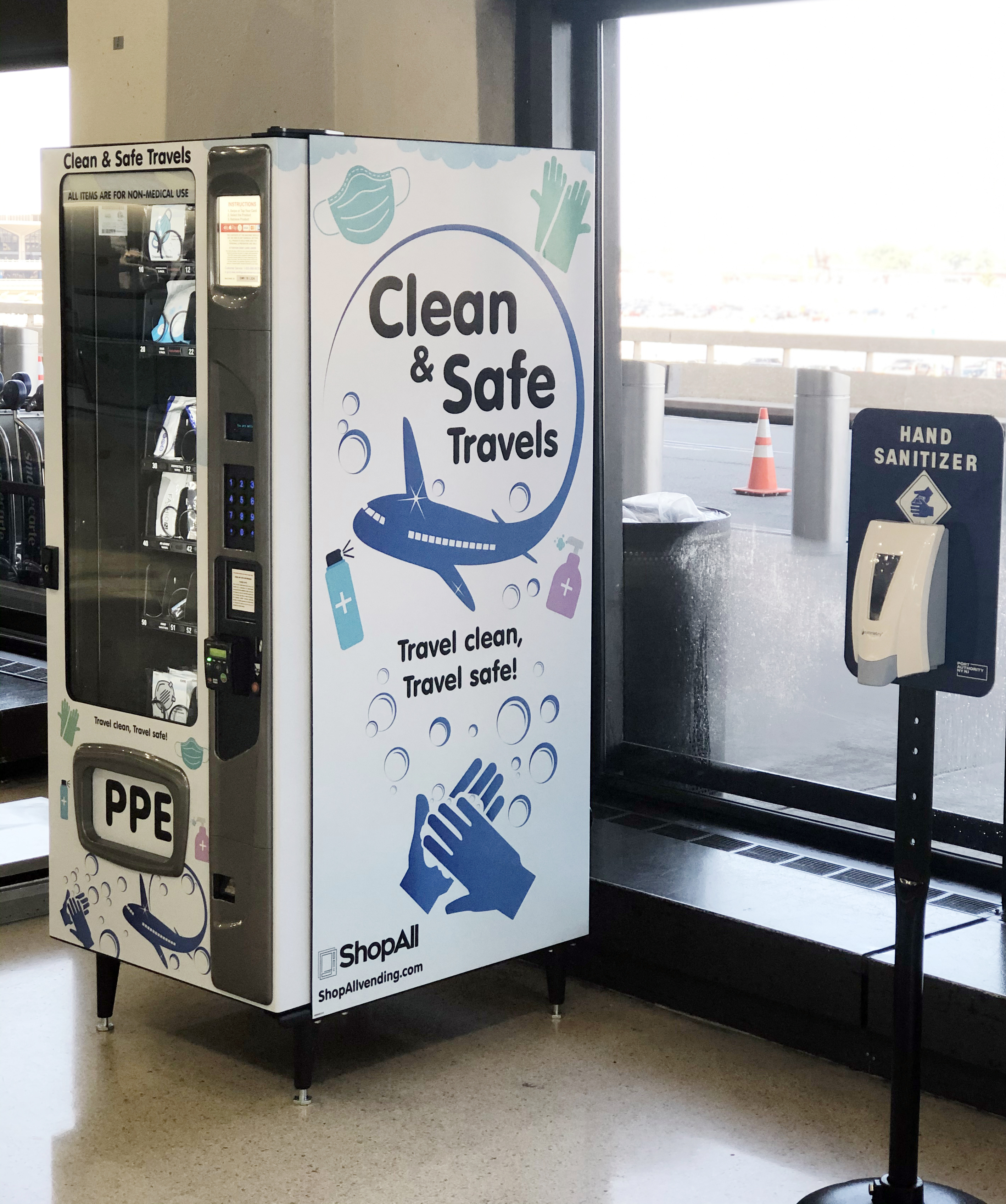
Newark Liberty also is actively offering personal protective equipment (PPE) to customers, located in vending machines with a logo that says “Clean & Safe Travels.” They are installed in Terminals A & B and items for purchase include disposable and washable face coverings, cleaning wipes, disposable gloves, and gels.  Most importantly, these units are easily accessible to passengers at all hours and limit exposure as they require no human interaction. IMG_4242 2020-06-22 18_23_08

In addition, Terminal B is piloting the use of sanitizing floor mats, which were created to disinfect the soles of the shoes of customers entering the terminals.

“The health and safety of our employees and the traveling public remains our top priority,” said Port Authority Aviation Director Huntley A. Lawrence. “I recognize that the COVID-19 pandemic has created a lot of anxiety for travelers. My team and I are working to implement several measures to keep all airport employees and customers safe and instill confidence in air travel.”

The results of these pilots will inform a broader airport rollout of more extensive safety protocols, particularly as the region continues on the road to economic and travel recovery. The airports are planning intensely for the phased resumption of its operations in line with guidance from the federal government and the states of New York and New Jersey. Significant and immediate steps have been initiated to limit access, further enhance cleaning and ensure full compliance with CDC guidelines.

lga-new-terminal-b-05

“We’re committed to ensuring that passengers have access to the essentials,” Lawrence said. “Limited food and beverage and travel essential retail options remain open in the terminals. As passenger volumes pick up, more stores will open with contactless payment methods and intuitive social-distancing markers.”principles

Through unified recovery efforts, the agency and its partners will be implementing leading-edge capabilities across its airports under four core principles: maximize hygiene, minimize contact, minimize access, and minimize dwell. 

Lawrence explained that the agency’s approach to protecting and facilitating the needs of passengers is comprehensive. “At virtually every turn, we are wiping, washing, spraying and sanitizing high touch point areas like check-in kiosks, hold room seating and concessions spaces,” said Lawrence. When hand-washing is not an immediate option, he said, hundreds of hand sanitizers in the terminals at check-in security, check-points, and near restrooms are available.

And for everyone’s safety, face coverings – over the nose and mouth – are required at the airports.

EWR Covid safety

“It won’t all be easy, but at the end of the day the customer journey will improve into a seamlessly connected, contactless passenger experience,” Lawrence said.

Posted in air travel, airport terminals, airports, AirTrain Newark, aviation, aviation geeks, Big Apple, coronavirus, COVID19, customer service, EWR, PATH Trains, Port Authority Trans-Hudson, Winter Storm Jonas, Port Region of New York and New Jersey, Portfolio, Uncategorized | Comments Off on Airports Reaching for New Heights of Passenger Safety