Port Authority Air Traffic Control: Birds of a Different Feather

By Roz Hamlett, Portfolio Editor

Air traffic controllers orchestrate the movements of airplanes in the air and on airport runways and taxiways to protect passengers and aircraft, while getting travelers to their destinations as efficiently as possible.

But they aren’t the only ones controlling air traffic, human or otherwise.

Flying beneath the radar is an altogether different kind of air traffic controller. This close-knit team, dedicated to reducing the chance of bird strikes, operates not from a control tower but the Port Authority Engineering Department, and comprises James Loudon, principal landscape architect, and three colleagues, Sara Yildirim, Jenifer Horst and Tom Nicklas, who mentored Loudon and works closely as his partner.
canda+geese

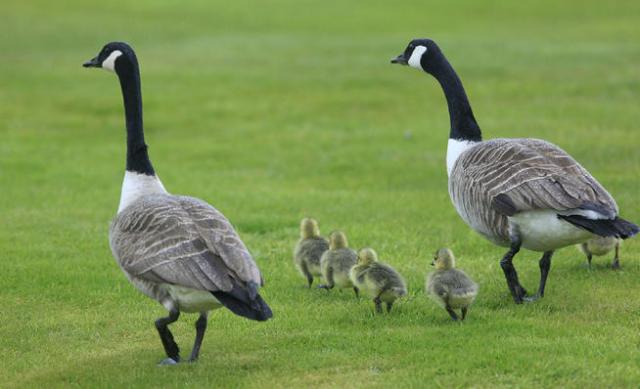
A family of geese enjoy an outing on a median strip on Washington Blvd. near the Newport PATH station in Jersey City.

“We do whatever we can to discourage birds because birds cause the greatest threat to aircraft in flight during landings and takeoffs,” says Loudon, who was promoted earlier this year after many years with the landscape team.

“We work on everything together at every facility at the Port Authority,” says Loudon, “it’s that camaraderie that makes us successful.”

When Captain Chesley “Sully” Sullenberger landed Flight 1549 on the Hudson River after a flock of Canada Geese flew into the engines three minutes after take-off from LaGuardia Airport in January 2009, the incident dramatized the dangers of bird strikes at airports across the country. Sully’s heroic story was further highlighted by a Hollywood movie.

The landscape architecture team aren’t the subjects of blockbuster films and their aviation-related responsibilities are under-publicized. They don’t operate from the tower, but rather from a modest warren of cubicles on the 19th floor of 4 World Trade Center, or in the field across the region.

Nevertheless, they protect against bird strikes by working closely with aviation wildlife biologist, Laura Francoeur, to implement the Port Authority’s wildlife management plan, which includes managing the landscape to reduce the types of trees, shrubs and grasses that birds prefer.

Major airports — such as those operated by the Port Authority — are like Club Meds for birds, featuring large tracts of open land with areas of standing water that attract feathery fliers and create potential hazards to aviation.

Geese, for example, prefer to land on lawns, parking lots and other big open areas. By spacing trees in a grid 50 feet apart, geese can be discouraged from landing in densely wooded areas because they do not roost, Loudon says.

“Large trees are never planted so close together that they create a tree canopy overhead, which would encourage roosting and large populations of flocking birds,” he says.

Loudon and Francoeur follow an advisory by the Federal Aviation Administration (FAA) — which oversees air traffic controllers — that mandates what to plant and what not to plant. For example, trees and shrubs that produce edible seeds or fleshy berries are avoided.

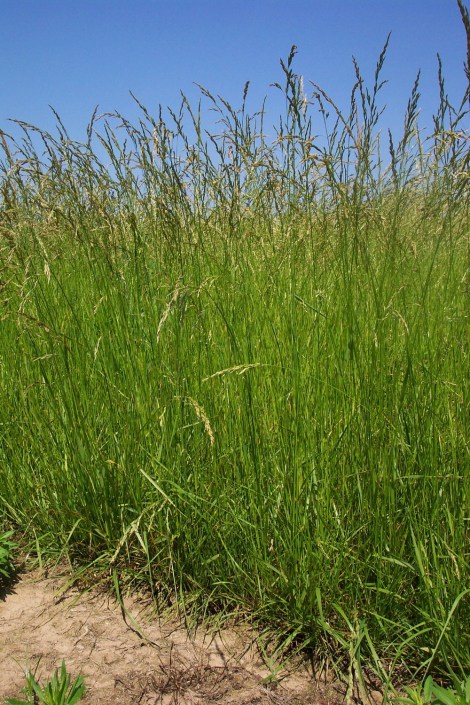
The use of tall fescue seed mix inoculated with Endophyte typically is planted at Kennedy, Newark Liberty and LaGuardia airports to discourage foraging birds. Endophyte is a fungus that grows within the plant itself, which birds find unpalatable and motivates them to find another food source.
Tall+Fescue_TPhillips

Tall fescue grass inoculated with Endophyte is used at the region’s airports to discourage foraging birds.  Endophyte is a fungus that grows within the plant, which birds find unpalatable.

The landscape architects reduce or eliminate altogether the presence of standing fresh water at the airports through design and construction. Major construction to redevelop Terminal A at Newark Liberty created additional storm runoff and potentially more standing water. Working with civil engineers, the landscape architecture team redesigned a peripheral ditch around the site to capture more storm water, which is bordered by plants to dissuade geese from landing and entering the banks.

At low-lying Teterboro Airport, where heavy rains create high water levels in the ponds, the landscape design is a game of bait and switch. A sub-surface storage for water is constructed that the birds can’t see, which is then camouflaged with a foot of soil.

“By limiting the edible delights of birds and the places they gather to feed and reproduce, we can discourage them from visiting the airports, which goes a long way towards protecting the flying public from deadly bird strikes,” says Francoeur.
Geese-Takeoff-2-1024x427

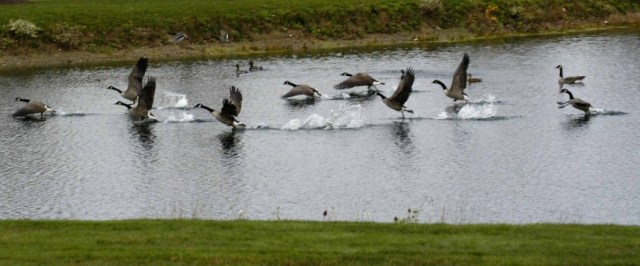
A flock of geese congregate at a golf course pond.  The FAA advises on-airport storm water management facilities to allow for the quick removal of surface water.  Where possible, airport operators must modify ponds to allow a maximum 48-hour detention period for drainage.


Posted in airplane crash, airports, Chesley Sullenberger, EWR, John F. Kennedy International Airport, Kennedy Airport, LaGuardia Airport, Newark Liberty International Airport, Port Authority of New York & New Jersey, Teterboro Airport, Uncategorized | Tagged , | Comments Off on Port Authority Air Traffic Control: Birds of a Different Feather

“Father” Juan Guzman, Savior of Distressed Souls at the GWB

By Lenis Rodrigues, Media Relations Staff

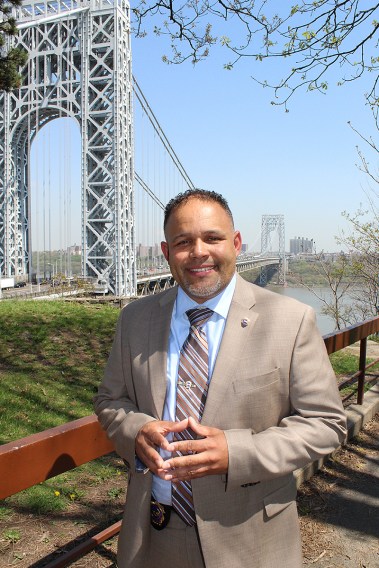
To those outside his Port Authority Police command at the George Washington Bridge, he is Officer Juan Guzman. To fellow officers who helped him patrol the world’s busiest bridge, he’s “Father” Guzman, with a unique ability to comfort the distressed souls he too frequently encountered during his tours.

Guzman and his colleagues at the GWB saved 70 lives in 2016 and reduced the number of people who jumped from the span from 18 in 2015 to 12 last year. Guzman, a married father of four assigned to the GWB command the past nine years, personally is credited with saving more than two dozen lives.

Guzman2

“Life is precious. I try to establish a connection with them whether it’s about God, family or love,” said Guzman, who once saved a man’s life by kneeling down in prayer with him on the bridge while traffic roared past.

The veteran officer has earned numerous awards for his heroism, including the Port Authority Police Department’s (PAPD) Officer of the Year Award in 2015 and Officer of the Year in 2016 by the New Jersey Center of Excellence Crisis Intervention Team

PAPD Police Inspector Geraldo Silva, who was Guzman’s supervisor at the GWB, describes him as among the most “exceptional police officers” he’s ever known. “He works hard, he’s ethical, he’s reliable and he’s a go-to officer for both his supervisors and his peers,” said Silva.

Guzman once even thwarted a possible terrorist attack. In 2015, he spotted a suspicious loiterer on two separate occasions on the bridge. The FBI discovered the individual was an aeronautical student who Googled information about electronic circuitry, the construction of pressure cookers and the terrorist group ISIS, and later pleaded guilty to federal charges.

Promoted recently to detective, the officer began his law enforcement career with the New York Police Department, where he worked four years before joining the PAPD in 2002, just months after the 9/11 tragedy. He transferred to the GWB command in 2008, not far from the Washington Heights neighborhood where he grew up.

In 2010, Guzman was put to the test for the first time. While on patrol, he spotted a young woman who had already climbed over the railing and was staring down into the Hudson River. With adrenaline pumping and heart pounding, Guzman’s first reaction was to cuff her to the railing. Instead, he rushed over, and with help from other officers, hauled her back over.

“My actions that day prevented a family from mourning the death of a child,” said Guzman. “This was a very rewarding feeling for me.” Since then, he repeatedly demonstrated a calm and compassionate demeanor crucial to helping  save lives.

Guzman3

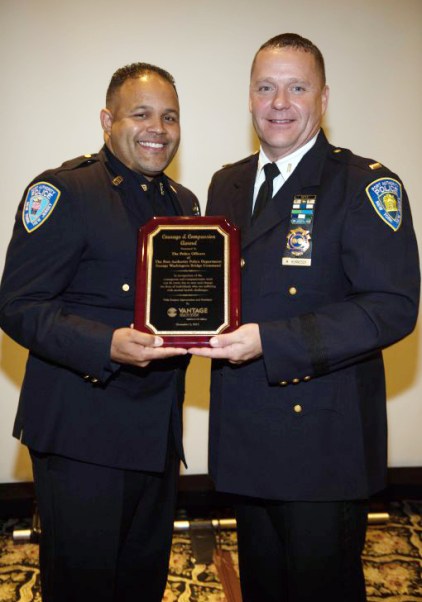
PAPD Lt. Michael Hennessy and Officer Guzman accept the “Courage & Compassion Award” from Vantage Health System in 2015.

Last fall, Guzman was faced with two potential suicides within a 24-hour period. On September 23, Guzman and his commanding officer, Lieutenant Michael Hennessy, were responding to a report of a man threatening to jump. When they arrived, the man was already hanging over the railing. It took 16 minutes, but Guzman and Hennessy managed to persuade him to climb back.

The next day, Guzman was patrolling with his partner, Officer Lavern Watson, when they encountered a man who told them, ‘I came to jump.’ But instead of cuffing him, Guzman convinced the man to seek medical attention voluntarily.

“I try to give them back their dignity. I remind people in pain of the things in life that are the most precious to us all,” he said.


Posted in bridges, George Washington Bridge, GWB, NYPD, PANYNJ, PAPD, Port Authority of New York & New Jersey, Port Authority Police Department, Uncategorized | Tagged , | Comments Off on “Father” Juan Guzman, Savior of Distressed Souls at the GWB

Port Authority Police Emergency Services Unit: A Day in the Life of Training

By Rudy King, Media Relations Staff

Whether on a bridge, inside a tunnel or in the water, an elite Port Authority police squad known as the Emergency Services Unit, or ESU, is specially trained to respond to every conceivable dangerous situation. What they do is the real-life stuff of action-packed movie thrillers.

It goes beyond what cadets are taught at the Police Academy. For eight months, these law enforcement daredevils learn how to perform special ops under the most extreme conditions with the least disruption to Port Authority operations: at high altitudes, or using the deadliest weapons. And it goes without saying, they must learn to conquer their fears.

The training is part of the New York Police Department’s Specialized Training School (STS). Working alongside the ESU unit within the NYPD, for example, members of the Port Authority ESU were among the boots on the ground during one of the deadliest and most destructive storms to ever hit the region, Superstorm  Sandy. They rescued citizens and evacuated the elderly from senior centers.  They cleared debris and trees from roadways and performed grid searches for possible victims.

For more on ESU training, watch this vlog by Rudy King of the agency’s Media Relations department on a recent training on the George Washington Bridge by ESU candidates, as they underwent the harrowing experience of climbing slippery barrel cables on a drizzly and foggy day.


Posted in bridges, George Washington Bridge, GWB, PANYNJ, PAPD, Port Authority of New York & New Jersey, Uncategorized | Tagged , , | Comments Off on Port Authority Police Emergency Services Unit: A Day in the Life of Training