Flashback Friday: Searching the Harbor for Sunken History

By Roz Hamlett, Portfolio Editor

The Port of New York & New Jersey has been preparing for decades for the day bigger ships could pass beneath the newly raised Bayonne Bridge. The Bayonne, a marvel of civil engineering, was raised to 215 feet above the Kill van Kull to allow mega-ships to clear the span. The shipping lanes in the New York harbor also were deepened to 50 feet to accommodate the newest class of big ships.

Yet, as so often happens when the Port Authority undertakes massive projects to retool and rebuild its marine infrastructure for critical future needs, amazing artifacts tend to surface.

For example, during the recently completed harbor deepening program, marine archaeologists discovered the existence of one of the last and largest graveyards of wooden ships anywhere in the country. The skeletal remains of six derelict ships from era of wooden shipbuilding were discovered along the shores and partially submerged in the waters between Staten Island and New Jersey.

Marine archaeologists contracted by the Port Authority and the Army Corps of Engineers (ACE) conducted underwater investigations, recording the existence of several vessels determined to be historically significant – including a fishing trawler named the Fish Hawk, the four-masted schooner Paul E. Thurlow, two floating dry docks and a tugboat.
lib

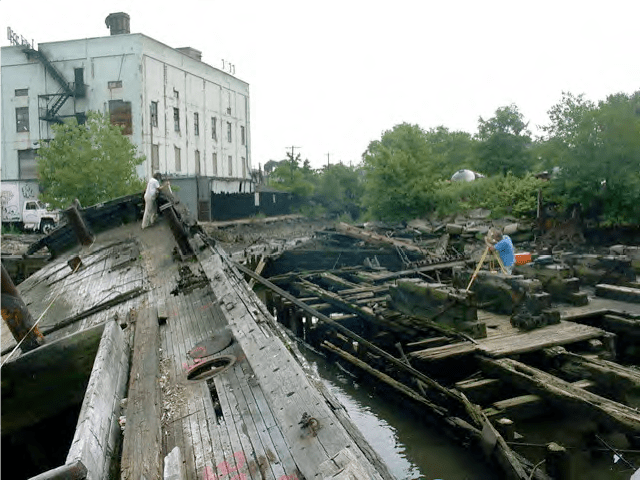
Workers dismantle the skeletal remains of two old seafaring vessels


To the casual passer-by, these artifacts don’t appear to be much more than piles of rotting timbers. But they’re actually forensic evidence of the technologies and innovations that powered ships in recent centuries.

The vessels likely were abandoned when they became technologically obsolete because of advances in shipping practices. According to Lynn Rakos, ACE archaeologist, some of the vessels likely were brought to these locations as salvage parts for historical restorations. All of the remains have been entrusted to ACE for protection and preservation under the Abandoned Shipwreck Act of 1987.

“The dredging project could potentially have damaged these historic shipwrecks that are located along the edges of the channel,” said Rakos. “They are still there along the quieter stretches of shoreline because money has not yet been appropriated to remove them.”

boat

A diving team prepares for the harbor search for sunken maritime history.

During excavations for construction of the World Trade Center site, scientists uncovered the remains of an ancient sailing ship in a pit that today is the Vehicle Security Center. That ship was the skeleton of a Hudson River sloop, designed to carry passengers and cargo over shallow, rocky water.   The white oak used in the ship’s construction was cut around 1773 or so – a few years before the war that established America’s independence from Britain.

Years earlier, as excavation began for the construction of the Twin Towers, a trove of artifacts from the 16th and 17th century was unearthed on the bottom of the Hudson River: anchors, cannons, cannon balls, ships’ wheels, even a section of the French ocean liner, the Normandie, which capsized after a fire in 1942.

“During the 18th and 19th centuries, sailing vessels of all sizes and shapes entered and exited the port of New York, including the famous clipper ships, deep-water sailing ships and large, multi-masted schooners, the largest sailing vessels of their time,” said Rakos. “The area also included schooner barges, pilot boats, lighters, fishing boats and other types of small craft. “

A few of these artifacts were on display in the main lobby of One World Trade Center, but most of them were stored in the basement of the Twin Towers, where they were lost on 9/11.
Posted in Bayonne Bridge, Uncategorized | Comments Off on Flashback Friday: Searching the Harbor for Sunken History

INSIDE THE LINCOLN TUNNEL’S ‘LIVE BURN’

By Rudy King, Media Relations Staff

The Port Authority has a highly trained group of men and women – tunnel and bridge agents, known as TBAs – who serve as an integral part of the PA’s Tunnels, Bridges & Terminals Department.

These special agents are responsible for patrolling various areas of the Lincoln and Holland tunnels, as well as the George Washington Bridge. Each TBA is required to learn emergency rescue vehicle or fire truck operation, in addition to troubleshooting problems, towing stalled or disabled cars, extinguishing fires and providing life-saving measures.

photo2

They also are trained to use heavy hydraulic equipment and battery-powered rescue tools, responding to overturned vehicles, identifying and sometimes handling dangerous cargo – all in an effort to keep traffic flowing through some of the nation’s busiest roadways and crossings. Port Authority bridges and tunnels routinely handle about two million vehicles annually.

burn

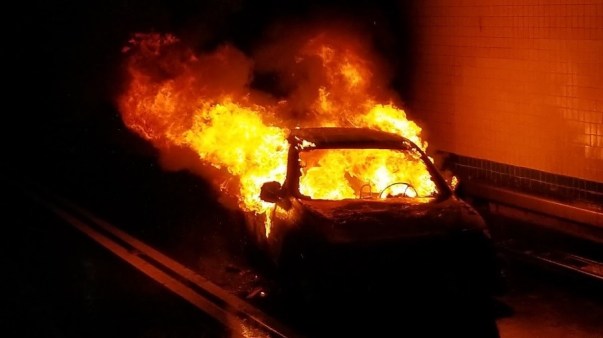
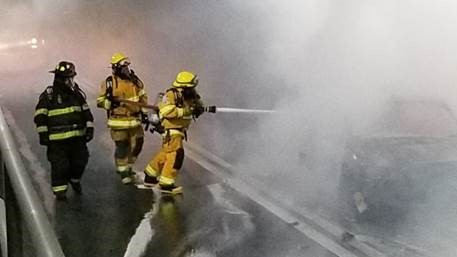
During the past 18 weeks, 15 TBA trainees have gone through a battery of tests in the classroom and in the field, provided by the Port Authority Technical Training Academy. Part of their intensive training required extinguishing a series of controlled – but very different – vehicle fires inside the Lincoln Tunnel.

It’s called the “live burn,” and here is an exclusive look at a recent Lincoln Tunnel exercise.


Posted in Lincoln Tunnel, Uncategorized | Comments Off on INSIDE THE LINCOLN TUNNEL’S ‘LIVE BURN’

PATH Effectively Handles First Morning Rush in Commuter “Summer of Hell”

By Port Authority Media Relations Staff

This certainly wasn’t the normal morning PATH commute through the Hoboken Terminal. Thousands of additional NJ Transit commuters, diverted to the Hoboken station with the start of major Amtrak infrastructure work at New York Penn Station, flooded PATH platforms for rides into Midtown Manhattan and to the World Trade Center.

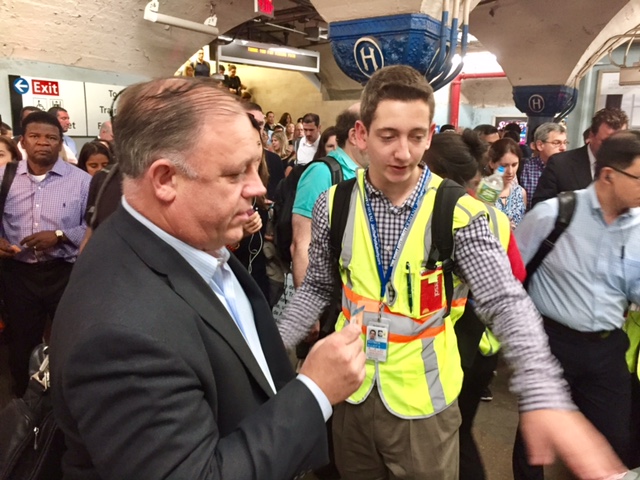
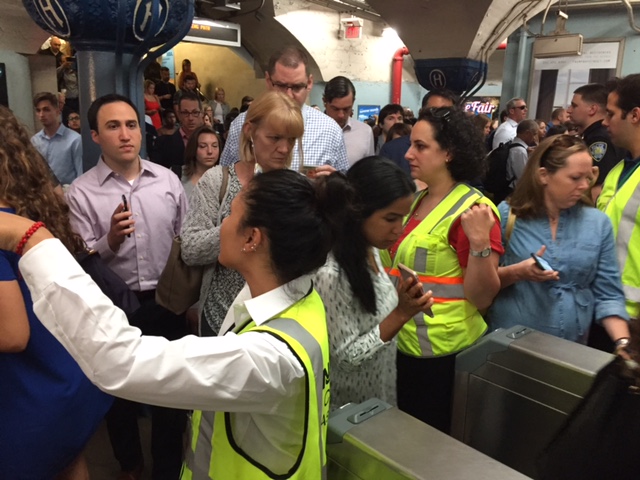
But Day One of what some have dubbed the transit “Summer of Hell” went off with very few hitches during the morning rush. Port Authority “Ambassadors” positioned at turnstiles in bright yellow vests checked NJT tickets as part of PATH’s cross-honoring operation, and answered questions from quizzical riders.

FullSizeRender

Port Authority PATH Ambassador Elliot Sotnick assists an NJT customer using the Hoboken station on the first day of the Amtrak infrastructure project at New York Penn Station.

Peak ridership between 8-9 a.m. filled the passageway between the terminal concourse and PATH turnstiles, but customers kept moving. Rail cars on the Hoboken-33rd line were more crowded than usual, and extra Port Authority Police were assigned to the station incase their assistance was needed. There were no major issues. PATH employees and site volunteers worked hand-in-glove with their NJT colleagues to put their transportation game plans into action.

“All in all, everything is going well so far,” said PATH General Manager/Director Mike Marino, toward the end of the peak morning commuting period. “We want to thank and commend the riding public for their patience, cooperation and good spirits during what could have been a far more challenging morning commute.”

Successful execution is always the by-product of effective planning, and PATH has been preparing its response to the Amtrak summer service outages for several months. Marino and his team have been meeting regularly with regional transportation partners – NJT, Amtrak and the Metropolitan Transportation Authority (MTA) – to devise a comprehensive plan to ease the upcoming transit burdens on passengers, most recently during a Friday session hosted by the Port Authority’s Office of Emergency Management.

Between now and Sept, 1, when this phase of the Amtrak project is scheduled for completion, PATH is adding approximately 9,200 more rider slots during the morning and evening peak commutes, by reducing the time between trains from Hoboken to 33rd Street and back from seven to five minutes.

Affected NJT riders who normally travel directly to New York Penn Station are being cross-honored at Hoboken, 33rd Street and the WTC. Cross-honoring is not an option at Newark Penn Station or other PATH stations.

PATH riders expecting to use the Hoboken station for the duration of the New York Penn Station project are urged to purchase PATH fares in advance to save time and avoid lines at ticket machines near the turnstiles. They are also asked to allow extra time for their commute, travel outside the peak periods if possible, move to the train’s center to allow additional passengers to board – and travel light. Leave the overstuffed backpack at home unless absolutely necessary, and don’t leave bags behind on the train or platform. That can cause security concerns and delay train service.

Crifo

The crowd was big, but the Port Authority’s Deputy Chief Ethics and Compliance Officer, Nicole Crifo (center, in yellow vest), and her PATH Ambassador colleague Ryan Zsamba (right) kept the lines moving.

Posted in PATH, Uncategorized | Comments Off on PATH Effectively Handles First Morning Rush in Commuter “Summer of Hell”