From Cuba to Jersey City: Finding a Home at PATH

By Port Authority Media Relations Staff

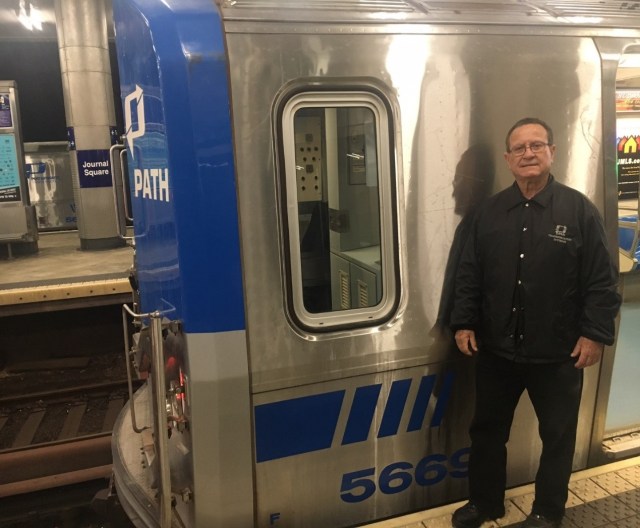
Between January 1, 1959 and October 31, 1980, more than 800,000 Cubans entered the United States. Jose “Sid” Fernandez, now a PATH engineer, was among them.

But, as one of countless young men growing up in Cuba and seeking escape from the repressive regime of Fidel Castro, Fernandez could only watch as other members of his family were able to leave the country, including his mother. Fernandez’s own exit was delayed by Castro, who in 1962 denied permission to leave the country to all males between the ages of 16 and 27.

By March 1968, more than a million Cubans had signed on to waiting lists to board a Freedom Flight – the largest airborne refugee operation in American history – which transported Cubans to Miami twice daily, five times per week, from 1965-1973.
PATH1

Fernandez was the last of his family to leave Cuba, in 1972, but not before being forced to live in cramped barracks for three years while awaiting permission to depart, and suffering humiliation and harassment in the meantime.  He said that opponents of Castro, in effect, were placed in internment camps.      

“I was called twice to the airport and twice I was sent back to the barracks,” Fernandez recalled. When he received final permission to leave, he was instructed to arrive at the airport one day early for processing.  And still there was a last-minute snag – the agent at the desk told him his name was not on the list.

“My stomach dropped.  I had my visa and I had permission,” said Fernandez, who has spent more than 34 years with PATH. “But my name wasn’t in the book. Luckily, they found it in another book.”

Even 45 years after leaving his homeland, the emotions are still painfully fresh.  When asked about his first glimpse of the airplane that would shuttle him to the U.S., his eyes brimmed with tears and his voice choked.

“When the American plane arrived, my tears came.  I cried because I knew I couldn’t stay there anymore,” he said. “My own people were doing that to me, treating me like an animal with no rights, nothing.”

Upon his arrival in the U.S., he was relieved to find communities of his countrymen in Elizabeth and Union City, N.J. Fernandez attended school in nearby Linden, where he pursued an unfulfilled dream of working as a translator.

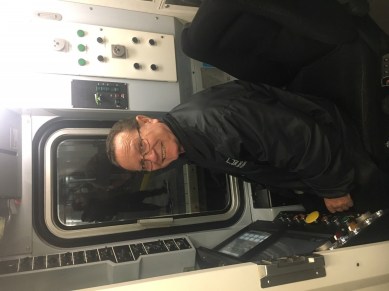
When he joined the Port Authority, his new co-workers thought he needed a nickname.  At the time, Sid Fernandez was a member of the celebrated New York Mets’ pitching rotation in the mid-1980s, so his colleagues started calling him ‘Sid.’ The name stuck. He started at PATH as a car cleaner before rising eventually to the position of train engineer – a job he’s had for more than 30 years.
PATH2

Thanks to steady employment at PATH, Fernandez has provided a comfortable home and college educations for five daughters, who have each achieved successful careers: a psychologist, a bank vice president, a human resources professional, a teacher and a make-up artist.

“The Port Authority has helped so many people like me get on their feet and put down roots.  I recall worrying the day the [twin] towers collapsed that my job was gone.  And yet a couple days later, I had a paycheck in my hand,” he said. “Working here has given me a deep sense of pride.”
Posted in Uncategorized | Comments Off on From Cuba to Jersey City: Finding a Home at PATH

The T. Roosevelt: Ushering in a New Era at the Port

By Lenis Rodrigues, Media Relations Staff

Less than two decades ago, the Regina Maersk made a much-heralded visit to the Port of New York and New Jersey, amid fountains of water sprayed from a fireboat and an armada of ships leading the biggest ship to ever call on an East Coast port to the dock.

The 1998 visit was trumpeted as a game-changer for global trade and for the future of the East Coast’s largest cargo port. When it docked at the Elizabeth Port Authority Main Terminal, the Regina Maersk had a capacity of 6,000 TEUs (20-foot equivalent units).

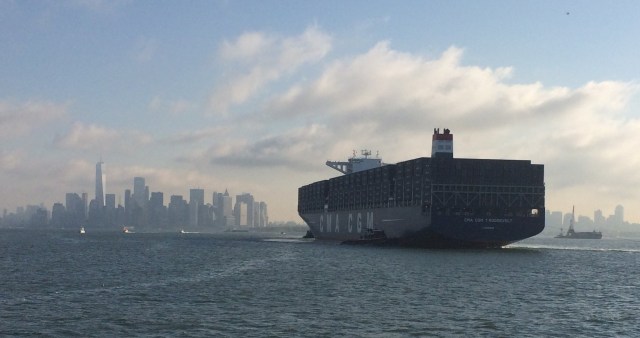
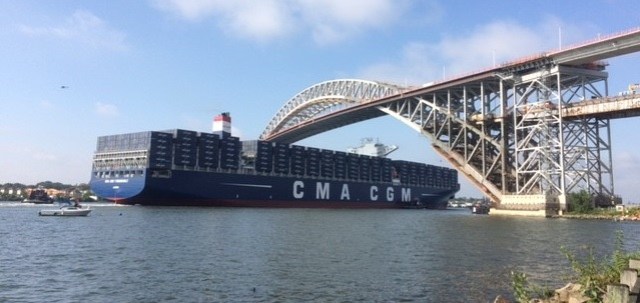
This morning, the T. Roosevelt arrived with the same fanfare as the Regina Maersk – water cannons shot from fireboats and a fleet of smaller vessels to welcome it to port. But the T. Roosevelt, named for the nation’s 26th president, has a capacity of 14,400 TEUs – more than 2 ½ times the cargo capacity of the Regina Maersk, whose hull was as long as the Chrysler Building. The T. Roosevelt, by contrast, is four football fields long.

DJH4zkmXcAEnxta
The ship’s call would not have been possible without the Port Authority’s recently completed project to raise the Bayonne Bridge to provide a navigational clearance of 215 feet. When the Regina Maersk came to town, the vessel had to lower its mast and radio antennae to sneak under the bridge’s roadway and its 151-foot clearance.

Though a much bigger vessel, the T. Roosevelt didn’t have to lower anything to get under the crossing. The ship would not have been able to make its historic maiden voyage had it not been for the widening of the Panama Canal and the 50-foot harbor deepening project, both completed in 2016.

For a glimpse of the big ship passing beneath the restructured Bayonne Bridge:

“We’re thrilled to have CMA CGM T. Roosevelt call at our port and serve as the celebratory vessel for the raising of the Bayonne Bridge,” said Port Authority Port Director Molly Campbell. “We invested billions of dollars to raise the Bayonne Bridge, deepen harbor channels, install rail facilities at all of our terminals and improve our port road network, with the goal of attracting the world’s biggest ships and cargo to our port and the jobs and economic activity they provide.”

While today’s visit was more about celebration and less about cargo movement, the ship and its sister vessels are expected to soon be frequent visitors to the Port of New York and New Jersey.

During the event, Marc Bourdin, the president of CMA CMG (USA), announced that the T. Roosevelt and other similar-sized ships will be making regular calls to the port beginning next month.

Bayonne

Posted in Uncategorized | Comments Off on The T. Roosevelt: Ushering in a New Era at the Port

Laura Francoeur’s Job is for the Birds (and the Terrapins)

By Alana Calmi, Media Relations Staff

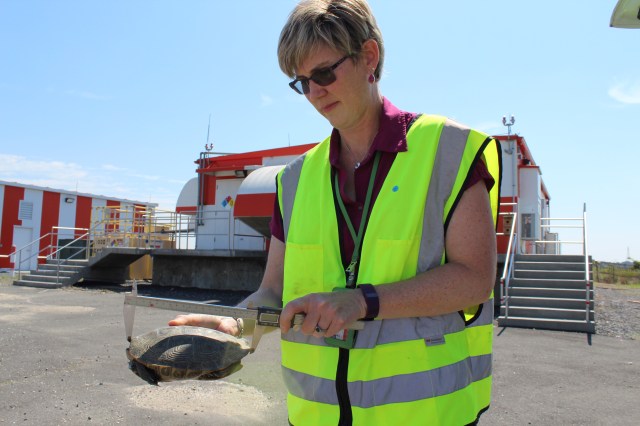
Chasing Diamondback terrapins from runways and harassing geese and other birds from airport property is all in a day’s work for Laura Francoeur.

As the Port Authority’s first Chief Wildlife Biologist, Francoeur works on wildlife mitigation across the five airports owned by the Port Authority of New York and New Jersey. It’s not necessarily the job many would immediately associate with maintaining safe and efficient airport operations, but her role is essential.

With 17 years at the Port Authority, Francoeur has encountered an array of wildlife issues she had never imagined. She is based at John F. Kennedy International Airport and also has oversight of Newark Liberty International Airport and LaGuardia, Teterboro and Stewart airports.

LauraKnown for being one of the busiest airports in the nation, JFK is home to a diverse ecosystem comprising various types of vegetation and the animals that thrive from them. Francoeur explains that with Jamaica Bay surrounding the airport, the area attracts an assortment of wildlife.
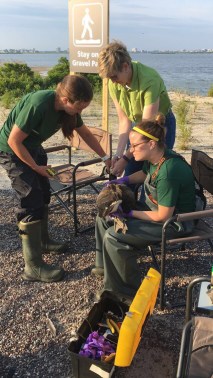
Every year in early summer, JFK becomes home to hundreds of Diamondback terrapins looking for a place to lay their eggs. Francoeur and her team collect the terrapins, inspect turtlethem, tag them with a small chip if they don’t already have one, and release them just outside the fencing around the airport.

While it might seem a small issue, it is in fact a potential hazard to planes traveling to and from the airport. Fencing was installed around the airport perimeter to keep the terrapins out, but many still manage to find a way in. Those that do are usually captured short of the runways.

Another issue that airports around the world face are bird strikes—from a small bird hitting a windshield to an engine ingesting a flock. There are a number of different species of birds that inhabit the areas surrounding JFK, LaGuardia and Newark Liberty.

Assisted by Senior Wildlife Biologist Jeff Kolodzinski, Francoeur continues to develop strategies to drive birds from the airports’ airspace to avoid a strike, using a mixture of human and technological tactics. CNN profiled Port Authority bird mitigation efforts in this 2016 report:


The New York Wildlife Services established wildlife management at airports starting with JFK in 1979. Since then, the presence of wildlife at airports is constantly being addressed with the help of the U.S. Department of Agriculture.

A Connecticut College graduate, Francoeur discovered her passion for wildlife through a friend of a friend who needed to borrow her typewriter to fill out an application. When Francoeur asked what the application was for, she learned it was for an internship with the Student Conservation Association. With her primary interest in wildlife damage management— the intersection of people in wildlife and the problems that ensue— the internship was an incredible opportunity to expand her understanding.

“I thought it was the coolest thing! You apply with this non-profit group and they link you up with natural resource agency internships, some with wildlife but they could also deal with archeology. I ended up working for the Bureau of Land Management,” says Francoeur.

During her internship, she inventoried springs and seeps (usually groundwater that reaches the earth’s surface) in the Vermillion Cliffs north of Phoenix, and other parts of the Bureau of Land Management’s Arizona Strip District. She also monitored vegetation and wildlife use of those areas.

She received her Master’s degree in wildlife biology from Clemson University, working on deer damage to crops. “I thought I might end up in a more agricultural setting but when I got my first job it was working at airports and landfills, and I thought the airside is really interesting – landfills, not as much,” she says.

Francoeur has played an integral part in changing wildlife policies across the airports. With technology constantly changing and improving, her teams tests different options for wildlife management. “We try to keep up with technology as it evolves. Some things that work at other airports might not be the best for us,” says Francoeur.

While LaGuardia has much less acreage, it also has less wildlife to manage compared to JFK with its nearly 5,000 acres. JFK and Newark Liberty use fencing, or grid wires, laid over larger areas of turf to keep out geese. Diamondback terrapins nesting at JFK is unique among Port Authority airports, and other U.S. airports. Countless airports have turtle issues, but none that seem to have terrapins, which are actually a species of sea turtle and different from other freshwater turtles.

Francoeur said her Port Authority experience has lived up to expectations. Having worked at a smaller airport, Richmond International, she saw the potential in moving to New York.

“I really do enjoy the work I get to do at our airports,” she said. “It’s incredible that we can run such large airports in all these different and diverse environments.”

Posted in Uncategorized | Comments Off on Laura Francoeur’s Job is for the Birds (and the Terrapins)